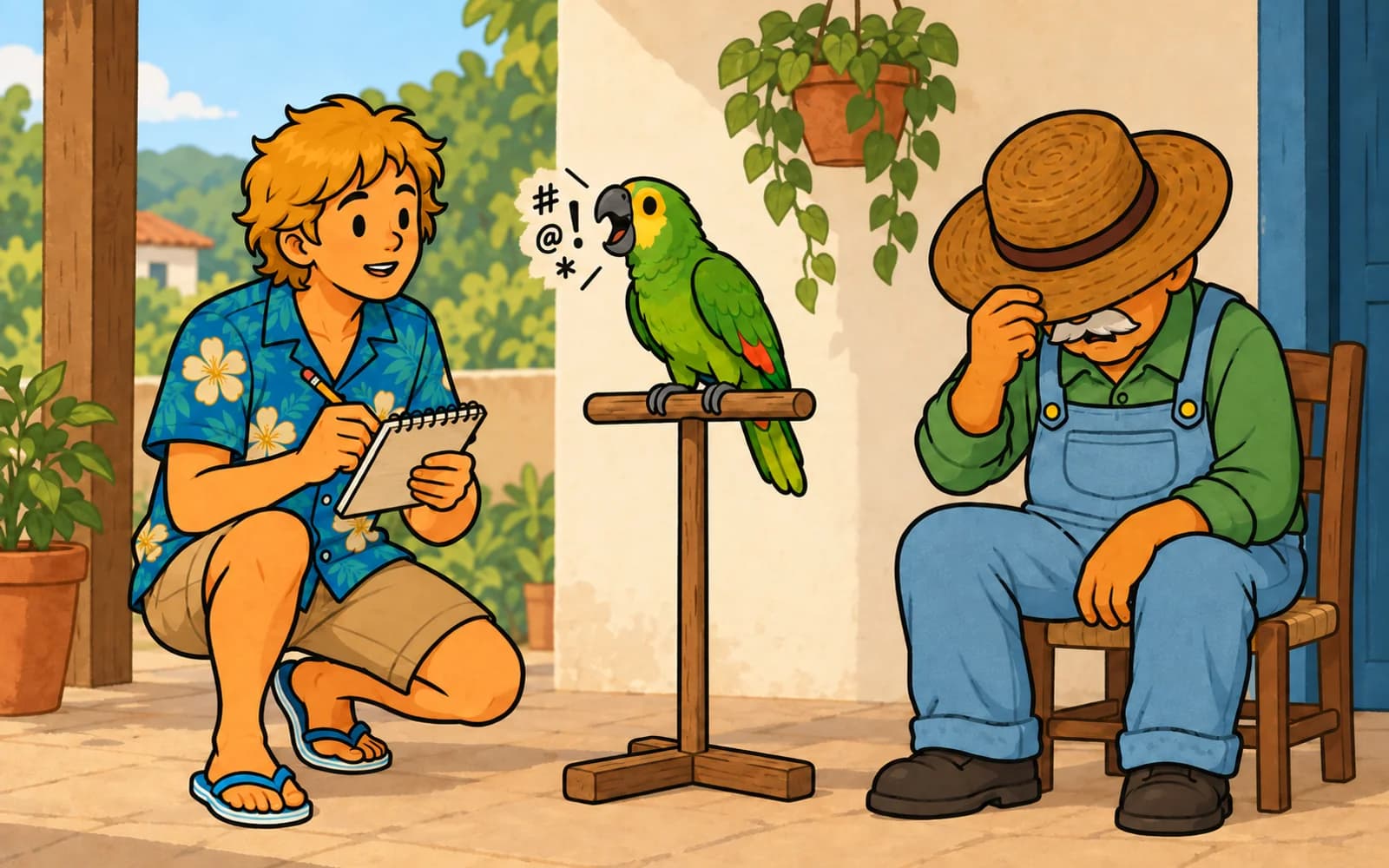
The Day I Called My Boss's Presentation "Weird"
Three weeks into my first job in São Paulo, my manager finished a slide deck and asked me what I thought. I wanted to say it looked great. Polished. Refined. So I smiled and said, "Nossa, ficou muito esquisito!"
Dead. Silence.
Here's what I thought I said: "Wow, it looks exquisite!" Here's what I actually said: "Wow, it looks really weird!"
In Brazilian Portuguese, esquisito doesn't mean exquisite. It means strange, bizarre, or annoyingly picky. My boss stared at me for three seconds that felt like thirty, and then — because Brazilians are fundamentally kind people — he laughed and said, "Obrigado? Acho?"
That was my introduction to Brazilian Portuguese false friends: words that look almost identical to English but mean something completely different. And I'm here to tell you, they are everywhere, and they will absolutely ruin your day if you're not ready for them.
Quick Reference: The Most Dangerous False Friends
Before we get into the stories, here's a cheat sheet you can bookmark. I wish someone had handed me this on day one.
| Looks Like English... | Portuguese Word | What It Actually Means | What You Want Instead |
|---|---|---|---|
| Push | Puxar | Pull | Empurrar |
| Actually | Atualmente | Currently | Na verdade |
| Pretend | Pretender | To intend / plan | Fingir |
| Eventually | Eventualmente | Occasionally | Finalmente |
| Assist | Assistir | To watch | Ajudar |
| Parents | Parentes | Relatives | Pais |
| Pasta | Pasta | Folder / briefcase | Massa / Macarrão |
| Novel | Novela | Soap opera | Romance |
| Propaganda | Propaganda | Advertisement | (same word, neutral meaning) |
Now let me tell you how I learned each of these the hard way.
The Ones That Got Me
Puxar ≠ Push
This one is almost cruel. Every door in Brazil that says PUXE on it is telling you to PULL. Not push. Pull.
I spent my first month in São Paulo walking into doors like a cartoon character. Shoulder-first into glass at shopping centers, botecos, padarias. There's a pharmacy near Pinheiros where I'm pretty sure the staff started watching me arrive just to see if I'd remember.
The word for push is empurre. Which looks nothing like "push." Because of course it doesn't.
Remember it this way: Puxe has an X in it. X marks the spot — pull the treasure toward you.
Atualmente ≠ Actually
This one is sneaky because it feels right in every sentence. If someone asks when you moved to Brazil and you say "atualmente vim em março" thinking you said "I actually came in March," you just told them "I currently came in March," which makes no sense.
Atualmente [ah-too-ahl-MEN-chee] means "currently" or "nowadays."
The word you want is na verdade (literally "in truth") or de fato ("in fact").
I mixed these up in a work meeting once and told a client we "currently don't have that problem" when I meant we "actually don't have that problem." Different vibe. Very different vibe.
Pretender ≠ Pretend
First time I heard a Brazilian friend say "pretendo ir amanhã," I thought she was being sarcastic. Like, "Oh, I pretend to go tomorrow." Was she not actually going? Was this passive-aggressive?
No. Pretender [preh-ten-DEHR] means "to intend" or "to plan." She genuinely planned to go.
If you want to say "pretend," use fingir [feen-ZHEER]. And maybe learn from my mistake of responding with "ah, so you're not really going then?" which led to a very confusing ten minutes.
Eventualmente ≠ Eventually
You'd think this one would be safe. You would be wrong.
Eventualmente in Brazilian Portuguese means "occasionally" or "from time to time." Not "eventually" or "in the end."
So when my landlord told me he "eventualmente checa os canos" (he occasionally checks the pipes), I heard "he'll eventually check the pipes" and figured it would happen soon. It did not happen soon. It had, apparently, been happening once a year. Maybe.
The word for "eventually" is finalmente or no final das contas.
Assistir ≠ Assist
This false friend in Brazilian Portuguese trips up almost every English speaker I've met here. Assistir [ah-sees-CHEER] means "to watch" or "to attend." Not to help.
"Eu assisti ao jogo ontem" = I watched the game yesterday.
Want to say you helped someone? Use ajudar [ah-zhoo-DAHR]. I once told a coworker I'd "assistir ela com o projeto" (I'll watch her with the project), which sounded creepy rather than helpful. She gave me a look. I deserved it.
Parentes ≠ Parents
Parentes means "relatives." All of them. The whole extended family tree your Brazilian partner introduces you to at a Sunday lunch that was supposed to be "small."
Your parents — mom and dad specifically — are pais [PIE-ss].
I once told someone "meus parentes moram nos Estados Unidos" thinking I said my parents live in the US. What they heard was that my entire family clan is over there. They asked me how I celebrate Christmas, clearly imagining 40 people around a table in Ohio.
Pasta ≠ Pasta
Order a pasta in a restaurant and you'll get a folder. Or a briefcase. Maybe a binder.
Pasta in Brazilian Portuguese means a folder or case. The food you're craving is massa or macarrão [mah-kah-HOWNG].
This one is less embarrassing and more confusing. I once asked an office supply store if they had "pasta integral" (whole wheat pasta) and the guy showed me a green filing folder. We stared at each other for a while.
Novela ≠ Novel
If a Brazilian says they're watching a novela, they're not reading Tolstoy. They're watching a soap opera. And they're not being ironic about it.
Novelas are a genuine cultural institution here. Prime-time TV, water-cooler conversation fuel, whole national mood shifts when a character dies or a couple finally gets together. I once tried to have an opinion about Pantanal without actually watching it. My coworkers saw through me instantly.
A novel — the book kind — is romance in Portuguese. Yes, that's another false friend. Romance means novel, not necessarily a love story. Except when it does. Welcome to Portuguese.
Propaganda ≠ Propaganda
In English, "propaganda" sounds sinister. Political manipulation. Wartime posters. Orwell.
In Brazil, propaganda just means "advertisement." A totally neutral word. That jingle stuck in your head from a detergent commercial? Propaganda. The banner ad on your phone? Propaganda. The guy handing out flyers on Avenida Paulista? Also propaganda.
I said "não gosto de propaganda brasileira" (I don't like Brazilian ads) at a churrasco and somebody thought I was making a political statement. I was talking about a Casas Bahia commercial. It got clarified, but not before things got tense for a minute.
Why Brazilian Portuguese Is Full of These Traps
It's not a conspiracy, even though it feels like one.
Both English and Portuguese borrowed heavily from Latin and French, but the words evolved differently over centuries. English kept one meaning, Portuguese kept another, and now you're standing in a pharmacy saying the wrong thing. According to linguists, there are over 100 commonly cited false cognates between English and Portuguese — and that's just counting the everyday ones.
Brazilian Portuguese has its own extra layer too. Some false cognates in Brazilian Portuguese don't even match European Portuguese. The word constipado means "has a cold" in Portugal but isn't really used that way in Brazil (they say resfriado). So even Portuguese speakers from Lisbon get tripped up sometimes.
The good news? Once you've been burned by a false friend, you never forget it. Pain is a pretty effective teacher. My esquisito incident was two years ago and I still flinch when I hear that word.
How to Stop Getting Fooled
A few things that helped me stop embarrassing myself — or at least embarrassing myself less:
- When a word looks too familiar, be suspicious. If it looks exactly like English, that's your cue to double-check, not relax
- Listen for context. Even if you don't know a word is a false friend, the sentence around it usually doesn't make sense if you're translating it wrong
- Make flashcards of the pairs. I know, flashcards are boring. But this is one topic where they actually work — you're training your brain to override an instinct
- Ask Brazilians. They think false friends are hilarious and will happily tell you stories of tourists getting confused. It's practically a national hobby
- Practice with real Brazilian context. Textbook vocab lists won't catch these, but conversation-based exercises will
If you want to drill these without the public humiliation, Falando's vocabulary exercises flag false cognates specifically — way less stressful than finding out in front of your boss. You can also practice related topics like Brazilian Portuguese idioms and small talk phrases that are full of tricky vocab, drill them in Quick Practice, or revisit them in Reviews so they actually stick.
People Also Ask
What are false friends in Brazilian Portuguese?
False friends (or false cognates) are words that look or sound similar in English and Portuguese but have completely different meanings. For example, pretender looks like "pretend" but actually means "to intend." They're one of the trickiest parts of learning Brazilian Portuguese for English speakers because your brain automatically reaches for the wrong meaning.
How many false friends exist between English and Portuguese?
There are over 100 commonly cited false friends between English and Brazilian Portuguese. Some estimates go higher depending on how you count technical and regional terms. The ones that cause the most problems are everyday words like atualmente, assistir, and parentes — words you'll encounter in daily conversation in São Paulo, Rio, or anywhere else in Brazil.
Are false friends different in Brazilian vs. European Portuguese?
Sometimes, yes. Brazilian Portuguese has its own usage patterns that can create additional false friends or resolve existing ones. For example, bicha means "queue/line" in Portugal but is a slur in Brazil. Always learn Portuguese online with materials that specify Brazilian usage if that's what you're studying — the differences matter.
How can I practice avoiding false friends in Portuguese?
The best approach is exposure to real Brazilian Portuguese through conversation practice, media, and targeted vocabulary study. A Portuguese learning app like Falando includes contextual examples showing how words are actually used in Brazil, not just dictionary definitions. Watching Brazilian novelas and YouTube — or better yet, drilling them in Real Talk — also helps. You'll start catching false friends naturally once you've seen them in context a few times.
Just Accept That It's Going to Happen
You're going to use a false friend wrong. Probably this week, if you're actively learning. That's fine. Every gringo I know here has at least one false friend horror story, and the best ones always involve accidentally saying something inappropriate in a professional setting.
The thing about Brazilian Portuguese false friends is that they're embarrassing in the moment but excellent stories later. My esquisito disaster? I've told it at every churrasco for two years. It gets a laugh every time. Even my boss still brings it up.
So learn the list, stay suspicious of familiar-looking words, and when you inevitably mess one up — and you will — just laugh it off. Brazilians will laugh with you, not at you. Probably. Usually. Okay, a little bit at you. But with love, né?
Vamos lá!