The Time I Ordered "Rubber" for Dinner in Rio
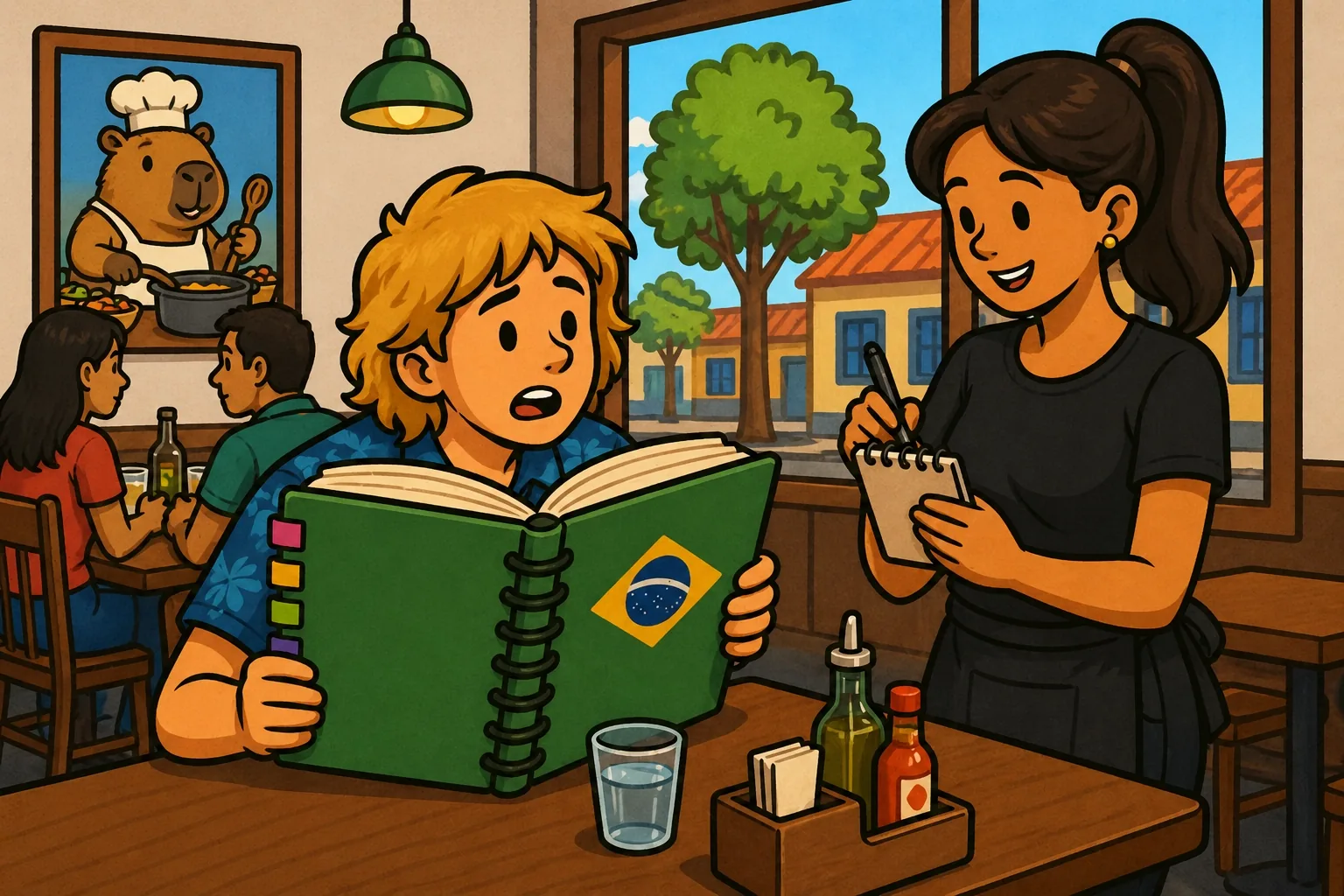
Let me set the scene. I'd been in Brazil maybe three weeks, feeling cocky because I'd successfully ordered a beer twice in a row without pointing. A friend took me to this tiny restaurant in Botafogo — one of those places with plastic chairs on the sidewalk and a TV blasting Globo news on the wall. I scanned the menu, saw "borracha" (which I was CONVINCED meant some kind of grilled meat), and confidently told the waiter, "Uma borracha, por favor."
He froze. Then he laughed. Then he yelled to the kitchen, and the cook came out to laugh too.
Borracha means rubber. I had just ordered rubber for dinner.
What I wanted was "borrego" (lamb). But you know what happened? The waiter didn't let me starve. He brought me the chef's special, refused to let me pay full price, and taught me how to read a Brazilian menu over a free caipirinha. That's when I realized ordering food in Brazilian Portuguese isn't about getting it perfect — it's about giving Brazilians an excuse to feed you and tell you stories.
So let me save you from ordering rubber.
Why Ordering Food in Brazilian Portuguese Is Its Own Skill
Here's the thing nobody tells you: even if you've nailed basic greetings (and if you haven't, go read this first), restaurants are a whole different game. Brazilian menus use slang, regional words, and shortcuts that no textbook will teach you. Plus, waiters talk FAST — São Paulo waiters especially sound like they're being timed.
But here's the good news: Brazilian food culture is built around warmth. The same country that invented the rodízio (all-you-can-eat where they bring food to YOU until you surrender) isn't going to judge your accent. They want you to eat. A lot. And then eat again.
Ready? Vamos lá!
The Phrases That Actually Work at a Brazilian Restaurant
Walking In: The Opening Moves
Forget "Hello, I would like a table for two." Nobody says that. Here's what you'll actually hear and say:
"Mesa pra dois, por favor." [MEH-zah prah doysh, poor fah-VOOR] Table for two, please. Note how "para" becomes "pra" — that's standard spoken Brazilian Portuguese. Say "para" and you sound like you're reading a royal decree.
"Tem mesa livre?" [tayng MEH-zah LEE-vree] Is there a free table? My favorite, because it works even when the place looks packed. Brazilians have a superpower for finding one more chair.
"Só pra beber." [soh prah beh-BEHR] Just to drink. Essential at botecos (neighborhood bars), where ordering food is optional but ordering a cold Brahma is practically law.
Reading the Menu Without Panicking
Brazilian menus love to abbreviate and use slang. Here's your survival cheat sheet:
- "Prato feito" or "PF" — The blue-collar hero. A full plate of rice, beans, meat, and salad, usually under R$30. This is how real Brazilians eat lunch.
- "Executivo" — Same idea as PF but fancier and pricier. Comes with a dessert or juice.
- "Porção" — A shareable portion, usually meant for 2-3 people. Order one and split, or learn the hard way like I did.
- "Chapa" — Something cooked on a hot plate. "Filé na chapa" = steak on the griddle.
- "À milanesa" — Breaded and fried. Put this on anything and it becomes 50% more delicious.
- "Grelhado" — Grilled. The healthy option, supposedly.
- "Na brasa" — Over charcoal. The option that actually tastes like something.
Try this in our app: Falando's Quick Practice cycles through real Brazilian sentences with native-speaker audio, so terms like "à milanesa" and "na brasa" land in your ear long before you have to say them out loud — and anything you flub gets surfaced again later in Mistakes Practice.
Ordering Like You Mean It
Here's the actual sentence structure you'll use 90% of the time:
"Eu vou querer [food], por favor." [eh-oo voh keh-REHR] I'll have [food], please. Literally "I'm going to want" — more polite than "eu quero" (I want), which sounds abrupt to Brazilian ears.
"Pra mim, [food]." [prah meeng] For me, [food]. Casual, efficient, and what my paulistano friends actually say.
"Me vê um(a) [food]?" [mee VEH oom/OO-mah] Can I get a [food]? Literally "show me a..." but it's the warmest, most Brazilian way to order. Use it and waiters soften immediately.
The "People Also Ask" Section (Because You're All Asking These)
How do you say "the check, please" in Brazilian Portuguese?
"A conta, por favor." [ah KOHN-tah poor fah-VOOR]
Or, more commonly in São Paulo: just lift your hand and make a scribbling motion in the air. Works every time. If you're splitting, say "Pode dividir?" (Can you split it?) — though Brazilians usually just put all cards on the table and let the waiter sort it out.
What's the difference between "lanche" and "refeição"?
A lanche is a snack or a sandwich — think of a late-afternoon coxinha at a padaria. A refeição is a proper meal with rice, beans, the whole works. If someone asks "Já almoçou?" (Have you eaten lunch?), they mean the real deal, not a pão de queijo you grabbed at 10 AM.
How do I order vegetarian food in Brazil?
Say "Sou vegetariano/a." [soh veh-zheh-tah-ree-AH-noh/nah] — I'm vegetarian. But be warned: in some places, "vegetarian" still includes chicken. Clarify with "Sem carne, sem frango, sem peixe" (no meat, no chicken, no fish). For vegan: "Sou vegano/a" plus "sem ovos nem laticínios" (no eggs or dairy).
Do Brazilians tip at restaurants?
Most restaurants automatically add a 10% service charge ("taxa de serviço"). It's technically optional — you can ask "A gorjeta está incluída?" (Is the tip included?) — but leaving it off is considered rude unless the service was genuinely terrible. For delivery drivers and bartenders, a few extra reais is appreciated.
Brazilian Food Culture: The Stuff That Will Trip You Up
The Cafézinho Ritual
Order a coffee anywhere in Brazil and you'll get a cafezinho — tiny, strong, and sweetened to the point of violence. Don't ask for milk. Don't ask for it "to go." Stand at the counter, down it in two sips, nod at the barista, and leave. That's the ritual. You want it without sugar? Say "Sem açúcar" when you order. Otherwise, prepare for diabetes.
The Brazilian "No" (Again)
If a waiter says "Acabou" (it's finished), it's finished. If they say "Vou ver" (I'll check), it's probably finished but they're being nice about it. Don't keep asking. Just pivot: "Então me vê outra coisa." (Then get me something else.)
Brazilian Portions Are Lies
A "porção pra uma pessoa" (portion for one person) feeds two Americans. A "porção pra duas pessoas" feeds a small family reunion. Order light the first time. Trust me. I learned this at a churrascaria in Porto Alegre and I still haven't fully recovered.
Regional Food Chaos
What's called "biscoito" in Rio is "bolacha" in São Paulo (and they will fight about it — this is a real feud). A "mandioca" in the south is "macaxeira" in the northeast is "aipim" somewhere else. It's all the same root vegetable. Brazilians don't agree on what to call anything, so don't worry if you don't either.
The Mistakes That Still Wake Me Up at Night
The "Preservativo" Disaster
I once asked a waiter if the bread had any "preservativos." I meant "preservatives." Preservativo in Portuguese means condom. The waiter, bless him, just said, "Não, senhor, aqui a gente só serve pão." (No sir, we just serve bread here.) The correct word is "conservantes." Burn that into your memory.
The "Pimenta" Problem
I asked for "pouca pimenta" (a little pepper) on my moqueca in Salvador. Bahian "pouca pimenta" is still roughly the heat of the sun's surface. If you have ANY sensitivity to spice, say "Sem pimenta, por favor." (No pepper, please.) You can always add more later.
The "Gostoso" Gender Trap
Trying to compliment the food, I told a waitress, "Tudo está muito gostosa!" Wrong gender. "Gostoso" (masculine) is the food compliment. "Gostosa" (feminine) directed at a person means "hot/sexy." The whole restaurant heard. I paid the bill and left through the kitchen.
Memory Tricks I Use (Don't Judge)
- "Água" (water) — I picture an iguana drinking from a puddle. Iguana → água. Works for me.
- "Cerveja" (beer) — "Service-ya a beer." Terrible pun, never forgotten.
- "Gelo" (ice) — Sounds like "jello," which is cold. Done.
- "Sobremesa" (dessert) — Literally "over-table." I picture dessert being walked across the table. It's weird. It works.
- "Garçom" (waiter) — Sounds like "garcon" in French, which it basically is. Easy cheat.
Try This Tonight: Your First Real Order
Okay, here's your homework. Walk into any Brazilian restaurant or delivery app this week and actually use this script:
- "Oi, tudo bem?" (Hi, how are you?)
- "Me vê um prato feito de frango, por favor." (Can I get a chicken PF, please?)
- "Pra beber, um suco de maracujá." (To drink, a passion fruit juice.)
- "A conta, por favor." (The check, please.)
- "Valeu!" (Thanks!) — Casual "thank you." Makes you sound local.
That's it. Five lines. You'll get real Brazilian food, pay a real Brazilian price, and probably get a real Brazilian compliment on your pronunciation.
Try this in our app: Drill the script above with Quick Practice so the words come out clean under pressure, and use the Idioms Trainer to lock in the slang you'll actually hear at the table — "valeu", "beleza", "tá osso". Much safer than my "borracha" moment.
One Last Thing: The Difference That Matters
Here's something wild I learned after years of eating my way through this country. In Portugal, you might say "Se faz favor, pode trazer a ementa?" (Please, can you bring the menu?). In Brazil? It's "Cardápio, por favor." Ementa means nothing here. And once you've cracked the cardápio, the next rabbit hole is regional — what shows up on a Bahian table is a completely different universe from what hits a Porto Alegre churrascaria. The Culinary Institute of America's breakdown of Brazilian cuisine by region is the cleanest map I've found.
The point is: Brazilian Portuguese for beginners is its own thing. Treat it that way and you'll eat better, tip better, and maybe — like me — end up with a regular table at a Botafogo restaurant where the owner remembers your order and still tells the rubber story every time you visit.
Ready to Stop Pointing at Menus?
Look, you can keep translating menus with your phone, squinting at "coração de frango" and hoping it's not what you think it is (it is — it's chicken hearts, and they're actually delicious). Or you can spend 10 minutes a day with Falando, our Portuguese learning app, drilling the exact food vocabulary, pronunciation, and cultural scripts that turn you from "confused tourist" into "the gringo who orders like a local."
Falando drills real Brazilian sentences with native-speaker audio in Quick Practice, automatically brings back the ones you flub in Mistakes Practice, keeps everything in spaced repetition through Reviews, and locks in the slang you'll actually hear at the table via the Idioms Trainer.
Sign up, practice the scripts above, and then go order something. Anything. Even rubber. Especially rubber — it makes for a better story.
Boa sorte e bom apetite! (Good luck and bon appétit!) And if you accidentally order something weird, tell me about it. I collect these stories now. It's the only thing that makes the "gostosa" incident feel less painful.