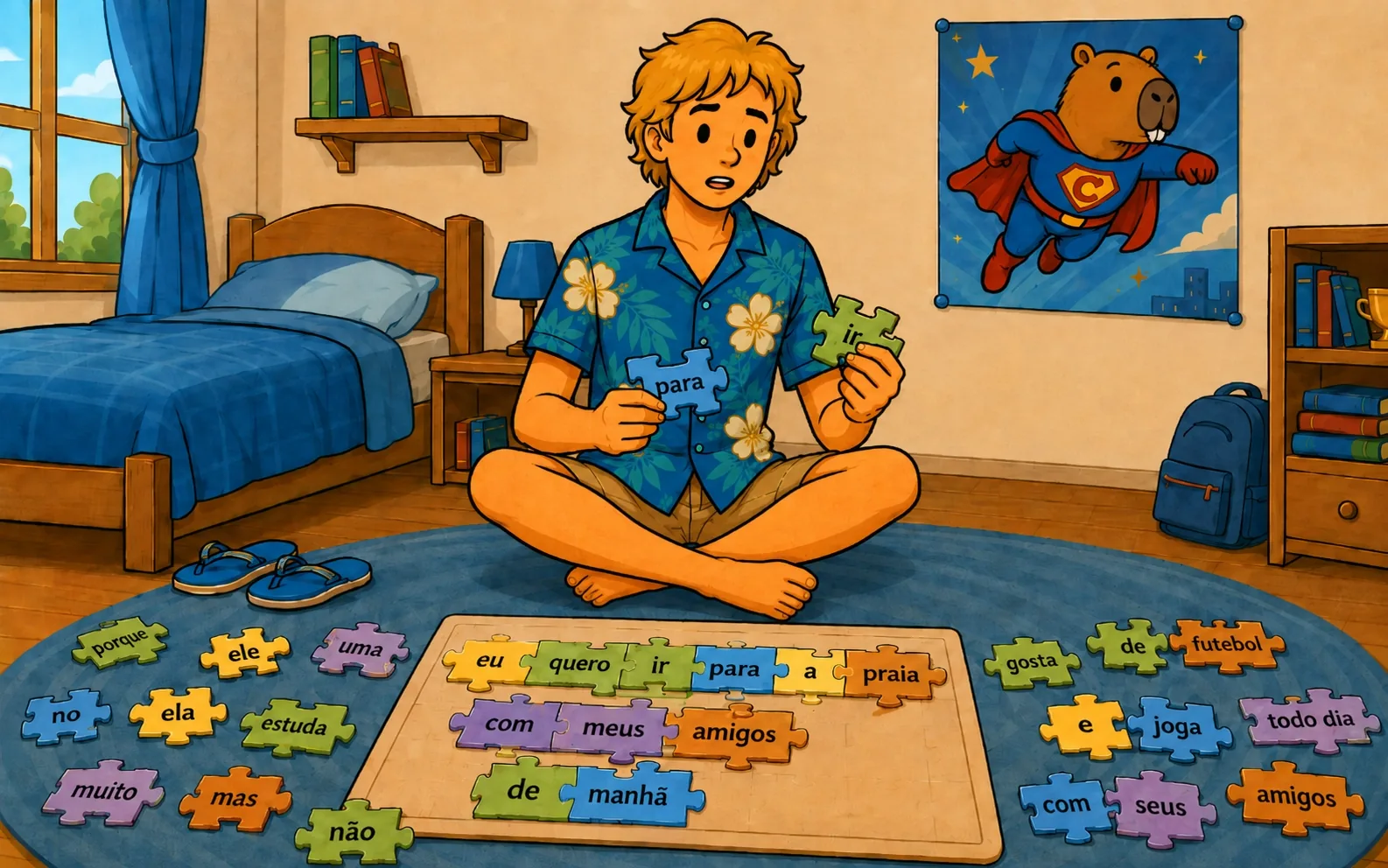
The A2 Plateau Is a Real Place, and I Lived There for Eight Months
There's a very specific kind of misery that hits you somewhere around A2 in Brazilian Portuguese. You're not a beginner anymore — you can order food, ask for directions, survive a pharmacy. But you're also very much not conversational. You're stuck in the linguistic equivalent of a Tuesday afternoon.
I lived on that plateau for about eight months in São Paulo. I could get through any transaction — coffee, Uber, atm, the guy at the feira — but the second a conversation went sideways into actual life ("so what do you think about the new mayor?" / "wait, why did your cousin move back from Portugal?"), I'd freeze, smile, and say "ahh, mais ou menos" like an idiot. Sound familiar?
Here's the good news, and the whole point of this post: the jump from A2 to B1 in Brazilian Portuguese is not about learning more words. It's about learning to survive an unscripted conversation. That's a different skill, and once you train it on purpose, the plateau ends fast. Vamos lá.
What A2 and B1 Actually Mean (No Jargon, I Promise)
People throw around "A2" and "B1" like everyone agreed on what they mean. These come from the CEFR, the European framework every serious Portuguese learning app uses to organize content (ours included). But the official descriptions are written like a tax form. Here's the human version:
| Situation | A2 ("survival") | B1 ("independence") |
|---|---|---|
| At a café | You order correctly | You make a joke with the barista about the rain |
| Someone speaks fast | You panic, ask them to repeat | You catch ~70% and bluff the rest gracefully |
| Telling a story | "Yesterday I go to beach. Good." | "So yesterday I was going to the beach but then..." |
| Opinions | "É bom." / "Não gosto." | "Pra mim, depende — porque..." |
| When you don't know a word | Full stop, dead air | You talk around it until they get it |
See the pattern? A2 is about completing tasks. B1 is about handling the unexpected. That last row — talking around a word you don't know — is the single biggest B1 superpower, and almost nobody practices it on purpose. We'll fix that below.
The Skills That Actually Move You From A2 to B1 in Brazilian Portuguese
After climbing out of the plateau the slow, dumb way, here's what I'd tell my past self to focus on. In order.
1. Stop Collecting Words. Start Collecting Connectors.
At A2 you speak in stone tablets: short, complete, lifeless sentences. B1 speech is glued together. The glue is a tiny set of connector words, and Brazilians lean on them constantly:
- então — so / then ("então, eu acho que...")
- aí — and then / so ("aí ele falou que não vinha")
- tipo — like / sort of (the Brazilian "like", used the exact same way)
- sei lá — I dunno / whatever ("foi sei lá, uns dez anos atrás")
- na real — honestly / for real
- enfim — anyway / in short
- só que — except / but ("eu ia, só que choveu")
Learn these seven cold and your Portuguese instantly sounds a level higher, even if your grammar hasn't changed at all. Quick pronunciation note: então is nasal — "en-TOWN" with the back of your nose, not "en-tao". And aí is two syllables, "ah-EE", almost always dragged out for emphasis: aaaí.
Try this in the app right now: open Real Talk on Falando, set the CEFR picker to B1, and just count the connectors in the first three clips. Real Brazilian speakers in real video clips, not textbook audio. You'll hear aí and tipo roughly every nine seconds. That's not an exaggeration.
2. Train the Past Tense Until It's Automatic, Not Correct
Here's a surprising fact about Brazilian Portuguese that took me way too long to accept: at B1, fluency matters more than accuracy. A Brazilian would rather hear "ontem eu vai no mercado" said smoothly than "ontem eu fui ao mercado" said with a four-second loading screen on your face.
The single biggest A2 tell is the broken past tense. You know fui, you know fiz, but they don't come out fast enough, so you default to the present and hope context saves you. It mostly doesn't.
This is pure reflex training, and it's exactly what Verb Conjugation Practice is built for — real Brazilian sentences with one conjugated slot, so you drill "Ontem eu ___ (ir) na casa da minha sogra" until fui fires without thinking. If you've already read our deep dive on the best ways to practice conjugation in Brazilian Portuguese, this is the same idea, aimed squarely at the B1 jump.
3. Learn to Talk Around the Word You Don't Know
This is the B1 skill and nobody teaches it. When an A2 speaker hits a word they don't know, they stop. When a B1 speaker hits one, they describe it:
- Don't know "saca-rolhas" (corkscrew)? → "aquela coisa que abre vinho" (that thing that opens wine)
- Don't know "genro" (son-in-law)? → "o marido da minha filha"
- Don't know "reembolso" (refund)? → "quando eles te devolvem o dinheiro"
This is a trainable trick, not a talent. Try it as a game: pick five random objects in your room right now and describe each one in Portuguese without naming it. Could you do it? That exact skill is what carries a real B1 conversation when your vocabulary inevitably runs out — and it always runs out.
4. Build a Listening Diet of Real, Fast, Messy Brazilian
At A2 you understand textbook audio because it's spoken by a saint at half speed. Real Brazilians from São Paulo and Rio talk fast, swallow half their syllables ("cê tá" not "você está", "tô" not "estou"), and never wait for you. B1 listening is just exposure hours — there's no shortcut, only a faster road.
Mix it up so you don't burn out:
- One Brazilian YouTuber you'd watch even in English
- One podcast for the commute
- One trashy novela for the slang and the drama
- Real Talk clips when you've got ten focused minutes and want it to count
The goal isn't to understand everything. The goal is to get comfortable understanding most of it and not panicking about the rest. That emotional shift — from "I must catch every word" to "I'll get the gist, beleza" — is B1.
5. Force Output Before You Feel Ready
You will never feel ready to speak. That feeling is a liar. The A2→B1 jump happens in the conversations that are slightly too hard for you, where you're sweating a little. Comfortable practice keeps you exactly where you are.
If live humans are still terrifying (totally normal), bridge it with low-stakes output first: Quick Practice for mixed daily reps, and Mistakes Practice to re-drill the exact things you keep botching. The app quietly tracks what you miss and hands it back later through Reviews on a spaced schedule, so your weak spots don't get to hide. Then go find a human and embarrass yourself anyway. Both. Always both.
Common A2-to-B1 Mistakes to Avoid
The traps I personally face-planted into, so you don't have to:
- Hunting for more vocabulary instead of activating what you have. You already know more than you can use. B1 is about retrieval speed, not a bigger dictionary.
- Treating the subjunctive as "advanced." It isn't. "Tomara que dê certo," "se eu pudesse," "espero que você goste" are everyday B1 phrases. Learn four skeletons, not the grammar table.
- Only practicing where you're comfortable. Re-reading A2 dialogues feels productive and changes nothing. Growth lives one notch above comfortable.
- Subtitle dependency. Portuguese subtitles are training wheels; Brazilian ones often paraphrase the audio anyway. Wean off them on rewatches.
- Comparing your speaking to your understanding. Your ears will always be a level ahead of your mouth. That gap is normal — not evidence you've failed.
A Quick Comparison That Makes the Whole Thing Click
Think of A2 as knowing all the individual ingredients in a Brazilian kitchen. You can name the rice, the beans, the farofa, the couve. B1 is being able to actually cook the feijoada — combining everything, in real time, while people are talking to you and the pot is too hot. Same ingredients. Completely different skill. You don't get there by buying more ingredients. You get there by cooking, badly, repeatedly, until it isn't bad anymore.
A Little Cultural Cheat Code: The "Boteco Test"
Here's my honest, unscientific benchmark, born in a boteco in Vila Madalena. You've hit real B1 when you can sit at a table of Brazilians for an hour and the conversation does not slow down for you. Nobody switches to English. Nobody does the patient-with-a-child voice. You miss things, you bluff, you laugh slightly late at the joke — but the river keeps moving and you're in it.
The first time that happened to me, we were arguing about whether pão de queijo is better in Minas Gerais (it is, and I'll fight about it). Three hours. Zero English. I walked home grinning like an idiot. That night, not some exam, was the day I knew I'd crossed from A2 into B1 — and it's a feeling no certificate gives you.
People Also Ask
How long does it take to go from A2 to B1 in Brazilian Portuguese?
With consistent, focused practice — say 30 minutes a day plus real listening — most people make the A2→B1 jump in four to eight months. Living in Brazil speeds it up, but only if you actually talk to people; plenty of expats stall at A2 for years by living in an English bubble. Consistency beats intensity every single time.
Is B1 enough to be conversational in Brazilian Portuguese?
Yes — B1 is essentially the definition of "conversational." You can hold a real, unscripted conversation, handle the unexpected, follow most of a group chat, and travel anywhere in Brazil without switching to English. It's not effortless yet (that's B2), but B1 is the level where the language genuinely becomes usable in daily life.
What's the hardest part of the A2 to B1 jump?
Listening to fast, natural speech and not panicking. A2 learners are used to slow, clean textbook audio; real Brazilian Portuguese in São Paulo or Rio is fast and full of contractions. The fix is unglamorous: lots of real-speech exposure until your brain stops needing every word.
Do I need a Portuguese learning app to reach B1, or can I do it free?
You can absolutely build B1 with free resources plus conversation — we even wrote a whole guide on learning Brazilian Portuguese for free. A structured Portuguese learning app mostly buys you efficiency: CEFR-leveled content, spaced reviews, and a record of what you keep getting wrong, so you spend your limited practice time on the right things instead of guessing.
Your Move: Pick One B1 Skill and Start Tonight
If you take one thing from this: A2 to B1 in Brazilian Portuguese is not a vocabulary problem — it's a "handle the unexpected" problem. You don't read your way across the plateau. You talk, mishear, bluff, and recover your way across it.
So pick one skill from this post tonight. Just one. Drill the seven connectors until aí and tipo fall out of your mouth on their own. Or play the describe-it-without-naming-it game with five objects on your desk. Small, specific, today.
When you want to turn that into a daily habit, Falando lets you set the CEFR picker straight to B1 and practice the real thing — Real Talk for actual Brazilian speech, Verb Conjugation Practice for the reflexes, and Reviews keeping your weak spots from sneaking back. Sign up and watch the level tracker tick from A2 toward B1 — that little bar moving is dangerously motivating.
The plateau is real. It's also temporary. Vai dar certo, meu — I promise.