The Night I Accidentally Asked My Crush If She Wanted to "Stay"
Six months into living in São Paulo, I met someone at a friend's birthday. We talked for an hour. It was going great. Then she leaned in and asked, "Então... a gente tá ficando ou tá namorando?" ("So... are we ficando or are we namorando?")
I had no idea. Both verbs sounded like "being together." So I confidently said "Os dois!" — "Both!" — which, I later learned, is the romantic equivalent of answering "Are we friends or business partners?" with a thumbs up.
She laughed. We did, eventually, figure it out (reader, I now have a Brazilian girlfriend). But that night taught me that flirting in Brazilian Portuguese runs on a set of rules nobody puts in a textbook. So grab a cafezinho — let me save you from my mistakes.
Why Flirting in Brazilian Portuguese Is Basically a National Sport
Here's the thing about romance in Brazil: it's warm, fast, and refreshingly direct. What counts as borderline-inappropriate PDA back home is just... Tuesday here. According to Babbel's guide to flirting with a Brazilian, it "wouldn't be out of the norm to kiss somebody on the lips less than five minutes after striking up a conversation." Five minutes! I once spent five minutes deciding whether to make eye contact.
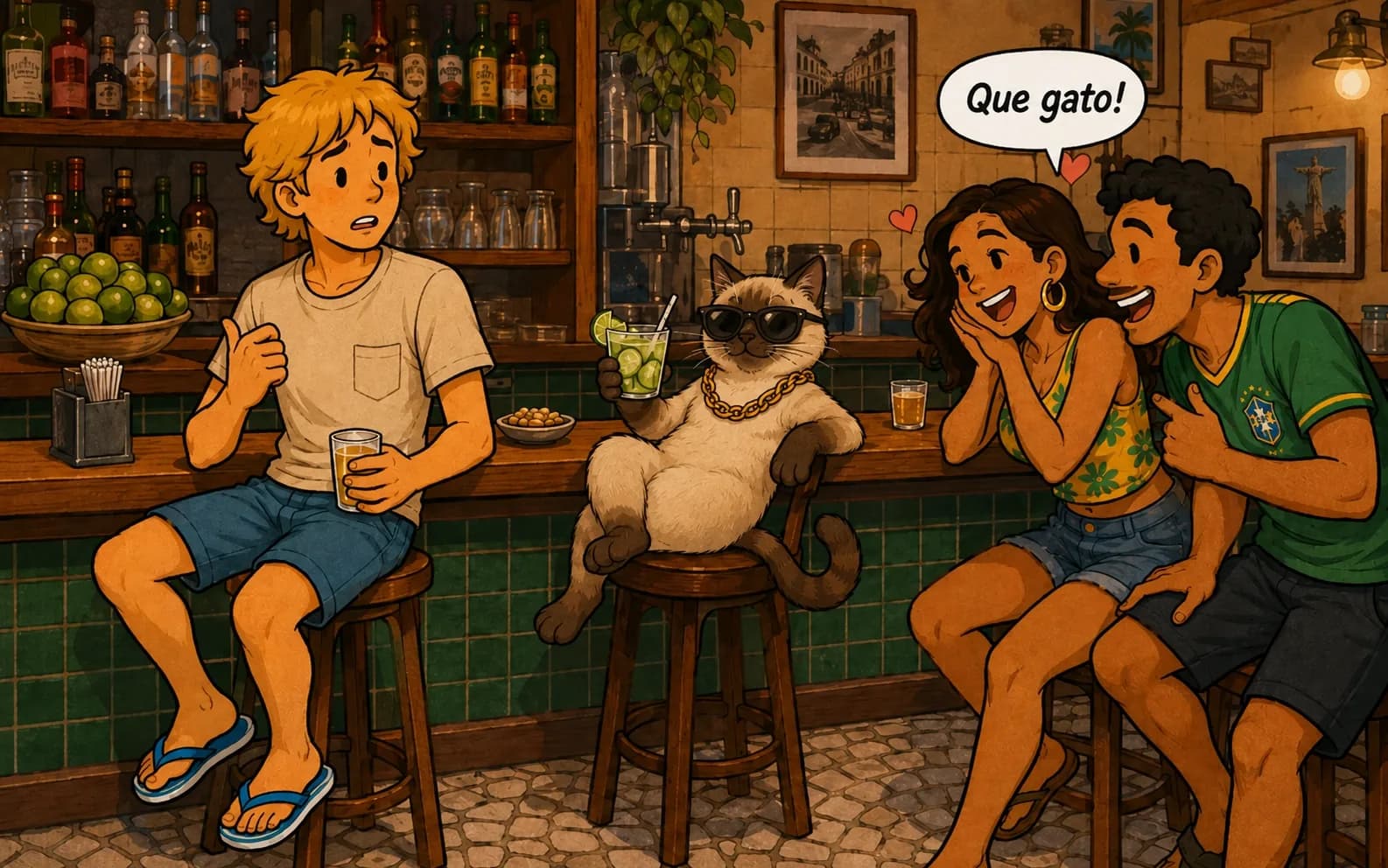
Brazilians also flirt out loud. The art of the cantada (pick-up line) is alive and well, dating apps are everywhere — Tinder is consistently the top-grossing dating app in Brazil, pulling in millions every month — and someone calling you gato or gata (literally "cat," meaning "hottie") across a bar is a perfectly normal Tuesday.
But before you slide into anyone's DMs, you need to understand the one word that breaks every gringo's brain.
The One Word That Breaks Every Gringo: "Ficar"
Ready for a surprising fact? Brazilian Portuguese has a relationship stage that English literally cannot translate in one word: ficar com alguém [fee-KAHR kong al-GENG].
Word-for-word, ficar means "to stay." But in romance, "ficar com" someone means to kiss/make out/hook up with no commitment attached. It's not quite "hooking up," not quite "dating" — it's the gloriously undefined gray zone in between. You can ficar with someone once at a party, or ficar with the same person for weeks without ever being officially together.
Think of a Brazilian relationship like leveling up in a video game. You don't jump straight to "boyfriend." You climb:
| Portuguese | The Stage | English-ish Equivalent |
|---|---|---|
| paquera | Flirting / having a crush | "talking," eyeing each other |
| ficar | Casual kissing, no strings | hooking up / seeing |
| ficante | A recurring casual someone | "situationship" |
| namorar | Official and exclusive | dating / boyfriend-girlfriend |
| pedir em namoro | The "make it official" ask | defining the relationship (DTR) |
| noivar | Getting engaged | engaged |
That pedir em namoro step is its own surprising fact: Brazilians often literally ask someone to be their official partner — a small, sincere "will you be my namorada?" moment. It's adorable, it's a real milestone, and yes, it caught me completely off guard. (If you want the deeper grammar of ficar versus its cousins ser and estar, I broke that down in ser vs estar in Brazilian Portuguese.)
Brazilian Portuguese Dating Phrases for Beginners
Okay, vamos lá — the good stuff. Here are the Brazilian Portuguese dating phrases for beginners that actually got used on me (or by me, with varying success). Bold is the phrase, brackets are how to say it, italics are what it means:
- "Tô a fim de você." [toh ah FEE-jee voh-SEH] — I'm into you. The clean, confident classic.
- "Que gato!" / "Que gata!" [kee GAH-too / GAH-tah] — What a hottie! Said about someone, or right to them if you're bold.
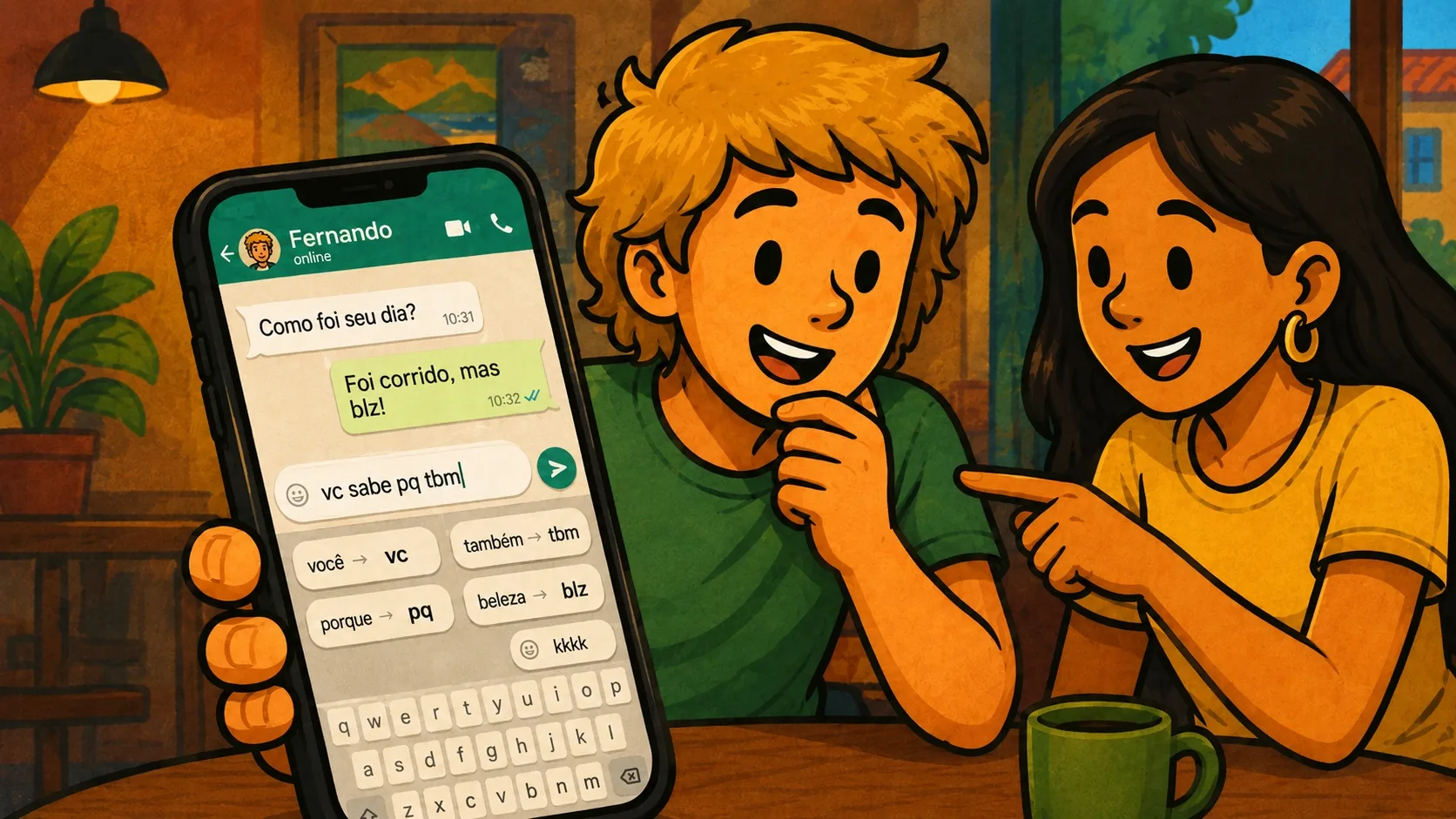
- "Me passa seu zap?" [mee PAH-sah seoo ZAHP] — Can I get your WhatsApp? (Zap = WhatsApp. This is THE move — see Brazilian WhatsApp slang.)
- "Bora marcar um rolê?" [BOH-rah mahr-KAHR oong hoh-LEH] — Wanna plan a hangout? Low-pressure, very Brazilian.
- "Você tá pegando alguém?" [voh-SEH tah peh-GAHN-doo al-GENG] — Are you seeing anyone? (Pegar here = casually seeing/kissing.)
- "Tô gamado em você." [toh gah-MAH-doo eng voh-SEH] — I'm smitten with you. Sweet, a step past "a fim."
- "Fica comigo?" [FEE-kah koh-MEE-goo] — Will you kiss me / be with me tonight? The legendary Carnaval line. Use with a smile.
Have you noticed none of these are full of fancy grammar? That's the secret — Brazilian flirting is casual and playful, not formal.
How to Ask Someone Out in Brazilian Portuguese
If you want to know how to ask someone out in Brazilian Portuguese without sounding like a hostage negotiator, keep it light:
- Casual: "Bora sair qualquer dia desses?" (Wanna go out one of these days?)
- A real date: "Topa um date sexta?" (Up for a date Friday?) — yes, Brazilians borrowed "date."
- Smooth: "Posso te pagar uma bebida?" (Can I buy you a drink?)
Want to drill these until they're automatic? Falando's Quick Practice mode throws short, real-world Brazilian Portuguese scenarios at you — perfect for building the muscle memory so "me passa seu zap?" comes out smooth instead of strangled.
The Art of the Cantada
A cantada is a pick-up line, and Brazilians treat the cheesy ones as a comedy sport. Deliver these with a wink — sincerity is optional, the laugh is the point:
- "Seu pai é ladrão? Porque roubaram as estrelas e colocaram nos seus olhos." — Is your dad a thief? Because someone stole the stars and put them in your eyes.
- "Você tem mapa? Porque me perdi nos seus olhos." — Do you have a map? I got lost in your eyes.
- "Você é Wi-Fi? Porque tô sentindo uma conexão." — Are you Wi-Fi? I'm feeling a connection.
Compliments, Pet Names, and How NOT to Call Someone "Aroused"
Now for the landmines. How to flirt in Brazilian Portuguese is 90% confidence and 10% not accidentally saying something unhinged. Here's what I learned the embarrassing way:
- "Excitado" does not mean "excited." It means aroused. Tell someone you're "muito excitado" to meet them and you've made things very weird. You want animado (excited/keen).
- "Estou quente" ≠ "I'm hot (attractive)." It means you're physically overheated — or worse. To say you're hot, let them call you gato/gata.
- "Gostoso/gostosa" means "tasty," i.e. sexy. Strong stuff. Wonderful with a partner, catastrophic when aimed at someone's grandmother (ask me how I know).
- Watch your genders. Lindo for a guy, linda for a woman. I once called a very burly personal trainer gostosa. He has never let it go.
- Pet names are everywhere: amor (love), meu bem (my dear), vida (my life), and the wildly popular mozão [moh-ZOWNG] — a squishy mashup of amor meaning "big love."
- Don't drop "te amo" too early. Te amo is deep "I love you." Too soon and you'll scare them off. Start with gosto de você (I like you) or te adoro (I adore you).
These "looks-like-English-but-betrays-you" words are classic traps — I rounded up a bunch more in Brazilian Portuguese false friends. Be honest: how many were you already saying wrong?
Pro tip: the fastest way to lock in vocabulary like paquerar, ficante, and mozão is spaced repetition. Save them in Falando's vocabulary tools and let Reviews resurface them right before you forget — so the word is there when the cute person actually shows up.
São Paulo vs. Rio: Same Language, Different Flirt
Romance sounds different depending on where you are. The Portuguese language in São Paulo is fast and a little guarded — paulistanos flirt over specialty coffee and craft beer, and you earn the warmth. Cross over to Rio and everyone is already querido, amor, and meu bem within thirty seconds, whether they're flirting or selling you a coconut. First-timers in Rio routinely mistake basic Carioca friendliness for true love. (Reader, I was one of them.)
And then there's Carnaval, the unofficial national championship of ficar. The whole "fica comigo?" tradition hits warp speed — friends genuinely compare how many people they kissed. Whatever you've learned about dating in Brazil, Carnaval turns the dial to eleven, né?
Speaking of warmth: a lot of flirting just grows out of good conversation, so the better your everyday chat, the smoother your love life. My Brazilian small talk guide is honestly half a dating manual.
Memory Tricks So These Actually Stick
- Ficar = "to stay." Remember: a ficante stays the night but not in your life. Dark, but you'll never forget it.
- Gato/gata = "cat." Hot people = cats. "Que gato!" Easy.
- Cantada comes from cantar (to sing). A pick-up line is "singing" to someone. The cheesier the song, the better.
- Mozão = amor + - zão ("big"). Big love. One word, maximum mush.
- Paquera — I picture "pah-KEH-rah" as the sound of a heart skipping. Whatever works, right?
A Quick European Portuguese Detour
Headed to Lisbon instead of Lisbon-on-Sea? A few things shift. In Portugal, a cutie is giro/gira, not gato/gata. The Portuguese also say engatar for "to pick up / chat someone up." Ficar exists across the Atlantic too, but that casual-make-out nuance is most alive and unembarrassed in Brazil. Same language, different rhythm — kind of like the idioms that mean totally different things region to region.
One more app nudge, because it's genuinely useful here: to train your ear for the fast, flirty Portuguese you'll actually hear, Falando's Real Talk plays 20-second clips from real Brazilian conversations and asks you to answer in Portuguese. It's the closest thing to eavesdropping on a date before you go on one.
People Also Ask
How do you say "I like you" in Brazilian Portuguese?
For a crush, say "Gosto de você" (I like you) or the flirtier "Tô a fim de você" (I'm into you). Save "Te amo" (I love you) for when things are serious — it's a heavy, sincere phrase in Brazil, and dropping it on a second date will read as intense rather than romantic.
What does "ficar" mean in Brazilian Portuguese dating?
Ficar com alguém means to kiss or make out with someone casually, with no commitment implied. It's the stage between flirting (paquera) and officially dating (namorar). A recurring casual partner is a ficante. There's no clean English translation — it's somewhere between "hooking up" and "seeing each other," and it's central to how dating in Brazil works.
How do you flirt in Brazilian Portuguese without sounding awkward?
Keep it casual and confident. Skip textbook formality, use você (never the stiff o senhor / a senhora), and lean on simple lines like "Que gato/gata!" or "Me passa seu zap?" Brazilians value warmth and directness over perfect grammar, so a friendly, slightly playful tone matters far more than flawless conjugation. A wrong word said with a smile beats a perfect sentence said nervously.
Is it okay to use cheesy pick-up lines (cantadas) in Brazil?
Absolutely — as long as they're clearly meant to be funny. Brazilians love a corny cantada delivered with a wink. The goal is to make the person laugh, not to be smooth. Over-the-top lines like "Seu pai é ladrão?" are a beloved part of the culture. Just read the room: playful and respectful always, creepy never.
Vai, Manda Ver: Go Flirt (Badly) in Portuguese
Here's the truth about dating in Brazil: nobody expects you to be perfect. They expect you to show up, try, mix up a gender or two, and laugh when you say excitado instead of animado. Brazilians will adopt you, correct you with love, and probably set you up with their cousin.
So your homework: pick ONE phrase from this guide and use it this week. Maybe "que gato!" Maybe a terrible cantada. Mess it up gloriously. Which one are you brave enough to try first?
And if you'd rather practice without a live audience first, that's exactly what a good Portuguese learning app is for. Sign up for Falando and warm up in Quick Practice, keep your new vocabulary sharp in Reviews, and train your ear in Real Talk before you go flirt for real. Because you can learn Portuguese online all you want — but the magic happens when you finally say "bora sair?" out loud.
Beleza? Beleza. Agora vai — manda ver! 😉