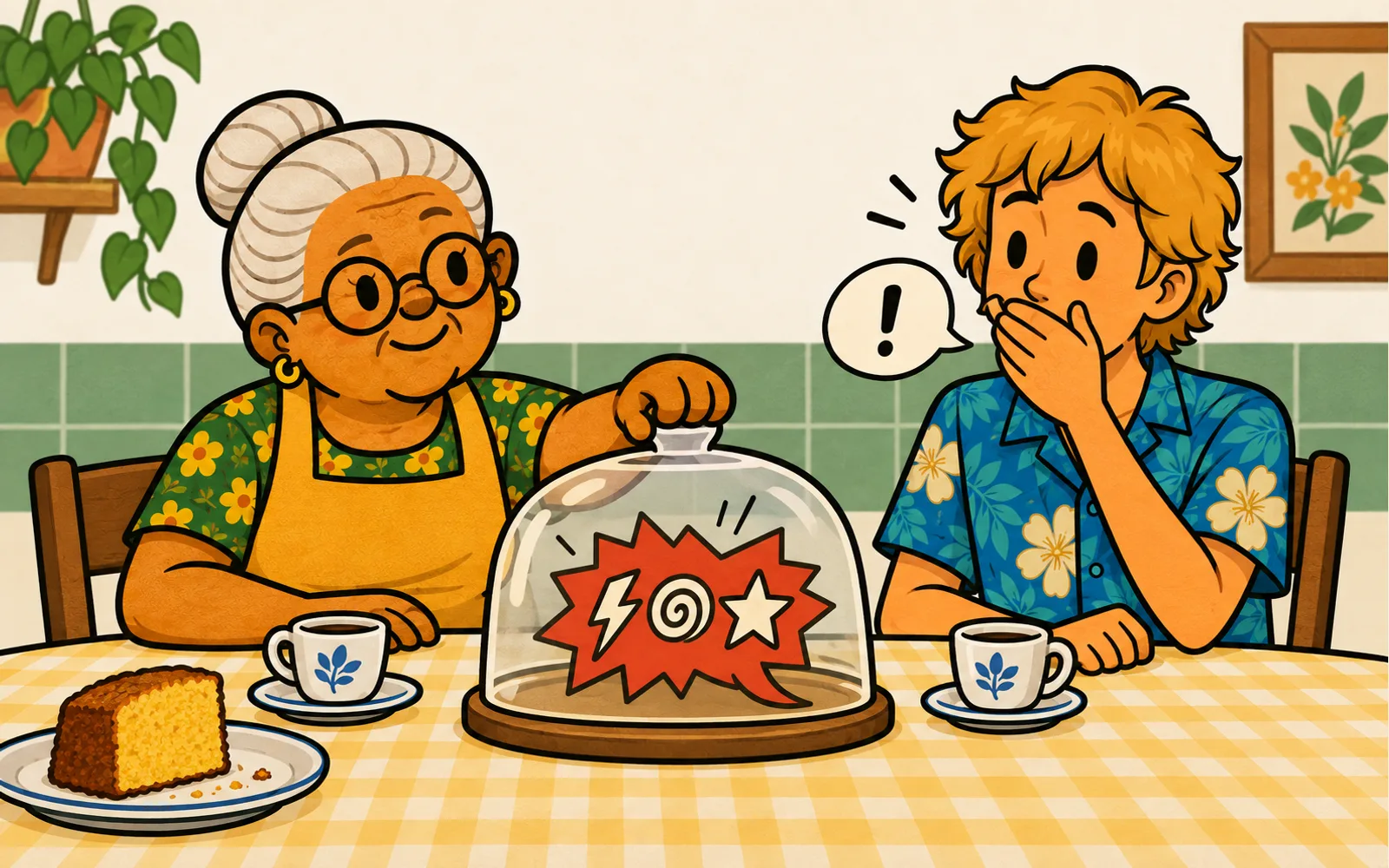
I once dropped a biscuit into my coffee and reacted with a Portuguese word I had picked up watching football. It was an impressive amount of language for a very small biscuit. Alone in the kitchen, fine. At Sunday lunch with somebody's grandmother, I would have preferred a second attempt.
That is the awkward part of learning Brazilian Portuguese exclamations: you can understand the emotion long before you understand the social setting. A word that sounds cheerful in a goal celebration can land badly over a slice of cake.
So what can you say when something surprises you? Start with nossa, poxa, caramba and eita. Then learn what the stronger words are doing, even if you never choose to use them. Your listening vocabulary can be considerably less polite than your speaking vocabulary.
Brazilian Portuguese exclamations, ranked by social risk
This is a practical guide for someone meeting new people, not a universal swear meter. Families, workplaces and friendships set their own limits. Volume and the person you aim a reaction at matter too.
| Expression | A possible English reaction | Starting point |
|---|---|---|
| Nossa! | Wow! / Oh my! | Mild; a useful everyday choice |
| Poxa! | Aw! / Oh, come on! | Mild disappointment or sympathy |
| Eita! | Whoa! / Well, look at that! | Informal surprise; not a swear word |
| Caramba! | Wow! / Darn! | Emphatic but generally mild |
| Oxe! / Uai! / Bah! | Huh? / Well! / Wow! | Regional associations; tone decides the meaning |
| Pô! | Come on! / Man! | Very informal; more caution with unfamiliar people |
| Porra! / Caralho! | Strong swearing; sometimes like “fuck!” | Vulgar; learn to recognize before using |
The translations are deliberately approximate. English “wow” can be delighted or unimpressed; Portuguese gives you the same freedom. A louder word does not necessarily contain more profanity, and a mild word can still be rude when spat at someone.
Think of the difference between saying “Oh!” at a beautiful view and “Oh.” after hearing an excuse. The spelling hardly helps. Your face and voice supply most of the missing information.
Nossa, poxa, caramba and eita: four you can use
Nossa: give the reaction a direction
Nossa! is a good first choice for surprise. Pronounce it roughly NOH-suh, with an open o, a clear s, and stress on the first syllable. These sound hints are approximations, not a substitute for hearing Brazilian speakers.
Nossa, que bolo bonito! — “Wow, what a beautiful cake!”
Nossa, que fila enorme! — “Wow, what a huge queue!”
One admires the cake; the other takes in an inconvenient fact. Add a warm smile to the first. Let the second sound tired if you have been standing outside in São Paulo's afternoon heat.
Here is a small surprise: this nossa is a shortening of Nossa Senhora, “Our Lady,” as recorded by Caldas Aulete. It is not the possessive “our” looking for a missing noun. You do not change it to nosso because the cake is masculine. The religious origin also does not tell you what any individual speaker believes.
Poxa: leave room for sympathy
Say POH-shuh, with a closed o and x like English “sh.” Poxa often suits a small disappointment, and can soften a response to somebody else's bad news.
Poxa, não vou conseguir ir. — “Ah, I won't be able to go.”
Poxa, que pena. — “Oh, that's a shame.”
The second needs a gentle voice. An enthusiastic reaction would sound strange if your friend had just cancelled a much-needed holiday. You are responding to their feeling as well as the information.
You can also complain with poxa. Put the stress into Poxa, de novo? — “Oh, come on, again?” — and the sympathy disappears. No vocabulary change required.
Caramba: impressed, irritated, or both
Caramba is roughly kuh-RUM-buh; the stressed vowel is nasalized before m. It has more dramatic weight than a quiet nossa, without automatically becoming strong swearing.
Caramba, você fez tudo isso? — “Wow, you did all of this?”
Caramba, esqueci a chave! — “Darn, I forgot the key!”
It also appears in para caramba: O bolo está bom para caramba means “The cake is really good.” That is an informal intensifier. At a first family lunch, Está muito bom — “It's very good” — does the job with less performance.
Eita: something just happened
Eita, roughly AY-tuh, is useful when events take a sudden turn. The first syllable carries the stress.
Eita, o café derramou! — “Whoa, the coffee spilled!”
Eita, você chegou cedo! — “Oh, you got here early!”
It can express admiration, alarm or amused surprise. It is strongly associated with Northeastern speech, but you will encounter it beyond the Northeast too. Nothing in the word itself makes it obscene. Treating every animated Brazilian reaction as swearing will make perfectly ordinary conversations sound far more scandalous than they are.
Try it in Falando: in Bate-papo, choose Dona Beatriz and practise a short everyday conversation. Work in one mild reaction where it fits. You do not need to turn every reply into an audition for a novela.
Oxe, uai and bah: listen for place as well as feeling
These words have regional associations, not geographic fences. People move, families mix, and expressions travel. Nor are they three exact regional translations of “wow.”
Oxe is particularly associated with the Northeast. You will also hear the longer oxente. Dicio identifies oxe as a shortened form of oxente. An approximate pronunciation is OH-shee, with an open o; local realizations vary.
Oxe, você já vai? — “Huh, you're leaving already?”
That can be surprised, affectionate or challenging. Listen to how the question ends before deciding someone is annoyed. Arriving in Recife does not oblige you to insert oxe into every sentence. Borrowing the expression gradually is more natural than performing an accent.
Uai is especially associated with Minas Gerais. Say it in one smooth movement, approximately English why. It can mark surprise or puzzlement, but also make an answer sound obvious to its speaker.
Uai, a chave está aqui. — “Well, the key is right here.”
Imagine you have spent ten minutes looking for it. The response might be helpful, teasing or faintly impatient. Uai does not settle that question by itself.
Bah is especially associated with Rio Grande do Sul. Say bah, without pronouncing the final h.
Bah, que frio! — “Wow, it's cold!”
A long bah can carry admiration or exasperation. In Porto Alegre, pay attention to the whole phrase instead of translating the interjection separately every time. Notice which expressions the people around you reach for; that will teach you more than a map suggesting everyone in a state speaks identically.
The spicy end, and how to practise without overdoing it
Pô is very informal. Roughly poh, with a closed vowel, it can introduce a complaint or add warmth between friends: Pô, valeu! — “Hey, thanks!” It is a riskier default around people you have just met than nossa. Familiarity makes a difference.
Porra and caralho are vulgar. You will hear them in anger, surprise and delighted celebration. Their presence alone does not mean an argument has started, but that range of uses does not make them suitable everywhere. Roughly POH-huh and kuh-RAH-lyoo: the strong rr in porra varies by accent, and lh in caralho is a single consonant, not a separate English “l” followed by “y.”
There is no useful promise that one is always exactly as offensive as a particular English swear word. Who is speaking, to whom, and in what setting matters. Recognizing strong Brazilian Portuguese exclamations helps you follow films and conversations; saying them is optional.
For a first Sunday lunch, I would keep these six habits:
- Choose one or two mild expressions you can already pronounce comfortably.
- React to the event, without aiming an angry exclamation at the person beside you.
- Match the size of the reaction to the situation. A lost biscuit is still a biscuit.
- After bad news, leave space for sympathy: Poxa, que pena.
- Listen before borrowing a regional expression or somebody's favourite swear word.
- If something comes out too strongly, say Desculpa, me empolguei — “Sorry, I got carried away.”
Try it in Falando: use Real Talk, where available, to practise listening with Brazilian video clips. When you encounter a reaction, listen again for the pitch and pace. Try a gentle and an irritated version yourself. This is a listening exercise you can apply to any suitable clip, not a dedicated exclamations lesson.
Which version sounds like your own voice? If you can only deliver a word as a shout, it probably needs a little more practice. Our Brazilian small-talk guide can help you put the reaction inside a longer exchange. In messages, you lose those vocal clues; our WhatsApp slang guide covers that different setting.
People also ask about Brazilian Portuguese exclamations
Is “nossa” a bad word?
No. As an exclamation it is generally mild, expressing surprise or admiration. Tone can still make it sarcastic or dismissive. Its origin in Nossa Senhora does not mean every use is a religious statement.
What does “eita” mean in English?
Depending on the situation, “whoa,” “wow” or “oh!” may fit. It marks a reaction, often to something unexpected. It is not inherently positive or negative, and it is not a swear word.
Can I say “caramba” around my partner's parents?
Usually it is a mild informal choice. Still, listen to the family and keep your tone friendly. Nossa, que bom! — “Oh, how nice!” — is an easy alternative when you are unsure. No expression guarantees approval from every parent.
Are “oxe,” “uai” and “bah” interchangeable?
Sometimes they can respond to the same event, but their conversational uses and regional associations differ. Learn each inside a phrase, with its intonation, instead of replacing one with another mechanically.
Start with the reaction you would really make
You do not need the whole list by dinner. Choose nossa for a surprise and poxa for a disappointment, then notice what happens to them in other people's voices. Later, add an eita or a caramba when the moment earns it.
In Falando's Bate-papo, try a brief conversation with Dona Beatriz and give yourself one small aim: respond naturally to something, then carry on talking. The useful progress is being able to react without stopping to assemble a sentence. Stronger language can stay in your listening vocabulary for as long as you like. I still think a biscuit falling into coffee is a poxa problem. And if you are visiting somebody, perhaps put the next biscuit on a saucer.