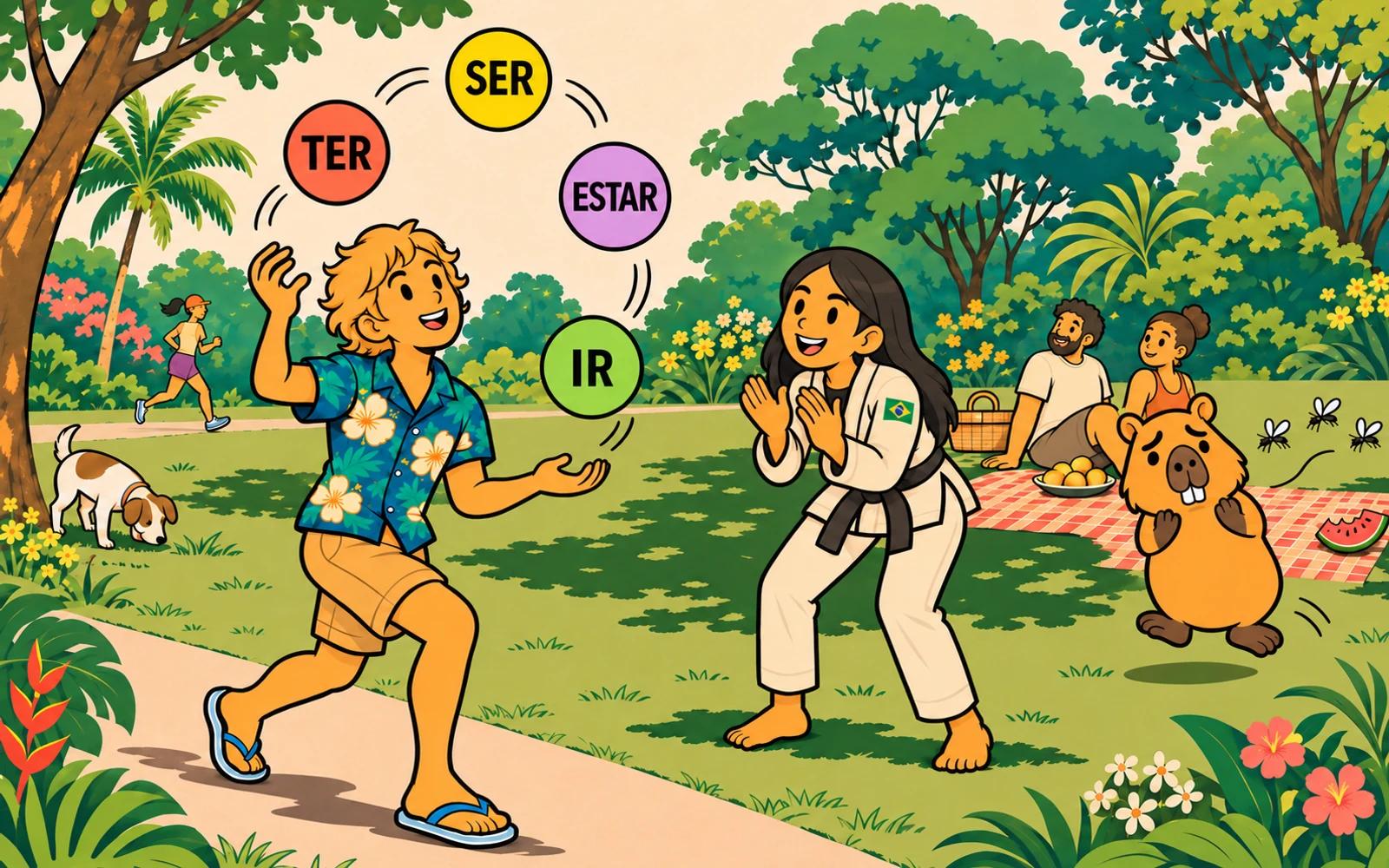
On a forty-minute Uber ride across Porto Alegre, I started counting the driver's verbs. He was telling me about his week: a cousin's wedding, a flooded street, and a Grêmio match he refused to talk about and then talked about for ten minutes. I ran out of fingers fast. Then I noticed something more useful. Almost every sentence ran on the same handful of verbs: tá, vou, fiz, acho que, tem, fica. The verb book on my shelf at home had hundreds. He got through a whole week with a couple of dozen.
So we measured it. This is the list of the most common Brazilian Portuguese verbs, ranked by how often Brazilians use them, with the present-tense forms you need for each one. After the list come the conjugation patterns, and then a few surprises, like the everyday verb that missed the top 50.
How we ranked the most common Brazilian Portuguese verbs
Falando measured word frequency across a large collection of everyday Brazilian Portuguese, both spoken and written. For verbs, every form counts toward its infinitive, so é, foi, era and sendo all count as ser.
The results are lopsided in a way that should cheer you up:
- Ser alone accounts for almost one verb form in five in everyday speech.
- Forms of ser make up about 3% of all spoken words, verb or not.
- The top 10 verbs cover about half of the verb forms Brazilians say out loud.
- The top 50 cover nearly three quarters of spoken verb use and just over half of written use.
- Verbs 51 to 100 add fewer than nine more points in speech.
In other words, learn these fifty well and roughly three of every four verb forms you hear will belong to a verb you already know. How many of them do you know today? Count as you go.
The 50 most common Brazilian Portuguese verbs, ranked
Verbs in bold are irregular somewhere in the present tense. The last two columns give the forms you'll use most: eu (I) and the form shared by você (you), ele (he), ela (she) and a gente (we, in everyday speech).
Verbs 1–10: the engine room
| # | Verb | Meaning | eu | você / ele / ela |
|---|---|---|---|---|
| 1 | ser | to be (identity, traits) | sou | é |
| 2 | ter | to have; there is | tenho | tem |
| 3 | estar | to be (states, location) | estou (tô) | está (tá) |
| 4 | ir | to go; going to | vou | vai |
| 5 | fazer | to do, to make | faço | faz |
| 6 | poder | can, to be able to | posso | pode |
| 7 | ver | to see | vejo | vê |
| 8 | ficar | to stay, to become | fico | fica |
| 9 | saber | to know (facts, how to) | sei | sabe |
| 10 | dar | to give; to be possible | dou | dá |
Nine of the top ten are irregular. English plays the same trick with be, have, do, go and say: the verbs a language uses most are the ones that hold on to their odd forms, because nobody gets a chance to forget them.
Verbs 11–20: opinions, wants and needs
| # | Verb | Meaning | eu | você / ele / ela |
|---|---|---|---|---|
| 11 | falar | to speak, to talk | falo | fala |
| 12 | querer | to want | quero | quer |
| 13 | dizer | to say, to tell | digo | diz |
| 14 | achar | to think (opinion); to find | acho | acha |
| 15 | deixar | to let, to leave behind | deixo | deixa |
| 16 | vir | to come | venho | vem |
| 17 | usar | to use | uso | usa |
| 18 | começar | to start | começo | começa |
| 19 | conseguir | to manage to | consigo | consegue |
| 20 | precisar | to need | preciso | precisa |
Number 14 is the one textbooks underrate. Acho que... (AH-shoo kee) is how Brazilians say "I think...", and you'll hear it in nearly every conversation about anything.
Verbs 21–30: the everyday middle
| # | Verb | Meaning | eu | você / ele / ela |
|---|---|---|---|---|
| 21 | chegar | to arrive | chego | chega |
| 22 | passar | to pass, to spend (time) | passo | passa |
| 23 | haver | there is (formal); to have (aux) | hei | há |
| 24 | acontecer | to happen | aconteço | acontece |
| 25 | dever | should; to owe | devo | deve |
| 26 | gostar | to like | gosto | gosta |
| 27 | colocar | to put | coloco | coloca |
| 28 | olhar | to look | olho | olha |
| 29 | entender | to understand | entendo | entende |
| 30 | chamar | to call | chamo | chama |
Gostar takes de before whatever you like: gosto de futebol (I like football). Leave out the de and people will still understand you, but it sounds off.
Verbs 31–40: coming, going and knowing
| # | Verb | Meaning | eu | você / ele / ela |
|---|---|---|---|---|
| 31 | acabar | to finish; to have just | acabo | acaba |
| 32 | existir | to exist | existo | existe |
| 33 | pensar | to think (reflect) | penso | pensa |
| 34 | sair | to go out, to leave | saio | sai |
| 35 | contar | to tell (a story), to count | conto | conta |
| 36 | entrar | to go in | entro | entra |
| 37 | conhecer | to know (people, places), to meet | conheço | conhece |
| 38 | mostrar | to show | mostro | mostra |
| 39 | parecer | to seem | pareço | parece |
| 40 | levar | to take, to carry | levo | leva |
Acabar de plus an infinitive means "to have just": acabei de chegar, I've just arrived. And conhecer is the "know" for people and places, while saber (#9) is for facts: conheço o Rafa, but sei o nome dele.
Verbs 41–50: the ones you'll use daily
| # | Verb | Meaning | eu | você / ele / ela |
|---|---|---|---|---|
| 41 | trazer | to bring | trago | traz |
| 42 | voltar | to come back | volto | volta |
| 43 | encontrar | to find, to meet | encontro | encontra |
| 44 | lembrar | to remember | lembro | lembra |
| 45 | ajudar | to help | ajudo | ajuda |
| 46 | pegar | to grab, to catch, to take | pego | pega |
| 47 | sentir | to feel | sinto | sente |
| 48 | tentar | to try | tento | tenta |
| 49 | criar | to create; to raise (kids) | crio | cria |
| 50 | trabalhar | to work | trabalho | trabalha |
Pegar covers a lot of ground: pegar um ônibus (catch a bus), pegar uma gripe (catch the flu), pegar o celular (grab your phone).
How to conjugate regular Brazilian Portuguese verbs
Thirty-three of the fifty are regular, so one pattern per ending gets you a long way. Drop the -ar, -er or -ir and add the endings. The only regular -ir verb in the top 50 is existir, which makes for dull example sentences, so meet abrir (to open), number 64:
| Who | falar (to speak) | entender (to understand) | abrir (to open) |
|---|---|---|---|
| eu | falo | entendo | abro |
| você, ele, ela, a gente | fala | entende | abre |
| nós | falamos | entendemos | abrimos |
| vocês, eles, elas | falam | entendem | abrem |
Brazilian Portuguese gives you a discount here. Você, ele, ela and a gente share one form, and a gente (literally "the people") is how most Brazilians say "we" in conversation. In day-to-day speech you can get by with three forms per verb: falo, fala, falam. If the pronouns are new to you, this guide to você, tu, a gente and nós maps who says what, region by region.
Three pronunciation notes will save you a lot of puzzled looks:
- A final -o sounds like "oo": falo is FAH-loo.
- The plural endings -am and -em are nasal: falam sounds roughly like FAH-lowng.
- In most of Brazil, a final -de or -te turns into "jee" or "chee": entende is en-TEN-jee, and sente is SEN-chee.
For the past tense (pretérito perfeito), the regular endings look like this:
| Who | falar | entender | abrir |
|---|---|---|---|
| eu | falei | entendi | abri |
| você, ele, ela, a gente | falou | entendeu | abriu |
| nós | falamos | entendemos | abrimos |
| vocês, eles, elas | falaram | entenderam | abriram |
Falamos and abrimos are identical in the present and the past, and context sorts them out. When to use this past and when to use the other one (falava) is its own topic, covered in preterite vs imperfect.
For the future, take verb number 4: ir plus an infinitive. Vou falar (I'm going to speak), a gente vai sair (we're going out). The textbook future (falarei) lives mostly in writing and speeches, and in a conversation it sounds stiff. That fits the numbers too: ir turns up almost six times more often in speech than in writing.
Try this in Falando: Verb Conjugation Practice lets you filter a session down to specific verbs. Pick five regular ones from the list, say falar, achar, gostar, entender and chegar, and drill the present tense. Then run the same five in the past.
The irregular verbs you can't avoid
Seventeen of the fifty break the pattern somewhere in the present tense, including all of the top five. Here are the ones that matter most, with the past forms for eu and você:
| Verb | Present: eu · você · nós · vocês | Past: eu · você |
|---|---|---|
| ser | sou · é · somos · são | fui · foi |
| estar | estou · está · estamos · estão | estive · esteve |
| ter | tenho · tem · temos · têm | tive · teve |
| ir | vou · vai · vamos · vão | fui · foi |
| fazer | faço · faz · fazemos · fazem | fiz · fez |
| poder | posso · pode · podemos · podem | pude · pôde |
| ver | vejo · vê · vemos · veem | vi · viu |
| saber | sei · sabe · sabemos · sabem | soube · soube |
| dar | dou · dá · damos · dão | dei · deu |
| querer | quero · quer · queremos · querem | quis · quis |
| dizer | digo · diz · dizemos · dizem | disse · disse |
| vir | venho · vem · vimos · vêm | vim · veio |
| trazer | trago · traz · trazemos · trazem | trouxe · trouxe |
A few patterns make this table much smaller than it looks:
- The odd one out is often eu. Faço, digo, trago, posso, consigo and sinto change the first-person form, and the rest of the present tense behaves.
- Ser and ir share a past tense. Fui means both "I was" and "I went". Fui ao Rio is a trip; fui feliz lá (I was happy there) is a memory.
- Spoken estar loses its first syllable. You'll hear tô, tá and tão (toh, tah, towng) far more than the full forms, and tamo junto (we're in this together) is a whole Brazilian attitude in two words.
- Tem and têm sound the same. The circumflex only marks the plural on paper, and the same goes for vem and vêm.
Ser and estar both mean "to be", and choosing between them gets its own guide.
Spoken vs written: verbs Brazilians say more than they write
Splitting the counts into spoken and written Portuguese turns up some of the most useful facts in the whole list.
Olhar is said about 14 times as often as it's written. You'll hear it constantly as olha at the start of a sentence, the way English speakers say "look" or "listen": olha, não sei (look, I don't know).
Achar beats pensar more than three to one in speech. Ask a Brazilian for an opinion and you'll get acho que sim (I think so) or acho que não (I don't think so). Penso que... sounds like an essay. The original meaning, "to find", is still alive: achei minha chave (I found my key). Michaelis lists the full range of meanings if you want to see how far one verb stretches.
Botar is the street version of "to put". It's said 22 times as often as it's written. Brazilian Portuguese has three verbs for "put", and they rank like this: colocar at 27, botar at 185 and pôr, the one most textbooks teach first, at 279.
Two verbs go the other way. Haver and dever each appear more than twice as often in writing as in speech. In conversation, ter picks up much of their work: tem um problema instead of há um problema (there's a problem), and tenho que sair more often than devo sair (I have to leave). If you studied Spanish first, this is where hay habits trip you up. If you want to dig into usage yourself, the Corpus do Português lets you search real Portuguese texts for any word.
Where's comer? Everyday verbs that missed the top 50
Can you guess where comer (to eat) landed? Number 74. Beber (to drink) sits at 354, estudar (to study) at 140 and dormir (to sleep) at 176.
Brazilians eat as often as anyone, and they say comer almost five times as often as they write it. It just can't compete with ficar, passar and deixar, which show up in conversations about anything at all. Food is one topic among many, while ficar fits into nearly every one of them.
That's why frequency order and teaching order differ. Falando's list of the 100 most common words in Brazilian Portuguese puts comer early because you need it on day one. This list shows what the language leans on most. Use both.
If you'd like a top 55, these five came next:
- tomar (#51): to take, to drink; tomar banho means to shower
- comprar (#52): to buy
- perder (#53): to lose, to miss (a bus)
- ganhar (#54): to win, to earn, to get (a present)
- continuar (#55): to keep on, to continue
People also ask about the most common Portuguese verbs
What is the most common verb in Brazilian Portuguese?
Ser (to be). In everyday speech it accounts for almost one verb form in five and about 3 of every 100 words. Ter (to have) and estar (the other "to be") come next.
How many verbs do you need to speak Brazilian Portuguese?
Fewer than you'd think to get started. The 50 here cover nearly three quarters of the verb forms in everyday speech, and the next 50 take you past 80%. After that, each new verb adds little coverage, so choose them by the topics you care about.
Are Brazilian Portuguese verbs hard to conjugate?
They look harder on paper than they are in practice. Você, ele, ela and a gente share one form, regular verbs follow one of three patterns, and the irregular ones are so frequent that you get endless practice with them.
What's the best way to memorize Portuguese verbs?
Short, regular drills with full sentences work better than reciting tables. These ways to practice conjugation are a good place to start.
Start with ten verbs this week
Devagar se vai ao longe, as Brazilians say: slowly, you get far. You don't need all fifty by Friday. Take the top ten, learn the eu and você forms, and use them on purpose for a week: tô cansado (I'm tired), vou sair (I'm going out), fiz o almoço (I made lunch), acho que sim. Then add the next ten.
Every verb on this list has a full table in Falando's conjugation pages, from fazer to trabalhar, with every tense laid out. The next time you're stuck in traffic in Porto Alegre, or anywhere else, you'll recognize most of the driver's verbs, né?
Try this in Falando: Open Verb Conjugation Practice and pick the top ten verbs from this list. Drill the present tense first, then the past, until faço, fiz, vou and fui arrive without a pause.
Beleza? Vamos lá.