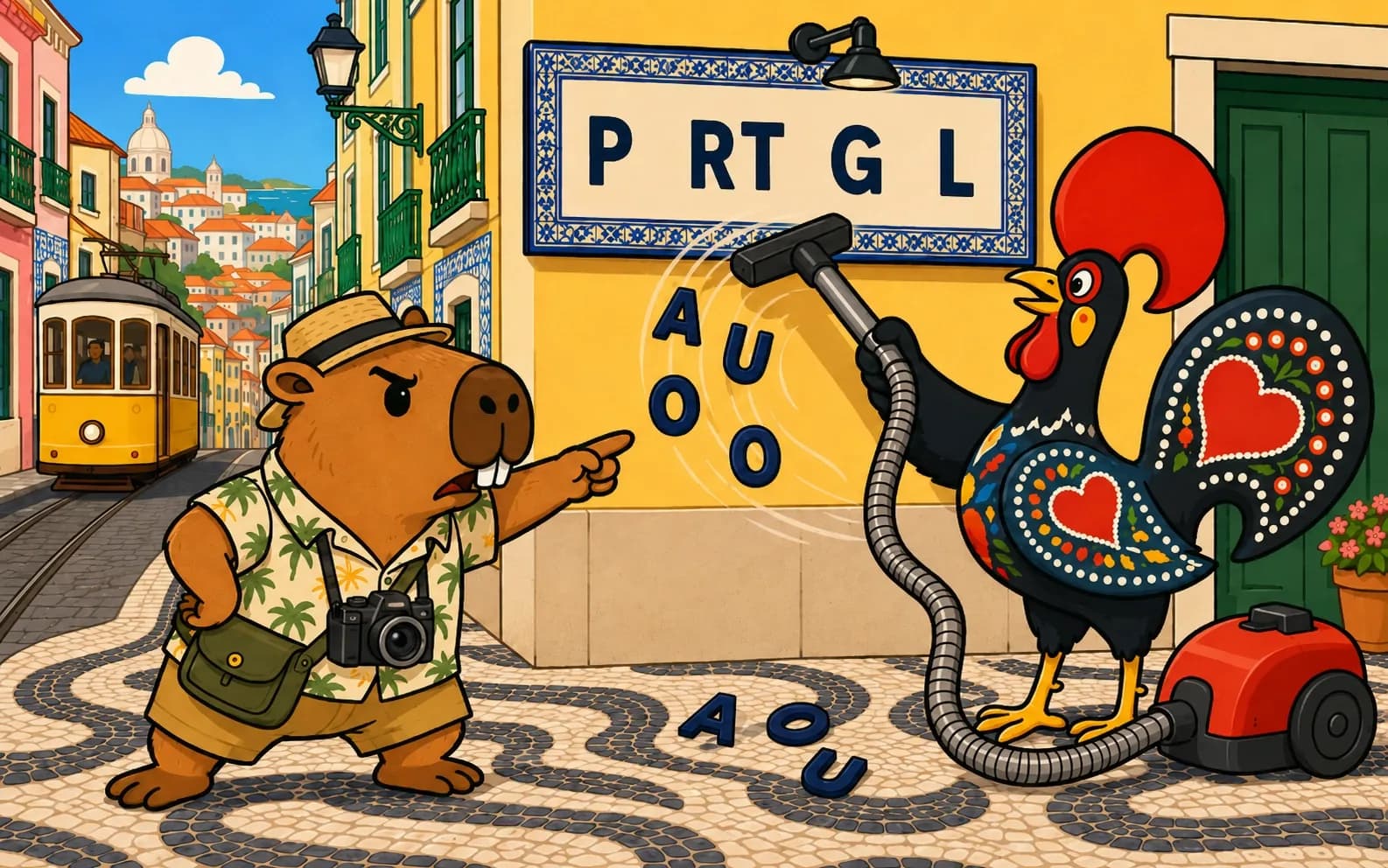
I Learned Portuguese in São Paulo. Then Lisbon Ate Me Alive.
Everyone will tell you Brazilian and European Portuguese are basically the same language. Technically, everyone's right. I believed it too — right up until a café in Lisbon, where I ordered a coffee and a pastel de nata in the Portuguese I'd spent two years building in São Paulo and felt quietly unstoppable.
The woman behind the counter answered. I understood maybe one word in five.
Same language. Officially, the exact same language. But the sounds coming out of her mouth had been through a paper shredder — vowels chopped, consonants stacked, all of it at the speed of someone with better things to do. I stood there nodding, the universal gringo move for "I have no idea what you just said."
Nobody warns you about this. The gap between European vs Brazilian Portuguese isn't really about whether you'll be understood — you will be. It's about whether you'll understand them, and whether the grammar you drilled belongs to the coast you're standing on.
European vs Brazilian Portuguese, in one breath: Same language, and speakers understand each other fine — think American vs British English, not Spanish vs Italian. The biggest gap is pronunciation: Brazilian is open and musical, European clips its vowels. Grammar and everyday vocabulary differ too, but the spelling is now mostly unified.
Some perspective before we start splitting hairs. There are roughly 260 million Portuguese speakers on the planet, and more than 200 million of them are Brazilian. Portugal has about 10 million. So the "Portuguese" most of the world actually hears — in music, on YouTube, in whatever your algorithm serves you — is Brazilian. The Academia Brasileira de Letras has refereed the Brazilian standard for over a century; Portugal keeps its own house through the Instituto Camões. Two standards, one language. Vamos lá.
Same Language or Not? (Short Answer: Yes)
Let me kill the scariest question first. Brazilian and European Portuguese are not separate languages. A Brazilian and a Portuguese person can hold a full conversation — no interpreter, no subtitles.
The honest comparison is US vs UK English: same language, but the accent, some grammar, and a pile of everyday words don't line up, and one side takes newcomers a while to tune into. Portuguese works the same way — with one lopsided detail I find genuinely interesting: the understanding doesn't run equally in both directions.
Portuguese people tend to understand Brazilians easily, because Brazilian novelas, music, and YouTube flood Portugal — they grow up with the accent in their ears. Brazilians get far less European Portuguese in daily life, so plenty of them find the Lisbon accent genuinely hard to follow. I've watched Brazilian friends turn on subtitles for a Portuguese film. Same language, subtitles. Let that sink in.
The Accent Is 90% of the Battle
If you internalize one difference, make it this one, because it's the one you'll feel every single day.
Brazilian Portuguese is open, sing-songy, vowel-forward — words land on full, round vowels, half the reason it gets called one of the better-sounding accents around. European Portuguese does the opposite: it eats unstressed vowels alive, pushing consonants together into that clipped, almost Eastern-European texture that ambushed me in the café.
A few concrete places they split:
| Word | Brazilian (São Paulo) | European (Lisbon) | What's going on |
|---|---|---|---|
| de (of) | "dji" | "de" | Brazil softens d and t before an i sound |
| sete (seven) | "SEH-chi" | "set" | A final -e becomes "ee" in Brazil, nearly vanishes in Portugal |
| Brasil | "bra-ZIW" | "bra-ZIL" | Brazilian l at the end of a syllable turns into a w |
| Rio | "HEE-oo" | "RREE-oo" | Brazilian strong r often sounds like an English h |
| as casas (the houses) | "as CA-zas" | "ash CA-zash" | A final s becomes "sh" in Lisbon (and, funnily, in Rio too) |
Look at that last row. The carioca accent in Rio turns its S's into "sh" sounds, which makes Rio — of all places — sound a shade closer to Lisbon than São Paulo does. Details like that are why "the Brazilian accent" is a bit of a myth; a paulistano and a carioca don't sound the same either, né?
That d-to-j, t-to-ch softening is the fastest tell. A Brazilian says dia ("day") like "JEE-ah" and tia ("aunt") like "CHEE-ah"; a Portuguese speaker keeps both hard — "DEE-ah," "TEE-ah." Say "JEE-ah" out loud right now — that little j is the single most Brazilian sound you own. Once your ear catches it, you can place an accent in about two seconds.
Try this in Falando: Reading about accents does nothing for your ear — you have to hear it. Real Talk drops you into a ~20-second clip of real Brazilians talking (not studio-clean textbook audio), then asks you one comprehension question about what you just heard. It's the closest thing to eavesdropping on a São Paulo café without leaving your couch.
Where the Grammar Quietly Diverges
Pronunciation is what you notice first. Grammar is what trips you later — usually mid-sentence, when the version you learned turns out to be the other one. Three differences do most of the damage.
"Doing" vs "to do." This is the big one. To say you're doing something right now, Brazil uses the gerund; Portugal uses a plus the infinitive.
- Estou fazendo o jantar. — I'm making dinner. (Brazil)
- Estou a fazer o jantar. — I'm making dinner. (Portugal)
If you learned "estou fazendo," you learned Brazilian, full stop.
Você runs Brazil; tu runs Portugal. Across most of Brazil you'll use você for "you," paired with third-person verb forms — which quietly makes your life easier, because you conjugate less. Portugal leans on tu, with its own dedicated endings you actually have to memorize (tu fazes, tu és, tu tens).
- Você tem um minuto? — Do you have a minute? (Brazil)
- Tu tens um minuto? — Do you have a minute? (Portugal)
Where the little pronoun goes. Brazilians shove object pronouns to the front, especially in speech. The Portuguese hook them onto the back with a hyphen.
- Me liga! — Call me! (Brazil)
- Liga-me! — Call me! (Portugal)
Your Portuguese teacher back home probably drilled "liga-me," the textbook-classical placement. Walk around São Paulo saying it and you'll sound adorably formal — like someone narrating their own period drama. The verbs themselves behave identically on both coasts; only the placement flips. For the deeper logic of how Brazilians actually build these sentences, our ser vs estar guide is a solid next rabbit hole.
The Vocabulary Landmines
This part is mostly fun — low-stakes and occasionally ridiculous. Loads of everyday objects have completely different names on each side of the Atlantic, enough that a Brazilian ordering breakfast in Lisbon can draw a blank.
A starter set worth knowing:
- Bus — ônibus in Brazil, autocarro in Portugal
- Train — trem in Brazil, comboio in Portugal
- Cell phone — celular in Brazil, telemóvel in Portugal
- Fridge — geladeira in Brazil, frigorífico in Portugal
- Breakfast — café da manhã in Brazil, pequeno-almoço in Portugal
- Ice cream — sorvete in Brazil, gelado in Portugal
- Juice — suco in Brazil, sumo in Portugal
And then there's the one every guidebook whispers about. In Portugal, bicha is an ordinary word for a queue — you stand in the bicha at the post office. In Brazil, it's a slur. So don't go looking for bichas to stand in while you're in São Paulo. That kind of gap is why I devote a whole post to Brazilian Portuguese false friends: "just learn Portuguese" is quietly dangerous advice, because which Portuguese matters. When you learn Portuguese online, the material should at least be honest about which coast it's teaching.
Weirdly, the one place these two are converging is on paper.
Wait — the Spelling Is Actually Merging?
Here's the surprising bit. While the accents drift further apart, the written language has been deliberately pulled closer together. In 1990 the Portuguese-speaking countries signed an orthographic agreement to standardize spelling: Portugal dropped a stack of silent consonants (acção became ação, óptimo became ótimo), and Brazil tidied up some accent marks.
So the plot twist is that Brazilian and European Portuguese now look more alike on the page than they sound out loud. Put a Portuguese newspaper next to a Brazilian one and you'll clock only a handful of differences. Then play the audio versions and you'd swear they were cousins, not twins.
So Which One Should You Actually Learn?
I'll give you my honest opinion instead of a diplomatic non-answer. That's really what the whole European vs Brazilian Portuguese question comes down to for most people.
Learn for your destination. Marrying into a Lisbon family, moving to Porto, chasing an EU passport? Learn European Portuguese, embrace tu, and make peace with those swallowed vowels. For nearly everyone else, I'd point you at Brazilian — and not only because I live here and I'm biased.
The practical case: Brazil holds the overwhelming majority of speakers, so you get more people to talk to and more to binge. The cultural case is stronger still. Bossa nova, sertanejo, funk, a whole galaxy of novelas, Cidade de Deus, Anitta, half the football commentary you already love — that's a lot of fuel for the long, boring middle stretch where motivation goes to die. A big slab of that fuel is slang, and the stuff you'll pick up in Brazilian WhatsApp texting is pure Brazil, not Lisbon. Beginners get a bonus too: those open vowels are easier to decode early on, so you understand what you hear sooner.
So which camp are you in? Whatever you decide, don't straddle both at once. Learn one coast well and you can adapt to the other in a few weeks — but pick a home base. Choosing Brazilian bakes in the accent, the você, and the gerund from day one, instead of making you un-learn them later.
Try this in Falando: The você + third-person pattern is the spine of spoken Brazilian Portuguese, so drill it until it's reflex. Open Verb Conjugation Practice, and when you fumble a form, Practice Mistakes hands you back the exact ones you missed instead of random verbs. Then let Reviews space them out so they actually stay put.
People Also Ask
Can Brazilians and Portuguese people understand each other?
Yes. It's one language, and speakers communicate without much trouble — closer to American vs British English than to two different languages. The one asymmetry: Portuguese people usually understand the Brazilian accent easily, thanks to Brazilian media, while Brazilians sometimes find the European accent harder to follow.
Is Brazilian Portuguese easier than European Portuguese?
For most beginners, yes — at least to hear. Brazilian keeps its vowels open and full, so it's easier to catch individual words early on. European Portuguese reduces unstressed vowels heavily, which sounds faster and more compressed to a fresh ear. On grammar, the two are roughly equal.
Should I learn Brazilian or European Portuguese?
Match it to your goal. Headed to Portugal or the EU? Learn European Portuguese. Everywhere else — travelling Brazil, Brazilian friends, the music and shows, the largest pool of speakers — Brazilian Portuguese is the more useful start. Whichever you pick, commit to one so the accent and grammar stay consistent. Already speak Spanish? Our guide to Brazilian Portuguese for Spanish speakers shows where your head start pays off.
Do European and Brazilian Portuguese use different spelling?
Less than they used to. The 1990 Orthographic Agreement standardized much of the spelling, so written Brazilian and European Portuguese are now largely aligned, with only minor differences left. The pronunciation gap, on the other hand, is as wide as ever.
The Bottom Line
Same language, different vibe. The whole thing on one napkin:
- Sound — Brazilian is open and musical; European clips its vowels. Biggest gap by far.
- Grammar — Brazil: você + gerund + front-loaded pronouns. Portugal: tu + "a fazer" + hyphen pronouns.
- Vocabulary — everyday words often differ (ônibus/autocarro, trem/comboio), and a few are outright landmines.
- Spelling — mostly unified since 1990.
None of this should scare you off. It should just make you deliberate. Pick the Portuguese that fits the life you're actually building, then get a little obsessive about that one.
Falando is a Portuguese learning app built specifically for Brazilian Portuguese — the accent, the você, the slang, all of it — so you're not accidentally memorizing a Lisbon textbook when you're planning a life in São Paulo. Warm up with a few rounds of Quick Practice, let Real Talk tune your ear to how Brazilians really sound, and go build something. Beleza? Vamos lá.