The first Brazilian birthday I sang at was in an office kitchen, around a supermarket cake with one candle in it. I knew the tune, because everybody knows the tune, so I hummed along and clapped when it finished. It had not finished. The room went straight into a second round, faster and louder, a chant of é pique, é pique that I had never heard, and ended with a shout I could only copy as "hah-cheen-BOON." Then someone asked who was getting the first slice, and everyone turned to look at the birthday girl.
Saying happy birthday in Portuguese takes one word. Getting through the party takes a little more, because a Brazilian birthday comes with an encore, a pecking order for the cake and a few rules nobody writes down.
How to say happy birthday in Portuguese
There are two standard ways, and Brazilians use both every day. Feliz aniversário is the literal "happy birthday." Parabéns means "congratulations," and on someone's birthday it is the word you will hear most.
| Portuguese | What it means | When to use it | Say it roughly |
|---|---|---|---|
| Feliz aniversário! | Happy birthday! | Cards, messages, anyone | feh-LEESS ah-nee-vehr-SAH-ree-oo |
| Parabéns! | Congratulations! | The everyday default, face to face | pah-rah-BAYNSS |
| Parabéns pelo seu dia! | Congratulations on your day! | A little warmer, common in messages | pah-rah-BAYNSS PEH-loo SEH-oo JEE-uh |
| Muitas felicidades! | Lots of happiness! | Added after parabéns | MWEEN-tuss feh-lee-see-DAH-jeess |
| Muitos anos de vida! | Many years of life! | Traditional, loved by older relatives | MWEEN-toos AH-noos jee VEE-duh |
| Tudo de bom! | All the best! | Friends and colleagues | TOO-doo jee BOHN |
| Feliz niver! | Happy b-day! | Close friends, texts | feh-LEESS NEE-vehr |
Two sounds deserve a moment. The accent in parabéns marks the stress on the last syllable, and the -éns is nasal: the air goes through your nose and the n is never fully pronounced. In aniversário, the stress falls on SAH, and the final -io is two quick vowels rather than one.
Parabéns does a lot of work outside birthdays. Brazilians say it to someone who passed an exam, got a job, had a baby or cooked a good dinner. That is why the birthday version often carries a reason: Parabéns pelo seu dia or Parabéns pelos 30 anos.
Talking about age and the big day
Turning an age uses fazer, not ter. Eu tenho 30 anos means "I am 30," but Eu faço 30 anos amanhã means "I turn 30 tomorrow." So the question before a birthday is Quantos anos você vai fazer? — "How old are you going to be?"
The birthday person has a name of their own: o aniversariante or a aniversariante. You will hear it in toasts, on cake toppers and in the question Cadê a aniversariante? — "Where's the birthday girl?"
To say when your birthday is, use the date pattern from our guide to days of the week and months: Meu aniversário é dia 3 de maio. In conversation, aniversário often shrinks to niver, and an invitation might read Bora no meu niver sábado? — "Coming to my birthday thing on Saturday?"
Birthday messages in Portuguese for WhatsApp
Most birthday wishes in Brazil now arrive by message, often in a group chat where twenty people write within the hour. These cover most situations:
- Parabéns! Muitas felicidades e muitos anos de vida! — the safe classic, for anyone.
- Feliz aniversário! Tudo de bom pra você. — friendly and short, good for a colleague.
- Parabéns, amiga! Que seu dia seja incrível. — "Happy birthday, my friend! I hope your day is amazing."
- Feliz niver! Bora comemorar? — "Happy b-day! Shall we celebrate?" For close friends.
- Parabéns atrasado! Espero que tenha sido um dia lindo. — "Happy belated birthday! I hope it was a lovely day."
- Que Deus te abençoe e te dê muitos anos de vida. — "May God bless you and give you many years of life." You may not write this one, but older relatives will send it to you.
- Obrigada pelo carinho, gente! — "Thanks for all the love, everyone!" This is what the birthday person posts in the group at the end of the day (obrigado if you are a man).
Notice the wishes that start with que: Que seu dia seja incrível, Que Deus te abençoe. A wish in Portuguese takes the present subjunctive, which is why you see seja rather than é. For the abbreviations that will fill the same chat, see our guide to Brazilian WhatsApp slang.
The Brazilian birthday song, and the part after it
The song uses the same melody as "Happy Birthday to You," with its own Portuguese words. Its title is Parabéns a você, and it came out of a radio contest. In 1942, the presenter Almirante asked listeners of Rádio Tupi in Rio de Janeiro to write Portuguese lyrics for the tune. According to ECAD, the body that collects music royalties in Brazil, about five thousand entries came in, and the winner was Bertha Celeste Homem de Mello, a pharmacist and poet from Pindamonhangaba in São Paulo state. The song congratulates the birthday person on their special day and wishes them happiness and a long life.
Here is the part that surprises Brazilians. The official title says a você, but almost everyone sings pra você, and the everyday name of the song is Parabéns pra você. In that same ECAD article, the author's granddaughter says she doesn't join in until the chant, because most people get two lines of her grandmother's lyrics wrong. The Portuguese words are still under copyright, and ECAD collects royalties on them.
Everyone claps on the beat from the first line to the last. Then comes the encore:
- É pique, é pique, é pique... (eh PEE-kee)
- É hora, é hora, é hora... (eh OH-ruh)
- Rá-tim-bum! (hah-cheen-BOON)
- The birthday person's name, shouted, usually more than once.
Rá-tim-bum is a small pronunciation lesson. A Brazilian r at the start of a word sounds like an English h, and a t before i turns into ch. Put both together and the shout I copied in that office kitchen makes sense. In some families and cities you will hear é big, é big instead of é pique. Pique is the older form.
Where does the chant come from? The story told most often credits law students at the Largo de São Francisco faculty in São Paulo around 1930. In one version, collected in a speech published by the legal news site Migalhas, "pique-pique" was a classmate's nickname, earned by a waxed moustache with sharp tips, and his friends shouted it at a bar on his birthday. Versions disagree on the bar and the year, and nobody has a convincing explanation for rá-tim-bum.
After the chant, many groups add a teasing verse that starts com quem será and asks who the birthday person is going to marry. Friends usually supply a name, ideally that of someone standing in the room. Then someone says Faz um pedido! — "Make a wish!" — and the candles go out. In Portuguese you soprar as velinhas, blow out the little candles. Brazilians put the diminutive on almost everything at a party, from velinhas to docinhos, and our post on diminutives and augmentatives explains why.
Who gets the first slice of cake?
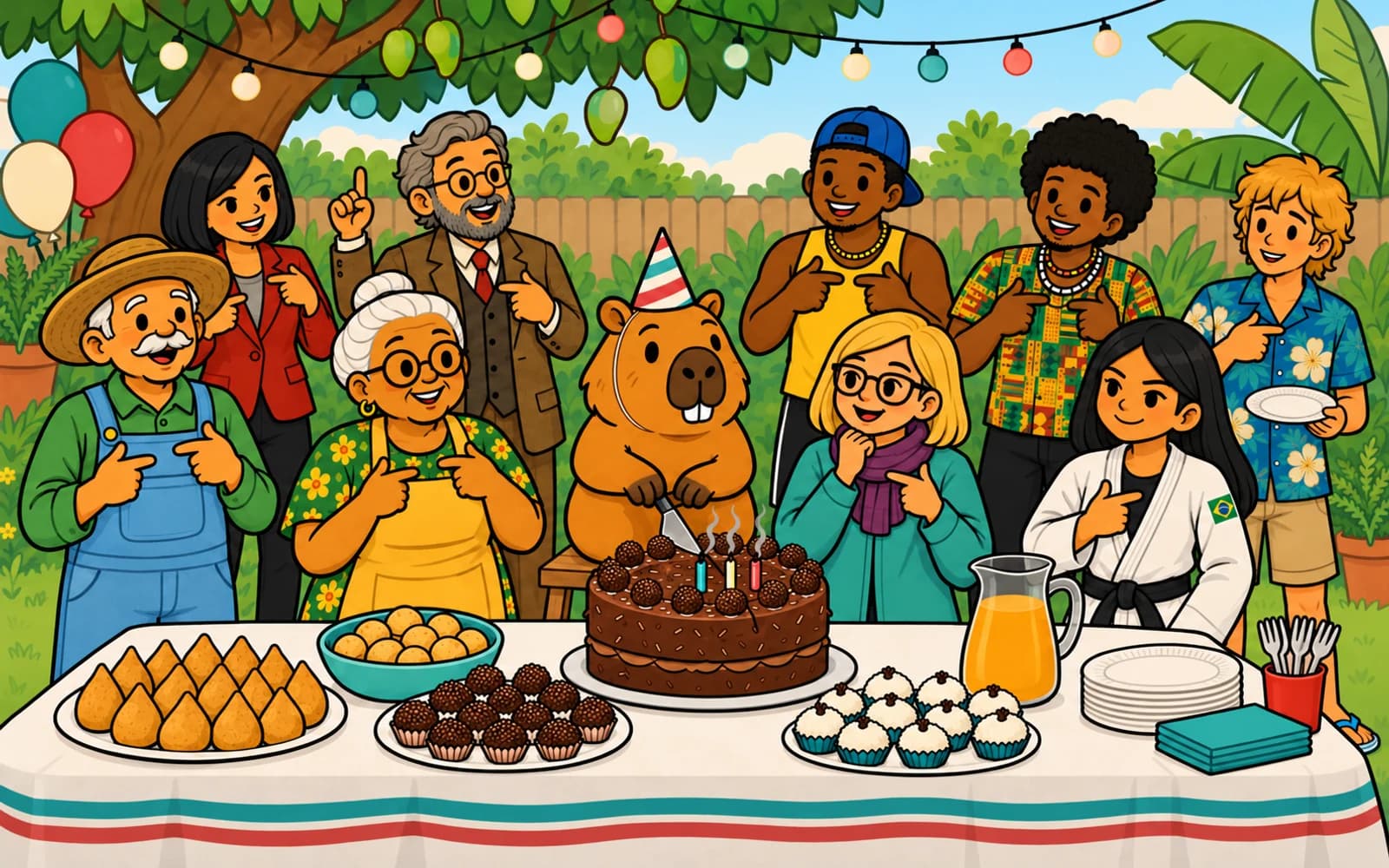
At a Brazilian party, the birthday person cuts the cake and hands the first slice, o primeiro pedaço, to someone special. That is usually a parent, a partner or a best friend. Guests shout Pra quem vai o primeiro pedaço? and watch closely. It is light-hearted, but people remember who got it.
The cake is only part of the spread. A proper party table has salgadinhos, small savoury snacks such as coxinha (a teardrop of shredded chicken in dough, fried) and bolinha de queijo (cheese balls), plus docinhos in tiny paper cups. The two essentials are the brigadeiro, made from condensed milk, cocoa and butter and rolled in chocolate sprinkles, and the beijinho, its coconut cousin, often finished with a single clove on top.
There is one rule every Brazilian child learns. The docinhos on the cake table are decoration until the song has been sung. Reach for a brigadeiro early and someone will tell you, Só depois do parabéns! — "Not until after the song!"
What happens at a Brazilian birthday party
Some practical notes for your first invitation:
The time on the invitation is approximate. Arriving exactly on time usually means helping to set up. The song often happens late, near the end, and leaving before it is a little rude. The question to ask as you go is Já cantaram parabéns? — "Have they sung happy birthday yet?" Notice that the song itself is called o parabéns: Vamos cantar parabéns!
Greet everyone, and say goodbye to everyone. Arriving means a round of hellos, often with a kiss on the cheek, and leaving takes even longer. Budget twenty minutes for the goodbye.
Adult birthdays often happen at a bar. The birthday person books a table and friends come and go. Each guest pays for their own share, and friends often split the birthday person's bill between them, so bring enough for a little more than your own drinks.
Children's parties are productions. Many are held in a buffet infantil, a party venue with staff, games and food, around a theme such as a cartoon, a football club or a superhero. The cake table is decorated to match, and the main photo is taken behind it. Guests often leave with a lembrancinha, a small party favour.
Some birthdays come monthly. Many Brazilian families celebrate a baby's mesversário, a small party for each month of life until the first birthday. Many offices have a version too: once a month, one cake for all the aniversariantes do mês, everyone with a birthday that month. That was my office kitchen.
Three Portuguese idioms come straight from the party table, and none of them is about parties. Dar bolo ("to give cake") means to stand someone up. A presente de grego, "a Greek gift," is a present that brings trouble, after the Trojan horse. Segurar vela, "to hold the candle," means to be the third wheel on someone else's date.
Try this in Falando: All three are in the Idioms Trainer, with example sentences. You can also read their explanations first: dar bolo, presente de grego and segurar vela.
Try this in Falando: In Bate-papo, choose Real-life situation and pick Guest at a churrasco. It is a barbecue rather than a birthday, but the guest's job is the same: say hello, accept what you are offered, chat with the host and leave with a proper Brazilian goodbye.
People also ask about happy birthday in Portuguese
What is the most common way to say happy birthday in Portuguese?
In Brazil, the most common way to say happy birthday is Parabéns!, often followed by Muitas felicidades! Feliz aniversário! is just as correct and appears more often in cards and messages.
What does "parabéns" mean?
Parabéns means "congratulations." Brazilians use it for birthdays, graduations, new jobs, engagements and any other good news, and it is always plural in form.
What do Brazilians sing after "Parabéns pra você"?
They chant É pique, é pique, then É hora, é hora, then Rá-tim-bum!, followed by the birthday person's name. Many groups add a teasing verse that asks who the birthday person is going to marry.
Is happy birthday the same in Portugal and Brazil?
The words parabéns and feliz aniversário are the same, and both countries sing a song called Parabéns a você to the same tune. The é pique chant is a Brazilian habit, though. In Portugal the song itself runs longer, with extra lines that include a call for uma salva de palmas, a round of applause. Our guide to European vs Brazilian Portuguese covers the wider differences.
Say parabéns, then keep clapping
If you remember one thing, make it Parabéns! It works for every birthday you will go to in Brazil, and for every promotion and exam result in between. Add muitas felicidades when you want to sound warmer, and feliz niver for friends. At the party itself, clap through the whole song, keep going for the chant, and keep your hands off the brigadeiros until it is over.
For practice before the real thing, write a birthday message in Falando's Journaling. Wish a friend a happy birthday with a Que seu dia seja... sentence, and the feedback will tell you whether the subjunctive is right. Then you will have one ready to paste when the birthday reminder pops up.
And if someone asks you who gets the first slice, pick quickly. Vamos lá!