The Result That Made No Sense to Me
A friend of my wife's — nine years in Salvador, argues with her mother-in-law at full speed, watches novelas without subtitles — sat the Celpe-Bras and came out with Intermediário. The lowest certificate there is.
I'd been in Brazil two years, still say um água at restaurants, and got Intermediário Superior.
That made no sense to me for about a month. Then it made total sense, and it changed how I'd tell anyone to prepare. She's a far better Portuguese speaker than I am. She just answered a different question than the one the exam asked.
I've already written up what sitting the thing feels like — the panic, the cryptocurrency reading task, the word for "skewer" arriving three seconds after I left the room. This is the other half. If somebody handed me those six months back, here's what I'd do with them.
It's a Task Exam Wearing a Language Exam's Coat
This took me far too long to work out.
The Celpe-Bras never asks you to conjugate anything. No grammar section, no multiple choice, not one gap-fill. What it hands you instead is a tarefa [tah-REH-fah] — a task — and every task comes with three things bolted on:
- Who you are in the situation (a resident, a student, a customer)
- Who you're writing or speaking to (a newspaper's readers, a city councillor, a friend)
- What you're trying to make happen (persuade, complain, invite, explain, thank)
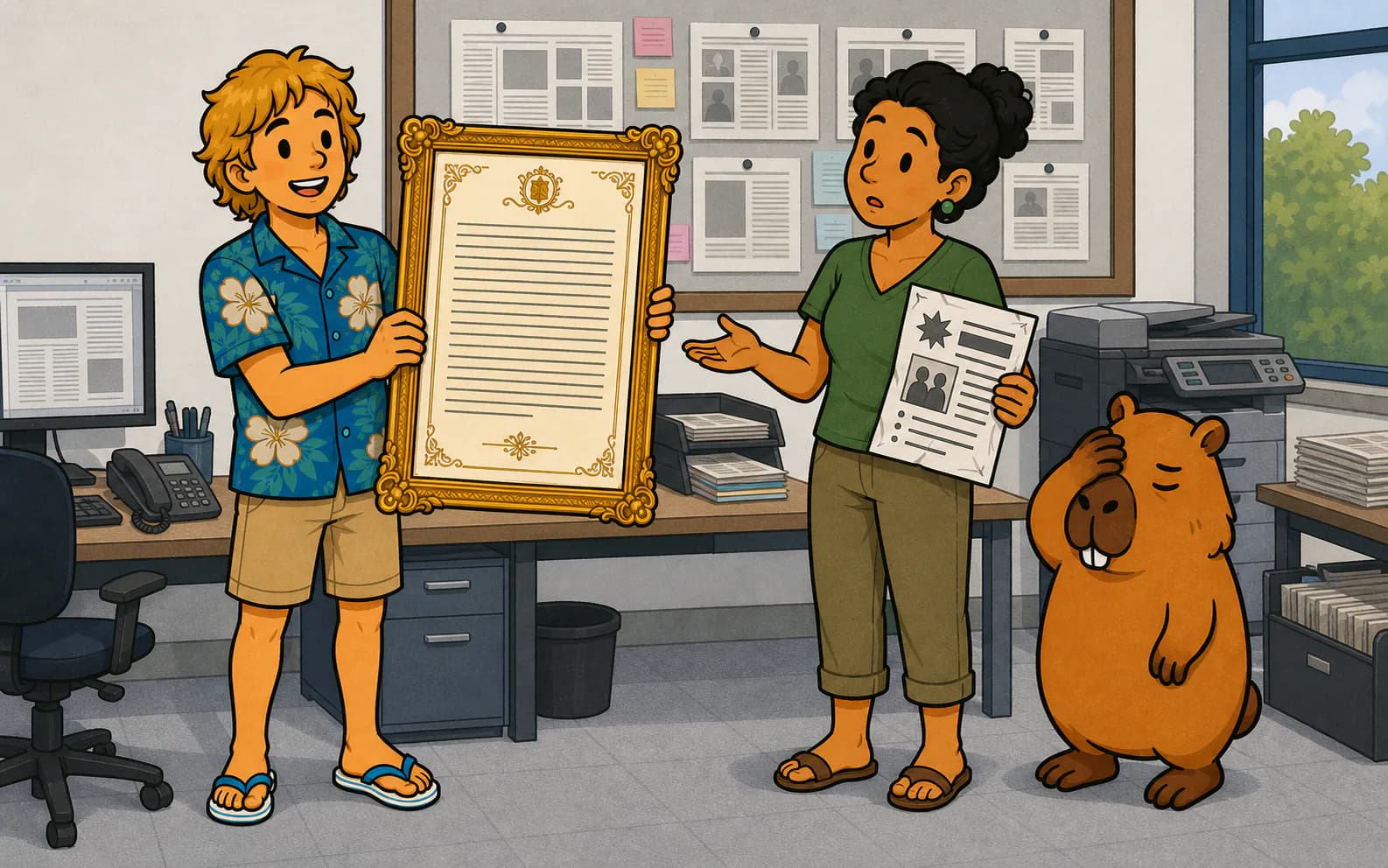
Miss any one of those and you lose marks no matter how elegant your Portuguese is. That's what happened to my wife's friend. Asked to write to a community newsletter, she produced a fluent, grammatically spotless essay. Wrong genre, wrong reader, no purpose. Beautiful, though.
Closest comparison I've got is a driving test. Nobody passes one by reciting the highway code — you pass by doing the manoeuvre, in traffic, in the time given, while someone watches. Celpe-Bras is that, for Portuguese.
Which is good news. Task performance is a trainable skill, and it trains much faster than fluency does.
The Table I Wish Someone Had Put in Front of Me
Four written tasks, three hours, and a line limit on each one. What's actually being scored:
| Task | What you get | What you produce | What it's really testing |
|---|---|---|---|
| Task 1 | A short video | A written text with a brief | Repackaging what you saw for a stated reader |
| Task 2 | An audio clip | A written text with a brief | Listening under pressure, then genre control |
| Task 3 | A reading text | A written text with a brief | Reading for purpose, not for translation |
| Task 4 | A second reading text | A written text with a brief | Same again, for a tighter, more formal reader |
The third column is identical every time; the fourth is where the marks live. Nobody grades your understanding of the video for its own sake. They grade whether you did something useful with it, for somebody specific.
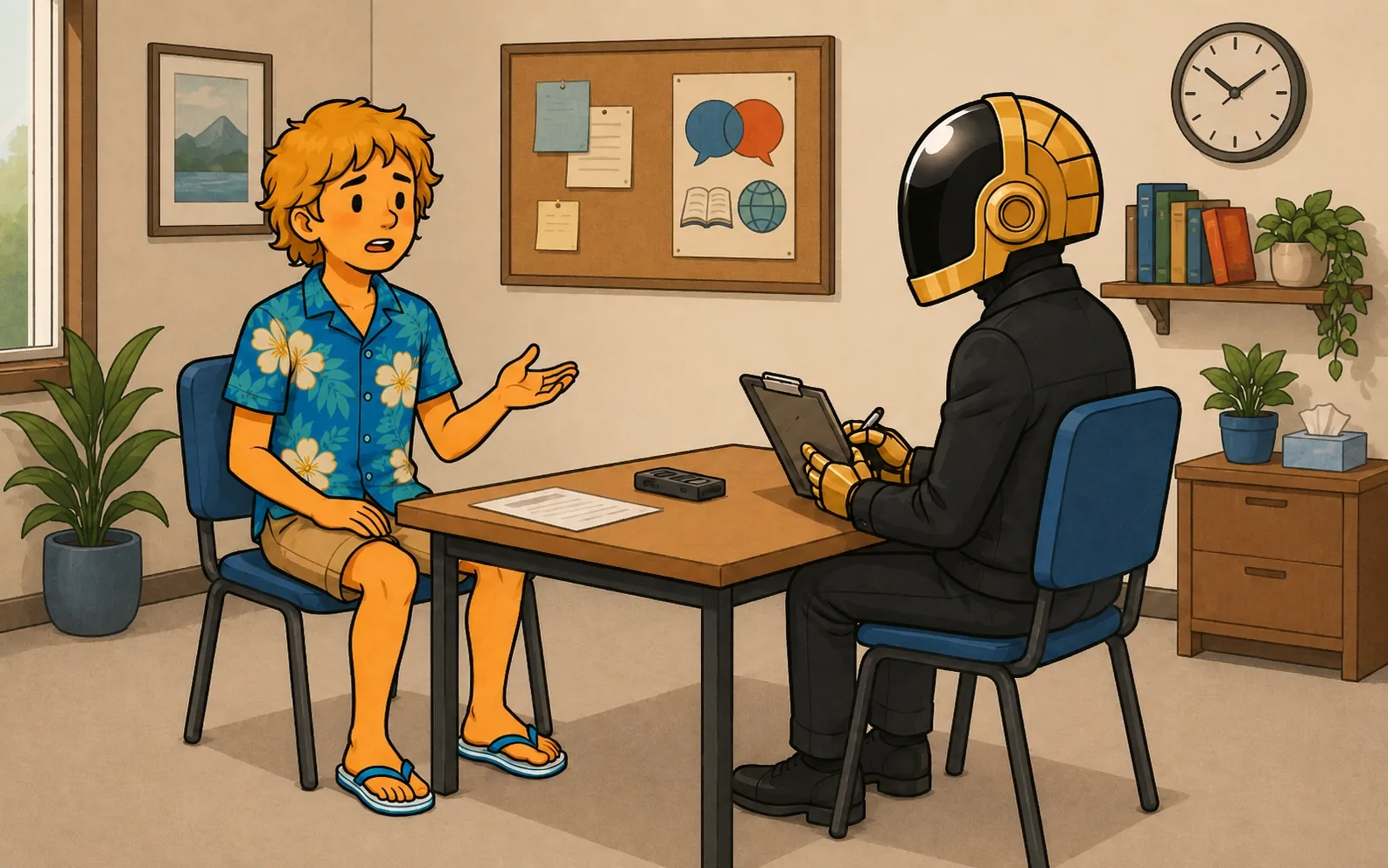
The oral runs on the same logic: about five minutes of conversation about you, then three elementos provocadores [eh-leh-MEN-too proh-voh-kah-DOR] — a cartoon, an ad, a poster — a minute to look at each, then roughly five minutes talking around it with the examiner.
Start at the End: Sit a Mock Before You Study
This is the single change I'd make, and the one people resist.
I spent three months "building a foundation" and didn't see a real exam paper until month four. Backwards. Reading a description of the format — including this one — does approximately nothing. You have to feel the three hours.
So sit a full mock in week one, while you're still bad at it. Get the humiliating number. Then study the gap.
We built Falando's Celpe-Bras mock exam for exactly this, because when I was preparing there was nothing between "read the format on a government website" and "fly to a testing centre and find out." It runs the real shape of the thing:
- Part 1 is the full three hours, four tasks in exam order, with a 30-line cap on what you write — the real paper limits your lines too, and that constraint changes everything about how you plan a text.
- Part 2 is the twenty-minute oral, out loud into your microphone: the personal interview, then three stimulus prompts with a minute of prep and five minutes of talking each.
- The session saves as you go, off stored timestamps, so if your laptop dies at minute 140 you don't lose the paper.
- You finish with an evaluation on the official 0–5 scale — the actual bands, Sem Certificação through Avançado Superior, not a percentage that means nothing.
- Every attempt lands in your history, so "take one early, take one later" becomes something you can actually look at. (Full feature walkthrough here.)
One caveat: full sessions need a paid plan; the free trial includes one complete mock, which is enough for a baseline. The whole thing runs on a phone if that is what you have, though three hours of writing goes a lot easier on a real keyboard — and you won't be sitting the real exam on an iPhone either.
Try this in Falando: Book three uninterrupted hours this week — a Saturday morning, phone in another room — and run Part 1 of the mock cold. Don't study for it. Don't look anything up. The number you get is your actual starting point, and everything below becomes easier to prioritise once you have it.
What I'd Do With the Weeks
Assume three months and a job. Roughly the rhythm I'd keep, and deliberately not a schedule you'll abandon on day four like my colour-coded one:
- Three full mocks: start, middle, ten days out. Not more — they're exhausting, and the recovery time is where the learning happens.
- One written task a week, timed, from the free INEP archive of past exams, which goes back to 1998. Highest-value hour in the plan.
- Fifteen minutes a day of Brazilian news you'd otherwise ignore. Not the sport. Housing, transport, education, the environment — the topics the exam keeps circling. You need enough vocabulary to have opinions, not just to follow along.
- Read the charges [SHAR-zhees] — not "charges", the Brazilian word for a newspaper's daily political cartoon, and a national art form in its own right. It's also the closest free thing to an elemento provocador you'll find. If you can explain one to a Brazilian friend and get a laugh, that part of the oral is handled.
- Ten minutes on Reviews most days, so the vocabulary from those articles is still there in March.
- Talk to one human, badly, about something you don't understand. I asked my barber about football, a sport I do not watch. Awkward. Also the best oral prep I did.
Six things, not fourteen. The plans that fail are the ones with fourteen.
Would you rather do one timed task properly on a Sunday, or four hours of vocabulary apps across the week? The exam has an opinion, and it isn't the one most of us want to hear.
The Oral Is Where Everyone Under-Prepares
Ask people what they're worried about and they'll say the three-hour paper. Then they walk into a twenty-minute conversation having practised it exactly zero times.
The intro is the easy half — the examiner has your candidate form and asks about your life, your work, why you're doing this. Genuinely rehearsable. Have four minutes of yourself ready.
The elementos provocadores are where it turns. A minute with a cartoon or an ad, then you have to do things with it: say what it shows, say what it's arguing, connect it to Brazil, connect it to where you're from, take a position. Describing the picture is where most people stop, and it's worth almost nothing.
That's what Falando's Free run mode is for: instead of committing three hours, you jump straight to one exam task and get feedback on that task alone, immediately. Free runs stay out of your exam history — they're for reps, not for the record. One oral stimulus task a week, treated like the gym.
Try this in Falando: Do a Free run oral task, then immediately do it again on the same prompt. The second attempt is always dramatically better, and noticing why — you organised it, you took a position, you stopped narrating the picture — teaches you more than the feedback does.
You'll also want your ears on real Brazilians rather than exam audio. I use Real Talk, and any Brazilian YouTube channel you already love can be dropped straight into Falando to quiz yourself on. That fast-talking carioca who ruined my Task 2 wasn't speaking exam Portuguese. Nobody does.
Three Mistakes I Made That Cost Me
I over-prepared formality. I memorised Prezado Senhor and Cordialmente, then got a task that wanted a message to a friend. The exam swings across registers on purpose — how Brazilians actually text is exam material, not slacking off.
I studied European Portuguese by accident for six months, from a colleague's textbooks. Celpe-Bras is emphatically Brazilian — gerunds everywhere, café da manhã not pequeno almoço. If you've absorbed some of both, read up on the split first.
I ignored the line limit until it was too late. A capped text is a planning problem, not a writing problem — you cannot discover your argument on the page. I now spend the first three minutes sketching the shape, which felt like wasted time right up until it stopped being wasted time.
One Thing Almost Nobody Tells You About the Levels
You don't pick a level. With most certificates you choose your exam — B1 or B2 — and sit the one you think you can pass. The Celpe-Bras has one exam. Everybody sits the same paper, and your performance decides which of four certificates you get: Intermediário, Intermediário Superior, Avançado, Avançado Superior — or Sem Certificação, no certificate at all.
Two consequences. There's no such thing as sitting the wrong level, so the whole "am I ready" calculation works differently here than in any other exam you've taken. But the floor is real: the lowest certificate sits around solid intermediate, so if you're not there yet, the work is getting from A2 to B1 first, not exam technique.
It runs twice a year and registration closes faster than you'd expect — I missed an April sitting purely by procrastinating. Dates and official rules live on INEP's Celpe-Bras page, the only source I'd trust on deadlines.
People Also Ask
How long does it take to prepare for the Celpe-Bras? Comfortably intermediate already? Three to four focused months, most of it on task format and timing rather than new Portuguese. Below that, you're preparing for the language first and the exam second.
Can I prepare for the Celpe-Bras on my own? The written part, fairly well — past papers, a timer, something that scores you. The oral doesn't work alone, because you can't hear how you sound while producing it. Find a speaking partner, or use a mock that records and evaluates the oral; that's why ours runs through the microphone.
Is the Celpe-Bras harder than DELE or DELF? Different more than harder. There's no grammar to revise, which sounds easier and isn't — you can't cram it, and strong speakers with weak task awareness get results that shock them.
Do I need to live in Brazil to pass? No, but you need Brazilian input daily. São Paulo helped me mostly because Portuguese was unavoidable; you can manufacture that anywhere with Brazilian YouTube and Netflix, a news habit, and someone to talk to.
Vamos Lá
The Celpe-Bras isn't testing how good your Portuguese is. It's testing whether you can use it to do a specific job for a specific reader under a clock — a skill you can train separately, and much faster, than fluency.
So: sit a mock early and take the bad number. One timed past paper a week. Read the news and the cartoons. Practise the oral out loud, not in your head. Sit a second mock and watch the number move.
The full Celpe-Bras mock exam is on Falando now — both parts, real timing, scored on the 0–5 bands, with Free run for single tasks when three hours isn't happening. The 7-day trial includes one complete mock, and honestly, that baseline is the useful part.
Book the three hours. This week, while it's early enough for the result to be useful rather than terrifying.
Boa sorte — and I mean it slightly less ominously than last time.