6 Apps to Practice Speaking Brazilian Portuguese (When There's No Brazilian in the Room)
A friend in Belo Horizonte once sent me a four-minute WhatsApp áudio about a parking space. Four minutes. About parking. I listened six times, caught maybe the middle forty seconds, and replied with a thumbs-up emoji like an absolute coward.
That was the week it clicked: in Brazil, almost everything happens out loud. WhatsApp sits on 99% of the country's smartphones according to the Panorama Mobile Time/Opinion Box messaging survey, and Brazilians use it the way other countries use their voice — long rambling audios, no punctuation, no mercy.
So if your plan is to read your way to fluency, I have bad news. Below are six apps to practice speaking Brazilian Portuguese, what each is good for, and where each falls apart.
Full disclosure: this is the Falando blog, and Falando is number one. Astonishing. Nobody saw it coming. It's last in the countdown so you can read the other five first — two of which compete with us directly, and which I've left in because pretending they don't exist would be insulting.
The Short Version
| App | What it actually does | Best for | Price |
|---|---|---|---|
| Falando | Spoken AI chat that looks like a WhatsApp thread | Daily reps, zero scheduling | A1 free; premium via trial |
| Speechling | A human coach records feedback on your recordings | What you can't hear yourself | Free tier; ~$20/mo unlimited |
| Langua | Long AI conversations, unusually human voices | Intermediates who want to ramble | ~$20/mo |
| Talkio AI | Voice chat + word-by-word pronunciation report | BR-PT treated as its own dialect | From ~$10/mo annually |
| Glossika | Sentence repetition drills, shadowing-style | Making structures automatic | ~$20/mo |
| HiNative | Natives judge your short recordings | "Does anyone really say this?" | Free; paid tier optional |
How to Practice Speaking Brazilian Portuguese Without a Brazilian Nearby
The rules first. I ignored these for about a year, so consider this a refund on my stupidity:
- Out loud means out loud. Mouthing it silently trains nothing. Your tongue is a muscle with no imagination.
- Ten minutes daily beats ninety on Sunday. Speaking is a reflex, and reflexes come from frequency.
- Practice situations you'll actually be in. Nobody's first conversation in Brazil is about the environment. It's about bread, rides, and Wi-Fi passwords.
- Record yourself weekly. Horrible, effective, and you'll hear an accent you didn't know you had.
- Learn to stall in Portuguese. Deixa eu ver..., então..., tipo assim... buys thinking time inside the language.
- Let small mistakes stand. Self-correcting mid-sentence kills momentum, and Brazilians understand you anyway.
- Have one source of correction. Talking only to yourself makes your mistakes fluent.
When was the last time you said a full sentence in Portuguese out loud? Not read one — said one, at normal volume, to something with ears?
The 6 Best Apps for Brazilian Portuguese Speaking Practice
6. HiNative — the reality check
Best for: Settling arguments with yourself about whether a phrase sounds normal
HiNative isn't really a speaking app. It's a room full of native speakers who'll tell you the truth for free. Record a few seconds, post it, ask: does this sound natural?
The value is the specificity. You can't ask a textbook whether "tá tranquilo" works with your landlord. You can ask a Brazilian, and someone in Recife will answer within the hour — usually with "yes, but we'd say it like this," which is the good part.
Answers vary and threads move slowly, though. Nobody got conversational from HiNative alone.
5. Glossika — the gym, not the game
Best for: Drilling sentence patterns until they arrive without thinking
Glossika plays a Brazilian Portuguese sentence, you repeat it, it returns on a spaced schedule. That's it. Closer to shadowing than to a lesson, and deeply, aggressively boring.
It's also what fixed my word order: after a few hundred reps, "eu tinha esquecido" stopped being a thing I assembled and became a sound I made. Around $20/month, which is a lot for what is essentially a treadmill — and repeating sentences isn't conversation. It's the drills before the match.
4. Talkio AI — the pronunciation nitpicker
Best for: Learners who want Brazilian Portuguese treated as its own dialect, not "Portuguese"
Talkio runs in the browser and lets you pick Brazilian Portuguese specifically instead of lumping it in with the European version. You talk, it talks back, and afterwards you get a word-by-word breakdown of the sounds you mangled — most apps tell you what to say, this one tells you which syllable you're fumbling.
From around $10/month annually. The conversations themselves are competent but characterless: a good coach, a dull dinner guest.
3. Langua — the one that lets you ramble
Best for: Intermediate learners who want long, unhurried conversation
Langua has the most convincingly human voices of any AI tutor I've used. Pick the Brazilian dialect and after ten minutes you stop noticing it's software. It corrects as you go and reports back at the end.
Around $20/month. If you're a comfortable B1 who wants volume — someone to talk at, endlessly, without apologizing for taking their evening — it's excellent. Beginners drown: there's no curriculum underneath, so it assumes you know what you need to practice.
2. Speechling — a real human, listening
Best for: The pronunciation problems you physically cannot hear yourself making
Here's what AI still can't quite do: notice you've been saying muito wrong for eight months and gently tell you so.
Speechling is a nonprofit. You record yourself reading sentences and a human coach sends back audio feedback, usually within a day. The free tier includes a small monthly allowance of coached recordings — genuinely free, not free-until-the-paywall — with unlimited coaching around $20/month.
It's asynchronous, so it isn't conversation practice. It's calibration. Pair it with something that forces you to improvise and you've covered both halves.
1. Falando — bate-papo
Best for: Actually opening your mouth every day, in situations you'll really face
Falando's Bate-papo mode drops you into a chat window that looks almost exactly like WhatsApp — round avatar, their grey bubbles on the left, yours on the right — except you don't type. You speak into the mic, your Portuguese appears as your bubble, and your partner answers out loud in their own voice. For a country that communicates in voice notes, that isn't a gimmick. It's rehearsal for the exact interface you'll be using.
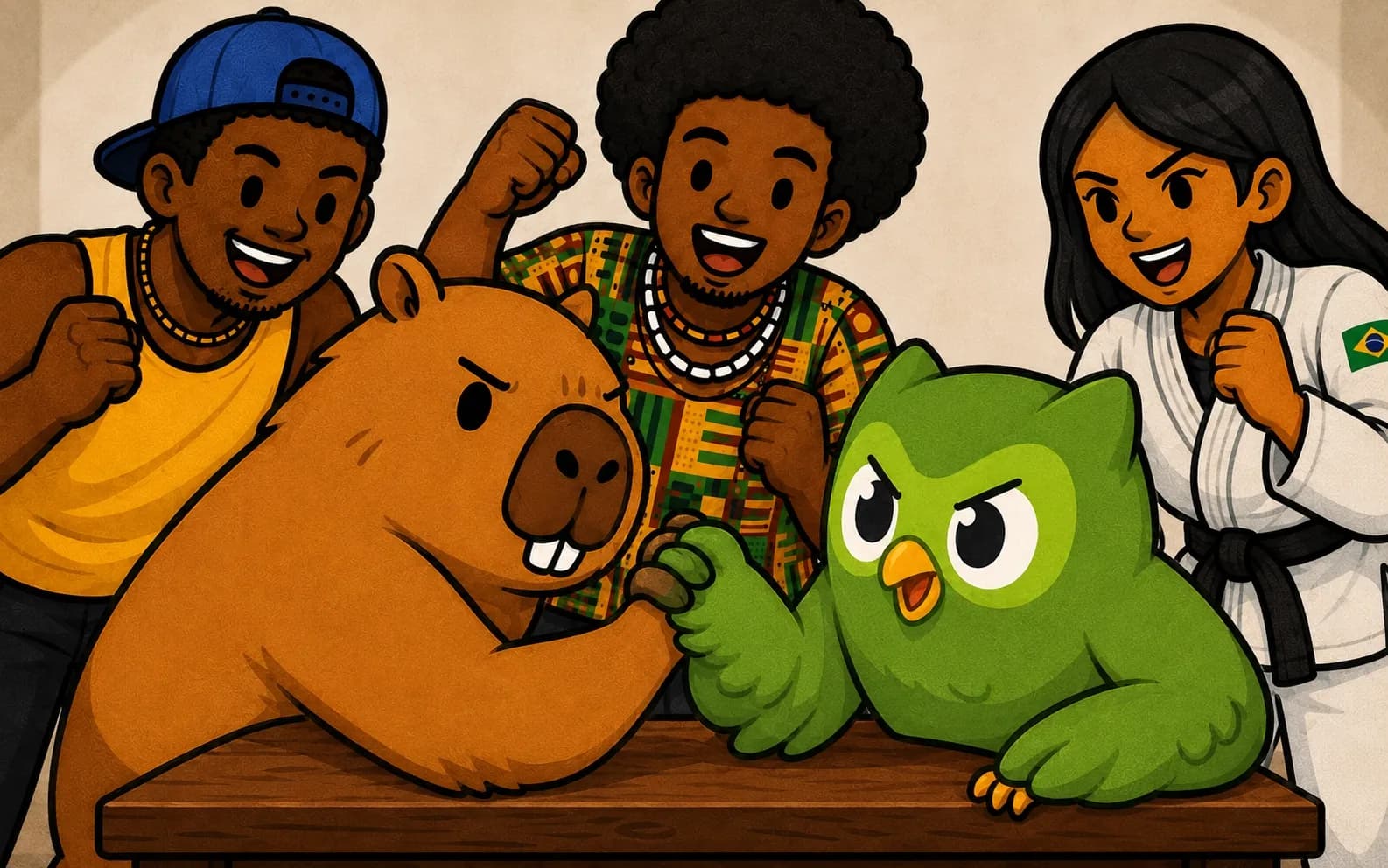
The part I didn't expect to love: there are nine characters, and they're from different corners of Brazil. Lucas is a Flamengo-obsessed student from Rio who'll hit you with caraca and maneiro. Seu Zé farms in the interior of Minas, says uai and trem bão, and talks at the speed of a man with all afternoon. Rafa is a percussionist from Salvador; Jade trains jiu-jítsu in Manaus; Dona Beatriz is a paulistana grandmother who will ask about your family. Brazil is enormous, and a mineiro does not sound like a carioca — meeting several voices early saves you a very specific panic later.
Two things stop you freezing mid-sentence:
- Translate. Didn't catch their message? Tap Translate under the bubble and the English unfolds right beneath it — no leaving the chat, no copy-pasting into a translator like a fugitive.
- The hint bulb. Stuck on what to say? Tap it for a suggestion for your own next line, in Portuguese, at your level. That's the difference between a two-minute conversation and a twelve-minute one.
You also choose what you're practicing. Free conversation pulls from a bank of 113 everyday topics with a random character. Or switch to real-life situations: 25 role-plays of things you'll genuinely do in Brazil. Registering at the Polícia Federal. Sending a PIX to the stranger buying your bike. Explaining to a mechanic what noise the car makes. Arriving at a churrasco and being handed a drink. Those have a proper ending, and you get feedback on what you actually said.
Try this right now: open Bate-papo, choose Real-life situation, pick At the bakery, and order a pão de queijo and a cafezinho out loud. Ninety seconds, and it's the single most likely conversation of your first morning in Brazil.
Bate-papo is premium, included in the free trial. All of A1 is free forever if you're starting from zero.
What I left off: italki and Preply for tutors, Tandem and HelloTalk for exchange. All good — and not one of them is a Portuguese learning app you can open at 11pm on a Tuesday without arranging your life around another human. That's the gap this list is about. For the wider field, we ranked the best apps to learn Brazilian Portuguese separately.
My Actual Speaking Week (Not the Idealized One)
Because "use all six" is useless advice, here's what I really do:
Weekday mornings, ten minutes: one bate-papo before I've properly woken up. Real-life situation if something's coming up that week — the mechanic, the bank — otherwise free conversation with whoever the app throws at me.
Wednesday-ish: record a set of Speechling sentences and wait for the coach to tell me my rr is still wrong. It usually is.
Whenever something nags at me: a ten-second clip to HiNative. Half the time the answer is "yeah, but nobody says it that way anymore."
Sunday: the actual test — a real conversation with a real Brazilian, even if it's ninety seconds with the guy at the café.
Two apps carry the routine. The rest are situational, and honestly, some weeks I skip them entirely.
Three Mistakes That Keep You Silent
The first is waiting until you're ready. There is no ready — only a version of you who has said 500 clumsy sentences and a version who hasn't, and one of them can order lunch.
The second is practicing one register. If every rehearsal is polite and transactional, you'll be fine at the pharmacy and useless at a barbecue.
The third is mistaking comprehension for progress. Understanding a podcast feels productive. It isn't speaking, and the two skills grow at embarrassingly different rates. Ask me how I know.
Try this right now: in Bate-papo, let one message go by without tapping Translate. Guess from context, answer anyway, check afterwards. Tolerating not-quite-understanding is the actual skill — real Brazilians don't come with subtitles.
People Also Ask
What's the best app to practice speaking Brazilian Portuguese?
For daily reps, an AI partner wins on availability — Falando's bate-papo, Langua, or Talkio. For accuracy, Speechling's human coaches still beat anything automated. Most people who get fluent run one of each.
Which speaking app is best for beginners?
At A1 or A2 you want something that won't strand you mid-sentence — translation on tap, a hint when you blank, or a fixed scenario with a predictable shape. Open-ended AI conversation is a better fit once you're around B1 and can carry your own half. Speechling works from day one, because reading sentences aloud doesn't require you to invent anything.
How can I practice speaking Portuguese for free?
More easily than you'd think. HiNative costs nothing to ask, Speechling's free tier includes real coach feedback, Falando's A1 content is free permanently, and the Brazilpod archive from UT Austin is a free university-made library of unscripted Brazilian conversation you can shadow line by line. Add a weekly exchange and that's a full routine for R$0.
Can an AI conversation app replace a real tutor?
No, and be suspicious of anyone selling you that. What it replaces is the waiting — scheduling, hourly rates, the mild social terror of being bad in front of a person. Most people who learn Portuguese online now run both: AI for volume, a human for calibration.
How long until I can hold a conversation in Brazilian Portuguese?
With ten focused minutes of speaking a day, most beginners manage a short, clumsy, real conversation around the three-month mark. "Comfortable" is closer to a year. The variable isn't talent, it's how early you start talking.
Vamos Lá — Pick One and Open It Tomorrow
The gap between reading Portuguese and speaking it doesn't close by reading more. It closes by producing sentences, badly, daily, until they stop being bad.
Daily conversation practice, weekly feedback from a human, one real Brazilian in your life — even if it's just the guy at the café. There's an entire museum dedicated to the Portuguese language in São Paulo, and not one exhibit will teach you to say "me vê um pão na chapa" without your voice cracking. Only reps do that.
Start with the real-life situations in Bate-papo — pick the padaria, the Uber, or the feira, speak into the mic, and hit the hint bulb whenever you stall. Ninety seconds, and you'll have said more Portuguese out loud today than most learners manage in a week.
After that: Brazilian small talk and ordering food in Brazilian Portuguese — the two conversations you'll have most.
Boa sorte. And answer the áudio next time — a thumbs-up fools nobody.