For a while, my Portuguese notebook looked like the inventory of a badly managed zoo. A cow in a swamp. A duck with an unpaid bill. A jaguar somebody had apparently decided to annoy. I could remember the animals perfectly. What I couldn't remember was whether the person talking was embarrassed, furious, or about to lose their deposit.
That's the catch with animal idioms in Brazilian Portuguese: the pictures stick before the meanings do. And the meanings include an attitude. You can describe the same awful meeting with a frog or a duck, but you'll be making two different complaints.
Here are ten worth learning as whole expressions, with the situations that make them useful. No wildlife expertise required. A little judgment about who you're talking to helps.
Ten Brazilian Portuguese animal idioms at a glance
| Expression | Literal picture | What you're saying |
|---|---|---|
| Cutucar a onça com vara curta | Poke a jaguar with a short stick | You're provoking trouble |
| Amigo da onça | The jaguar's friend | A supposed friend lets you down |
| Engolir sapo | Swallow a toad | Put up with something unpleasant |
| Pagar o pato | Pay for the duck | Take the blame for someone else |
| Pagar mico | Pay a little monkey | Embarrass yourself |
| A vaca foi para o brejo | The cow went into the swamp | The plan has fallen apart |
| Dar zebra | Produce a zebra | Get an unexpected result |
| Tirar o cavalinho da chuva | Get the little horse out of the rain | Give up that idea |
| Comprar gato por lebre | Buy a cat as a hare | Get something worse than promised |
| Matar um leão por dia | Kill a lion a day | Face a tough daily struggle |
First, the jaguars: trouble and terrible friends
1. Cutucar a onça com vara curta
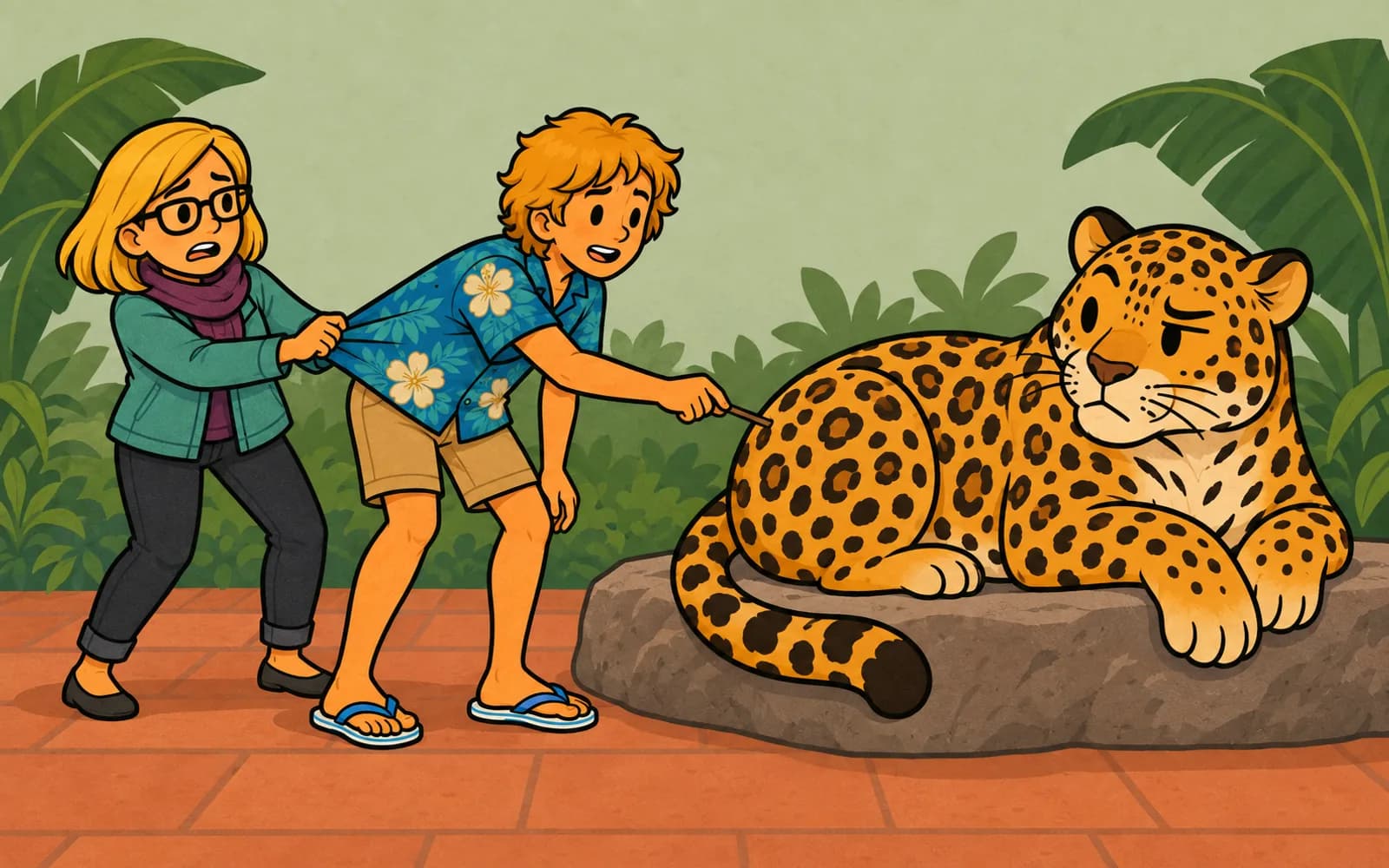
English has “poke the bear.” Portuguese gives you a jaguar and specifies that your stick is too short. The danger is uncomfortably close to your hand.
This means provoking someone or inviting a reaction you might regret. Michaelis includes the expression under cutucar.
“Reclamar do almoço na frente de quem cozinhou é cutucar a onça com vara curta.” — “Complaining about lunch in front of the person who cooked it is asking for trouble.”
Think of a family Sunday lunch: you can dislike the beans without announcing a full investigation. The expression works as a warning, often humorous. It doesn't mean that any disagreement is dangerous.
Pronunciation: onça is roughly OHN-sah, with a nasal first vowel; the ç sounds like s. The jaguar in the picture is onça-pintada, a spotted jaguar.
2. Amigo da onça
An amigo da onça is someone whose friendship turns out to be distinctly unhelpful. Imagine a friend volunteers you to sing first at karaoke after you've explained that you only know the chorus. Whose side are they on?
“Você contou o final do filme? Que amigo da onça!” — “You told me the ending? Some friend you are!”
It can be affectionate teasing or a real accusation. Don't assume the smile is included in the words.
There is a genuine piece of Brazilian cultural history here: Péricles's cartoon O Amigo da Onça debuted in O Cruzeiro in 1943, as documented by Fundação Joaquim Nabuco. That establishes the cartoon's history, not the first-ever use of the expression. I'm happy to leave the original jaguar out of it.
The frog, the duck, and the monkey aren't interchangeable
3. Engolir sapo
Literally, “swallow a toad.” It means putting up with something unpleasant, often an insult or unfair treatment, because reacting would cost you. The Aulete definition makes that element of necessity or convenience explicit.
“Ouvi a crítica injusta e engoli sapo para não discutir.” — “I heard the unfair criticism and swallowed it to avoid an argument.”
You might keep your face composed while writing an extremely rude reply in your head. That's the emotional territory. It doesn't mean agreeing with the criticism, and it isn't advice that you should always tolerate it.
Don't replace sapo with rã just because both animals can become “frog” in an English translation. The expression has its own wording.
4. Pagar o pato
Here the problem is who takes the consequences. Somebody else causes the mess; you get the bill, the blame, or the punishment. Michaelis records that meaning under pato.
“Eles fizeram a bagunça, mas eu paguei o pato.” — “They made the mess, but I took the blame.”
Picture a shared kitchen. You didn't cook, you didn't eat, and somehow you're the one apologizing for the burnt pan. The duck is useful even when no money changes hands.
A person could pagar o pato and then engolir sapo: get blamed unfairly, then bite their tongue. Two animals, two separate parts of a miserable afternoon.
5. Pagar mico
Same verb, different complaint: pagar mico means embarrassing yourself.
“Acenei para uma pessoa que não estava falando comigo. Paguei mico.” — “I waved at someone who wasn't talking to me. I made a fool of myself.”
Notice the wording: pagar o pato, but pagar mico in the version we're learning. Memorizing the whole phrase saves you from rebuilding it from animal flashcards.
I find this one kinder when aimed at myself. Telling another person they've embarrassed themselves can sound like you're enjoying it. If you're trying to console somebody, ordinary reassurance usually does a better job than demonstrating your idiom collection.
Try it in Falando: the Idioms Trainer includes meaning explanations and sentence-creation exercises. When you get a prompt, decide what happened before choosing a clever-sounding expression.
When the plan goes wrong, more animals arrive
6. A vaca foi para o brejo
The cow has gone into the swamp: the situation has deteriorated or the plan has failed.
“Perdemos o último ônibus. Agora a vaca foi para o brejo.” — “We missed the last bus. Now we're in trouble.”
There's a little resignation in the picture. You had a plan, and now you're looking at what's left of it. It can be exaggerated for comic effect; missing a bus isn't automatically the end of your life.
In conversation, para o often comes out as pro, which explains the version a vaca foi pro brejo you'll hear. Both point to the same swamp. Brejo is roughly BREH-zhoh; its j resembles the middle sound in English “measure.”
7. Dar zebra
A football favorite loses to a team nobody gave a chance. Deu zebra! — “What an upset!” That's an especially useful setting for this expression.
The Michaelis entry also allows an unexpected or bad result more broadly. Context decides.
“O favorito perdeu em casa. Deu zebra.” — “The favorite lost at home. It was an upset.”
The cow and the zebra differ: the cow emphasizes that things have gone badly; the zebra emphasizes the surprise. If you support the underdog, the zebra might be the best part of your weekend. Don't translate it automatically as “disaster.”
8. Tirar o cavalinho da chuva
This is a firm way of telling someone to abandon a hope or proposal. Michaelis lists both cavalo and cavalinho versions.
“Quer que eu trabalhe no domingo? Pode tirar o cavalinho da chuva.” — “You want me to work on Sunday? You can forget it.”
The little horse sounds adorable. The refusal can be quite sharp. With a friend, it might be playful; with somebody asking a reasonable question, it could sound dismissive. For gentler options, see our guide to saying no in Brazilian Portuguese.
9. Comprar gato por lebre
You buy what is presented as a hare and get a cat. In practice: you've been sold something worse than advertised. The distinction between comprar and vender gato por lebre tells you whether you're the deceived buyer or the deceptive seller.
“O anúncio dizia couro, mas a bolsa era de plástico. Comprei gato por lebre.” — “The ad said leather, but the bag was plastic. I didn't get what I was promised.”
An expensive purchase isn't enough by itself. The mismatch between the promise and the thing you receive is what makes this expression fit.
10. Matar um leão por dia
This describes the effort of getting through repeated difficulties: work, bills, an endless succession of problems. It has a weary, sometimes proud quality.
“Para manter a loja aberta, ela mata um leão por dia.” — “Keeping the shop open is a daily struggle for her.”
The por dia matters. The point is having to do it again tomorrow. You can understand the image without treating it as a useful philosophy of work; personally, I'd prefer a week with fewer lions.
How to learn animal idioms without sounding rehearsed
Which of these describes your last frustrating day? Start there. An expression attached to a situation you recognize has somewhere to live in your memory.
My six rules for practicing Brazilian Portuguese animal idioms:
- Save the complete phrase, including little words such as o and por.
- Write one ordinary situation where you'd use it.
- Learn the literal picture and the intended meaning separately.
- Notice whether the speaker is joking, complaining, or refusing.
- Say your own example aloud before trying it on somebody else.
- Use one when it fits; leave the other nine for another day.
Try it in Falando: browse the public idiom collection and compare an expression's meaning with its example. Then cover the explanation and say what the speaker is doing: blaming, teasing, refusing, or simply reporting bad news.
Questions about Brazilian animal expressions
Why do Brazilian Portuguese idioms use so many animals?
Animals provide memorable pictures for human behavior. English does this too with bears and scapegoats. That doesn't give all ten Portuguese expressions one shared origin; learn their documented meanings before trusting tidy stories about how they began.
Are pagar o pato and pagar mico the same?
No. The duck is about bearing consequences for someone else's actions. The monkey is about embarrassment. You could experience both at once, but neither automatically implies the other.
Can I use these expressions in a work email?
Consider the relationship and purpose. They can fit a casual exchange with a colleague; a formal complaint is usually clearer with a direct description. Amigo da onça and tirar o cavalinho da chuva especially need care when aimed at someone.
Should beginners memorize all ten?
Recognize them first. Choose two or three you can imagine using and practice those. Understanding a joke is already progress; you don't owe every conversation a new animal.
I used to think getting an idiom right meant remembering its translation. Now I pay more attention to the moment just before it: who did what, who's annoyed, and whether anybody is laughing. That's usually where the meaning becomes clear.
Pick the duck and the monkey first if you keep mixing them up. Say an example of each, then give them a rest. Falando's Idioms Trainer can give you more practice explaining meanings and building sentences when you're ready. Over time, the animals become less distracting and the conversation becomes easier to follow. And if somebody warns you about a jaguar, you can concentrate on putting down the stick.