The first complete conversation I ever held with a stranger in Brazil took place in a lift. A man carrying a folded umbrella stepped in, looked at me and said, Que calor, hein? — "Hot, huh?" I agreed. He mentioned that it would rain later. I agreed with that as well. By the eighth floor we had covered the heat, the forecast and his umbrella, and I walked out feeling briefly fluent.
Weather is the easiest way into Brazilian small talk, and this is a good moment to use it. Spring in Brazil officially began at 21:05 on 22 September, Brasília time, according to INMET, the national meteorological institute. In Porto Alegre that can mean storms and sudden heat. In Recife you could miss the change entirely.
So this guide sticks to the weather in Brazilian Portuguese that people say out loud: heat, rain, the cold front everyone waits for, and enough replies to last eight floors.
Does Brazil really have spring?
On the calendar, yes. Most of Brazil lies in the Southern Hemisphere, so the seasons run opposite to Europe and North America:
| Season | Portuguese | Roughly | What people tend to talk about |
|---|---|---|---|
| Spring | a primavera | late September to late December | Heat building, storms in the South and Southeast |
| Summer | o verão | late December to March | Heat, beaches, heavy afternoon showers |
| Autumn | o outono | March to June | Milder days; the season people mention least |
| Winter | o inverno | June to September | Cold in the South, very dry air in the Centre-West |
Primavera is feminine and the other three are masculine, so you say na primavera but no verão, no outono and no inverno. Say primavera roughly pree-mah-VEH-ruh, with an open e. Verão ends in a nasal diphthong, close to veh-ROWNG without a hard g.
The table is the textbook version. A country this size experiences those four labels very differently. The South gets frost and real winter coats. Much of the rest of Brazil thinks less about four seasons and more about two: the rainy months and the dry ones.
The biggest surprise comes from the Northeast. In Ceará, people traditionally call the rainy season inverno, even though the main rainy period runs from February to May, which is astronomical summer and autumn. Diário do Nordeste explains the confusion for its own readers. A farmer in the sertão hoping for um bom inverno is hoping for rain, not cold. In Belém and Manaus, inverno amazônico likewise means the rainiest months, roughly December to May.
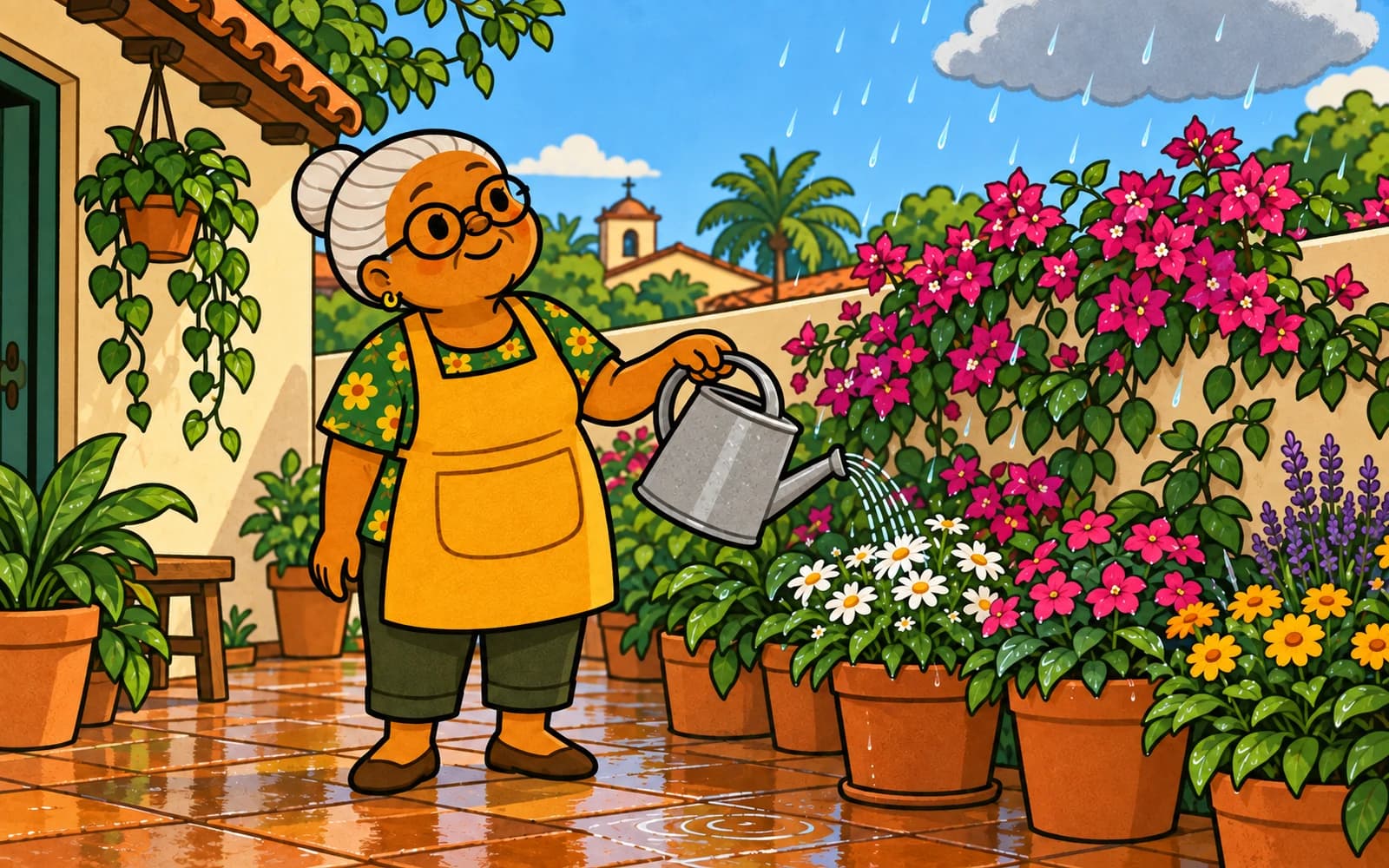
One more twist for a spring post: primavera is also a popular Brazilian name for bougainvillea, the papery magenta climber that spills over garden walls. Context will tell you whether someone is admiring the season or a plant.
Hot and cold in Brazilian Portuguese: calor, quente, frio and gelado
How do you say "hot" in Portuguese? That depends on what is hot.
For the weather, Brazilians say Faz calor, Está calor or Está quente — all "It's hot." For your body, you say Estou com calor, literally "I am with heat." For things, quente does the work: O café está quente — "The coffee is hot."
The rule underneath is simple. Calor is a noun, "heat." Quente is an adjective, "hot." That is why you can say Faz muito calor or Está muito quente, but not Faz quente. Our calor vs quente comparison has more examples if the two still blur together.
The mistake almost every English speaker makes once is Estou quente for "I'm hot." Brazilians will probably understand you, but the sentence describes your body temperature, the thing someone checks with the back of a hand on your forehead. Estou com calor is what you mean. The same pattern gives you Estou com frio — "I'm cold."
Cold has its own pair. Frio is the general word: Hoje está frio — "It's cold today." Gelado means ice-cold or chilled, and with drinks it is good news: uma água bem gelada is exactly what you want after a walk in the sun. A café frio, on the other hand, is a complaint. Brazilians also use gelo, "ice," for exaggeration. Está um gelo aqui dentro! — "It's freezing in here!" — is a normal reaction to office air conditioning.
A few sound notes. Quente is roughly KAYN-chee: the en is nasal, and in most of Brazil a final te sounds like "chee." Calor is kah-LOHR, with a final r that is soft or breathy depending on the region. In gelado, zheh-LAH-doo, the g sounds like the s in "measure."
Rain words: garoa, pé-d'água and chover canivete
Spring rain in the South and Southeast tends to arrive in a hurry, so it helps to have a scale. From lightest to heaviest:
- chuvisco — a few drops; the rain that cannot make up its mind
- garoa — drizzle; São Paulo's old nickname is terra da garoa, "land of drizzle"
- pancada de chuva — a short, heavy shower; forecasts love pancadas de chuva à tarde
- temporal — a proper storm, wind and all
- pé-d'água — a sudden downpour: Caiu um pé-d'água!
- toró — an informal word for a heavy downpour: Que toró!
- Está chovendo canivete — "It's raining penknives," Brazil's answer to "raining cats and dogs"
That last one has a useful cousin. Nem que chova canivete means "come rain or shine": Eu vou ao show nem que chova canivete — "I'm going to the concert whatever happens." Garoa also has a verb, so you will hear Está garoando on grey mornings.
Watch the verbs Brazilians use for the sky changing, because they are not the ones you might guess. O tempo fechou — literally "the weather closed" — means it has clouded over and rain is coming. O tempo abriu means it has cleared up. Vai esfriar is "It's going to get colder," and Esquentou is "It's warmed up."
In the South and Southeast, frente fria, "cold front," turns up in ordinary conversation as often as in forecasts. Vem uma frente fria aí — "There's a cold front on its way" — can be a warning or a promise of relief, depending on the week you have had. In spring a front often brings the storms with it. INMET's outlook for this spring predicts above-average rain across much of the South.
Try it in Falando: the A2 grammar point on weather expressions works through está chovendo, faz calor and estou com calor, and its exercises open once you are signed in.
Muggy, sultry, freezing: describing the air
Temperature is only half the conversation. Brazilians have good words for how the air feels.
Abafado, ah-bah-FAH-doo, is muggy or stuffy: the heavy, still air before a storm, or a room with the windows shut. Está abafado hoje is a complaint you will hear constantly in late spring.
Mormaço is harder to translate. It is the hot, hazy heat of an overcast day, when the sun is hidden but still makes itself felt. Brazilians will warn you that you can burn no mormaço, so do not put the sunscreen away just because the sky is white.
Then come the exaggerations. Está um forno — "It's an oven." Um sol de rachar is a blazing sun, strong enough to crack things. Está um calor danado means roughly "It's darned hot." At the opposite end, the diminutive turns cold into something cosy: Está um friozinho gostoso is "There's a nice little chill." Our guide to diminutives and augmentatives explains why that -inho sounds so affectionate.
You will also meet the casaquinho, the little jacket. It is a running joke in Brazil that mothers and grandmothers tell everyone to take one — Leva um casaquinho! — on evenings that a visitor from a colder country would call warm. Take one anyway. It costs you nothing and pleases somebody.
Regional differences shape the small talk as well. Recife and Porto Alegre are almost 3,000 kilometres apart. In Recife, the thermometer barely moves through the year, so weather talk is mostly about rain: whether it will hold off, whether the street will flood. In Porto Alegre, winters are cold enough that people have a name for the icy wind from the south-west, the minuano. Curitiba, meanwhile, has a reputation for fitting four seasons into one day. In Brasília, spring is when people start watching for the first proper rain after months of dry air. When it finally comes, it makes the local news.
A quick note on two words that look like weather words. Tempo means both "time" and "weather": Como está o tempo aí? — "What's the weather like there?" Clima means climate, and many people use it for the weather in everyday speech too. It also means the atmosphere between people: O clima ficou estranho — "Things got awkward."
Weather small talk that goes somewhere
Back to the lift. Here is how a short exchange might go:
— Que calor, hein? — "Hot, huh?"
— Nem me fala! E dizem que vai chover à tarde. — "Don't get me started! And they say it'll rain this afternoon."
— Tomara. Esse tempo está maluco: ontem fez frio, hoje está um forno. — "Let's hope so. This weather is crazy: yesterday it was cold, today it's an oven."
Nem me fala is the all-purpose sympathetic reply. Tomara, "let's hope so," works whether you want rain or dread it. And a né? on the end of almost any weather sentence, as in Está quente, né?, invites the other person to agree and keep talking.
What do you say if the other person starts? Mostly, you agree and add one detail. Weather small talk does not need to be informative. Its job is to show that you are friendly and willing to talk. If you need a next step after the forecast, our Brazilian small-talk guide covers where the conversation can go.
Try it in Falando: open a chat in Bate-papo with Que calor, hein? and see how long you can keep it going. Try reacting to the reply before you ask anything new.
People also ask about weather in Brazilian Portuguese
How do you say "hot" in Brazilian Portuguese?
For the weather, say Está calor, Faz calor or Está quente. For how you feel, say Estou com calor. For objects, food and drinks, use quente: A sopa está quente.
When does spring start in Brazil?
In 2026, spring began on 22 September at 21:05 Brasília time and ends on 21 December, when summer begins. Brazil follows Southern Hemisphere seasons, so its spring coincides with autumn in Europe and North America.
What does "garoa" mean?
Garoa is a light, fine drizzle. The verb is garoar: Está garoando. São Paulo is so associated with it that the city's old nickname is terra da garoa.
Why do people in the Northeast call the rainy season "inverno"?
In much of the Northeast, inverno is the traditional everyday name for the rainy months, which matter far more to daily life and farming than temperature does. In Ceará the main rainy period runs from February to May, even though astronomical winter falls in June to September.
Start with the sentence you will use tomorrow
You do not need every word above this week. Learn Que calor, hein?, Estou com calor and Será que vai chover? — "Do you think it'll rain?" — and you can join most weather conversations in Brazil. Add abafado when the air gets heavy and frente fria when relief is on the way.
Then use them. Spring has only just started, so the next few months will give you heat, storms and plenty of opportunities to complain about both. Practise a short exchange in Falando's Bate-papo, and look for the weather sentences in what you watch and read. And if a stranger in a lift says Que calor, hein?, you now have at least eight floors of material.