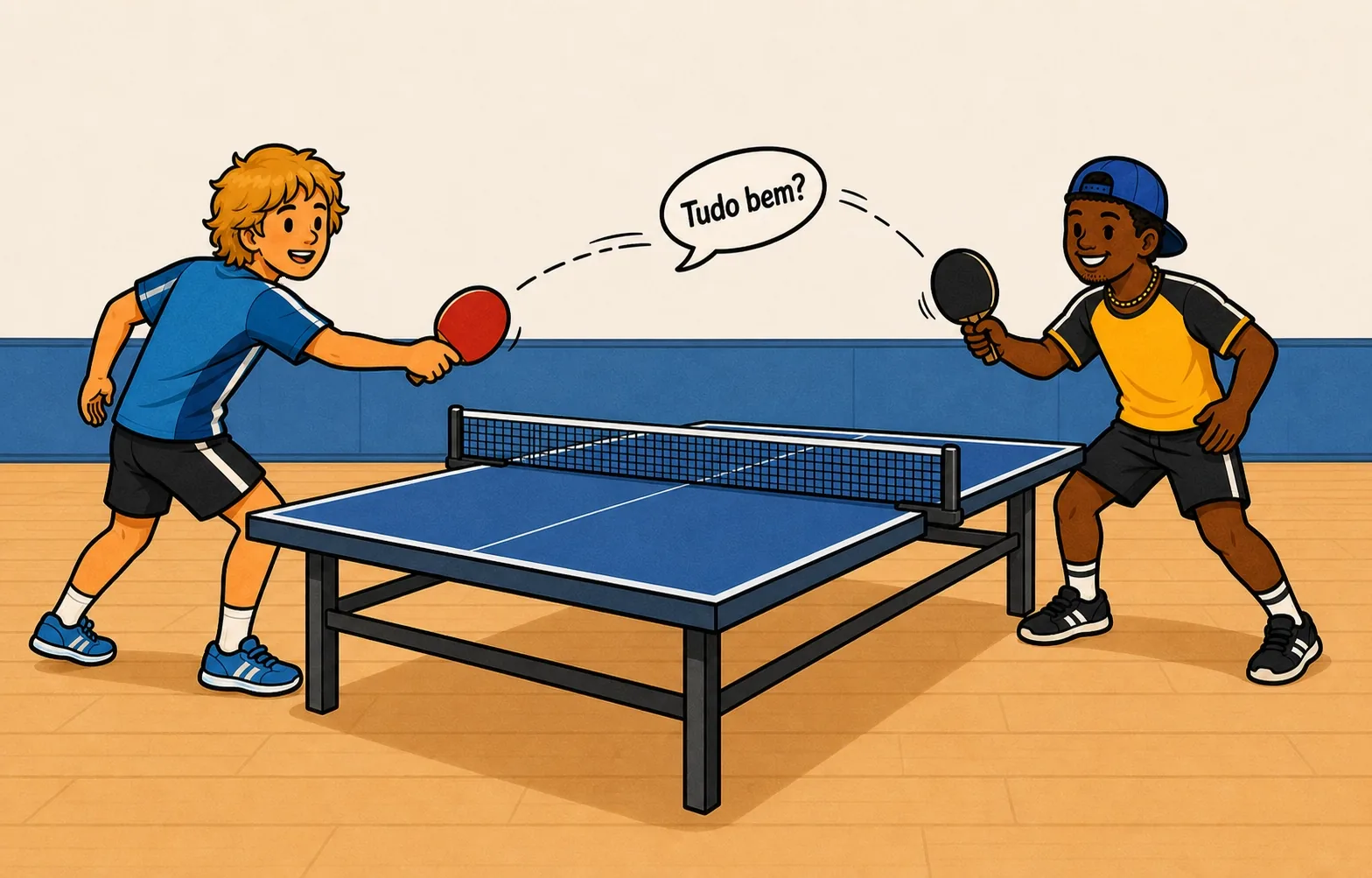
Saying No in Brazilian Portuguese (Without Saying Não)
I once sat alone at a bar in Pinheiros for fifty-one minutes with two beers going warm in front of me.
My friend Rafa had said — and I quote — "opa, vou ver se eu consigo!" I heard "I'll see if I can make it," which in my head meant a solid seventy percent yes. What he actually said, in the language everyone around me had spoken their entire lives, was no. A warm no. A no with a smile emoji attached. But a no.
Nobody teaches you this. You learn não in week one, feel good about it, and then spend two years misreading people because the word almost never shows up when someone is turning you down. Saying no in Brazilian Portuguese is less about vocabulary than about a code — one that's easy to crack once somebody points at it.
So here's the pointing.
Não Exists. It's Just Not Aimed at People.
Brazilians say não constantly. Não tem (we don't have it). Não funciona (it doesn't work). Não é bem assim (it's not quite like that). The word isn't taboo and nobody's scared of it.
What changes is who's on the receiving end. Say não to a fact and it's information. Say it to a person — their invitation, their favor, their plate of food — and you've dropped something on the table that someone now has to clean up.
The word for that mess is constrangimento: a specific social awkwardness Brazilians treat as genuinely unpleasant, almost physical. Sparing other people from it is close to a civic duty, and the entire apparatus of the soft no exists so nobody has to feel the sting in public.
Is it inefficient? Sure. Do I now do it automatically, in English, to the visible confusion of my family in Ohio? Unfortunately.
The Phrases That Mean No (Ranked by How Much No They Contain)
Ever had a friend here agree enthusiastically and then evaporate? Here's the field guide I wish someone had handed me. The percentages are my own unscientific read after years of getting these wrong — vibes with numbers attached.
| What They Say | What It Literally Means | Actual No Content |
|---|---|---|
| "Vamos marcar!" | Let's schedule something! | ~95% no (no date will ever be proposed) |
| "Vou ver" | I'll see | ~90% no |
| "Quem sabe?" | Who knows? | ~90% no |
| "Tá complicado" / "Tá osso" | It's complicated / it's rough | ~85% no, and it's final |
| "Se eu conseguir, eu te aviso" | If I manage it, I'll let you know | ~80% no |
| "Talvez" | Maybe | ~70% no |
| "Ah, que pena!" | Oh, what a shame! | 100% no — but affectionate about it |
The tell isn't the phrase, it's what follows. A real yes arrives with logistics attached — a time, a place, a "te chamo no zap." A soft no arrives with enthusiasm and no details at all. Enthusiasm minus logistics equals no. Write that on your hand.
The one that fooled me longest
"Vamos marcar!" [VAH-mohz mar-KAR] — Let's set a date!
This is the friendliest sentence in Brazil and it means nothing. It's the verbal equivalent of a hug at a party. I spent months believing I had a packed social calendar because nine people a week told me we were going to marcar something.
The exception is real, though: if someone follows it with "quando?" or opens WhatsApp on the spot, that's a yes. Brazilians who actually want to see you will have you in a group chat within forty seconds.
How to Turn Someone Down Yourself
Now the part you actually came for. Learning how to say no in Brazilian Portuguese works like a recipe, and the recipe has four ingredients: a reaction, some regret, a vague reason, and a door left open.
Nossa, queria muito, mas essa semana tá impossível. Fica pra próxima? (Wow, I'd really love to, but this week is impossible. Next time?)
That's the whole machine. Here's your parts bin:
- "Poxa, adoraria, mas..." [POH-shah, ah-doh-rah-REE-ah] — Aw, I'd love to, but... The safest opener in the language.
- "Tô meio enrolado essa semana" [toh MAY-oo en-hoh-LAH-doo] — I'm kind of tangled up this week. Vague on purpose. Nobody asks follow-ups.
- "Ó, vou ser sincero contigo..." — Look, I'll be honest with you... For when the no needs to actually land. Announcing the directness is what softens it.
- "Fica pra próxima!" — Let's make it next time! This is the door. Never close a refusal without one.
- "Agora não vai dar, mas me chama de novo, viu?" — It won't work now, but invite me again, okay? That viu? does enormous emotional labor.
- "Prefiro não, se não tiver problema" — I'd rather not, if that's okay. Slightly formal, good for work.
- "Melhor não, cara" [MEH-lyor nohw] — Better not, man. Close friends only. Blunt by local standards.
Those pronunciation brackets are a crutch, by the way. The vowels in adoraria don't survive being written down in English letters — hear them before you trust my spelling.
Notice what's missing: "não quero." I don't want to. Grammatically flawless, socially a small grenade. I said it once to a coworker offering me a ride home and watched her face reorganize itself in real time. Say não posso instead, even when the truth is that you don't want to. Everyone knows. The form is the point.
Try this in Falando: Open Bate-papo, ask the AI partner to invite you somewhere, and turn it down four different ways without using não quero. Cheaper than getting the rhythm wrong at an actual churrasco.
Refusing Food Is a Completely Different Sport
Separate section, because the normal rules don't apply here.
If a Brazilian grandmother offers you food, "não, obrigado" is not a refusal. It's an opening bid. What you want is:
"Tô satisfeito, tá ótimo!" [toh sah-tees-FAY-too] — I'm full, it's excellent! (Women: satisfeita.)
Praise plus fullness. Both required. Drop either half and a second plate materializes. And at a Festa Junina in June, when you're handed your fourth cup of quentão, the honest move is "só um pouquinho" — just a tiny bit — which lets you accept without committing. Half a no, delivered as a yes.
That -inho ending is the single most useful politeness tool in the language. Um minutinho, um cafezinho, uma perguntinha. Shrinking a thing takes the weight off it. Our post on ordering food in Brazilian Portuguese covers the restaurant version of the same dance.
The Grammar Hiding Inside Every Polite No
Here's the surprising bit, and the thing that made this whole topic click for me.
Portuguese kept a tense most of its Romance cousins let die: the future subjunctive. In Spanish it survives only in fossils and legal boilerplate. In Portuguese it's Tuesday. Se eu puder (if I'm able), quando eu puder (when I'm able), se der (if it works out) are everywhere in daily speech, and they're the load-bearing wall of the polite no — they let you commit to a condition instead of an outcome.
The second trick is the imperfect. Brazilians say queria (I wanted) where English says "I want."
- Quero falar com você — I want to talk to you. Slightly heavy.
- Queria falar com você — literally "I wanted to talk to you." Much softer.
It's the same instinct that makes English speakers say "I was wondering if you could" instead of "can you." Push the request one step into the past and it stops feeling like pressure.
Try this in Falando: Quick Practice lets you pick your CEFR levels and mix Grammar, Conjugation, and Speaking questions into one session, and it doesn't touch your review schedule — so you can hammer queria / poderia / se eu puder without wrecking your queue. For the deeper route, see the best ways to practice conjugation.
The Mistakes (Mine, and One From Class)
There was a Canadian guy in my old Portuguese course in São Paulo — Dev, worked in logistics, direct by temperament. People kept telling him his Portuguese was "muito bom mas muito seco." Very good but very dry. He'd been saying não posso with no cushioning for a year and couldn't work out why the invitations had dried up.
Our teacher gave him one assignment: never let a refusal end on the refusal. Add something after it. Mas semana que vem eu tô livre, mas me conta como foi. Six weeks later he had a standing Thursday futebol game. Same vocabulary, one structural change.
The other errors I see constantly, mostly because I made all of them:
- Taking vamos marcar literally and then feeling ghosted. You weren't ghosted. You were answered.
- Asking "por quê?" after a soft no. Don't. The vagueness is the gift; poking at it forces the person to invent a lie.
- Apologizing three times. One poxa is warmth. Three is a scene.
- Over-formality. O senhor with someone your own age reads as sarcasm — the same trap covered in our guide to Brazilian small talk.
- Reading Portugal's rules onto Brazil. Continental Portuguese is far more comfortable with a plain não, along with the other splits in European vs Brazilian Portuguese.
One genuine curiosity while we're here: "pois não" literally reads as "because no," but in Brazil it means certainly — it's what a waiter says when he arrives at your table. A negative word doing affirmative work.
Regionally, the Portuguese language in São Paulo moves fast and clips the softeners into a mumble, so the no arrives buried. In Rio it comes wrapped in querido and meu amor, which hides it even better. Which of those have you been mishearing?
Practice This Week
Saying no in Brazilian Portuguese is a muscle, not a fact. Four things you can start today, none of which require a teacher:
- The tally. For one week, note every vou ver and vamos marcar you hear, and mark whether a concrete plan followed within 48 hours. Your own data will convince you faster than I can.
- The rewrite. Take three refusals you'd normally send in English on WhatsApp and rebuild them with the four-part recipe. The texting and WhatsApp slang guide covers the written tone, which is its own dialect.
- The listening pass. Real Talk runs listening practice on real YouTube clips of Brazilians talking, and hedges like é, tá complicado turn up constantly once you're listening for them.
- The mirror drill. Say poxa, adoraria, mas essa semana tá impossível out loud until it sounds like a sentence and not a recitation.
People Also Ask
How do you say no politely in Brazilian Portuguese?
Warmth, a reason, an open door — and skip the word não entirely: "Poxa, adoraria, mas essa semana tá impossível. Fica pra próxima?" That three-beat pattern is essentially all there is to how to politely decline in Portuguese. The safest all-purpose refusal is não posso (I can't) rather than não quero (I don't want to) — Brazilians read the first as circumstance and the second as rejection, even when everyone knows they mean the same thing.
Does "talvez" really mean no in Brazil?
Usually. Talvez is a legitimate adverb of possibility — Priberam's dictionary defines it exactly that way — but inside a social invitation it functions as a decline about seven times out of ten. The reliable test isn't the word, it's whether logistics follow it.
Is it rude to say "não" directly in Brazil?
Not rude, just heavy. Nobody will be offended, but a bare não lands colder than you intend, especially with people you don't know well. Save it for facts, and use the softened forms for people — one of the first things you notice when learning Brazilian Portuguese while living in Brazil.
Do Brazilians and Portuguese people refuse things differently?
Broadly, yes: continental Portuguese speakers reach for a direct não far more comfortably, while Brazilian norms lean on hedging and diminutives. For the cultural backdrop, the Museu da Língua Portuguesa in São Paulo is one of the best afternoons in the city for anyone curious about how the language got this way.
Beleza, Now Go Turn Somebody Down
If you take one thing from this: enthusiasm without logistics is a no. That rule alone will save you fifty-one minutes at a bar in Pinheiros, plus a fair amount of low-grade worry about whether people like you. They do. They answered you in a code you hadn't learned yet.
And when it's your turn — react, regret, reason, door. Four beats. Poxa, queria muito, mas tá osso essa semana. Fica pra próxima, viu? Say it out loud once now. It's shorter than it looks.
To drill it somewhere nobody's feelings are involved, Bate-papo will keep inviting you to things until you can decline smoothly, and what you pick up can go into your Reviews queue so it resurfaces right before you'd forget it — which is why we built a Portuguese learning app instead of another phrase list. You can learn Portuguese online for free while you test whether any of this works on real Brazilians.
Spoiler: it does. Report back.
Vamos lá!