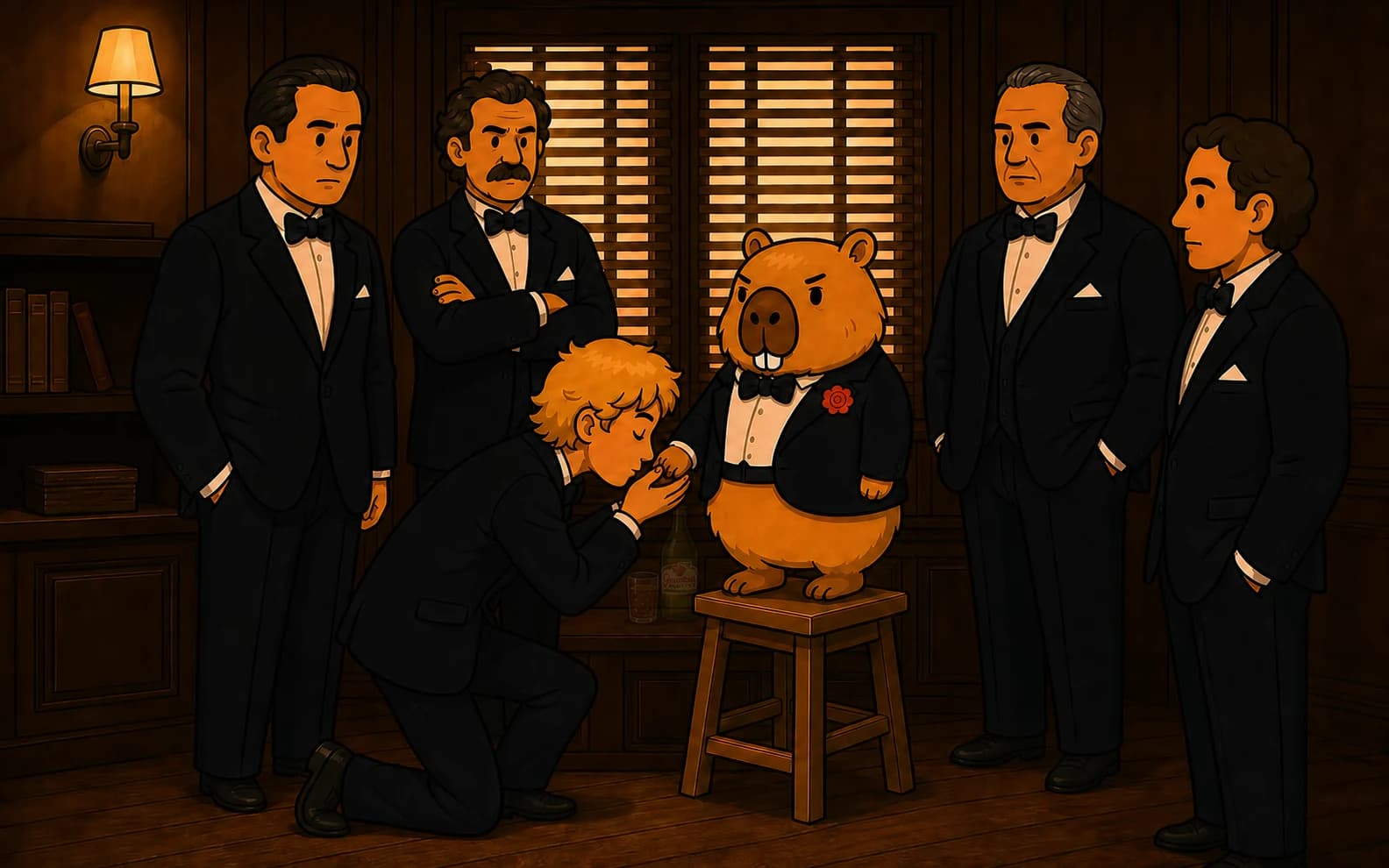
Nodding Along to "O Poderoso Chefão"
Second week at an office in São Paulo, someone in the kitchen asked whether I'd seen O Poderoso Chefão [oo poh-deh-ROH-zoo sheh-FOWNG]. I said yes. I said yes to a lot of things that year — agreeing is cheaper than the follow-up conversation. For months afterwards I carried around a vague sense that there was a Brazilian mafia epic everybody had seen except me.
It's The Godfather. "The Powerful Big Boss."
Nobody here finds that odd. Foreign films arrive in Brazil and get renamed by a distributor's marketing department, and what you end up with is a parallel canon: the same films you grew up with, wearing entirely different names. For the first month of living here that's just annoying. After that it turns into one of the better free study resources you have, because Brazilian Portuguese movie titles are built to be read at a glance from the other side of a shopping mall. Short, loud, grammatically tidy. Each one is a tiny lesson that somebody else already paid to distribute.
A Parallel Canon You Have to Learn Separately
The thing to understand is that these aren't translations. They're pitches. A Brazilian distributor gets a film, decides what will sell it on a poster, and writes that on the poster — the original title is treated as a suggestion. AdoroCinema, Brazil's biggest film site, has been running lists of the worst offenders for over a decade, which tells you how much affection and irritation Brazilians hold for the practice at the same time.
A starter set from the classics, since these come up constantly in conversation:
- Tubarão [too-bah-ROWNG] — Jaws. Just "Shark." Sometimes the answer is the boring one.
- Esqueceram de Mim [es-keh-SEH-rowng jee MEENG] — Home Alone. "They forgot about me." Note there's no subject pronoun anywhere in it; spoken Brazilian Portuguese drops those constantly.
- A Noviça Rebelde — The Sound of Music. "The rebellious novice." Maria is, by any reasonable measure, not rebellious.
- Apertem os Cintos, o Piloto Sumiu — Airplane!. "Fasten your seatbelts, the pilot has vanished." An entire plot summary, delivered before you buy the ticket.
- Um Sonho de Liberdade — The Shawshank Redemption. "A dream of freedom."
- Enrolados [en-hoh-LAH-doos] — Tangled. Literally "tangled up," and also the everyday word for being hopelessly behind on everything. Tô enrolado essa semana.
- Divertida Mente [jee-ver-TCHEE-dah MEN-tchee] — Inside Out, and the best one anybody has managed. Divertidamente is a single word meaning "amusingly." Split it in two and you get "amused mind."
That last one is the exception that proves how rarely this goes well. Most of the time you get a subtitle bolted on after a colon — Up: Altas Aventuras, Frozen: Uma Aventura Congelante — because the marketing logic says a Brazilian audience needs to be told what genre it's buying.
Brazilian Titles Are Obsessed With the Imperative
Here's the part that's actually worth your time. Distributors love commands. Once you notice it you can't stop seeing it, and it happens to hand you a clean drill in one of the trickier corners of beginner grammar.
The affirmative command form for você isn't the verb's dictionary form — it's the present subjunctive. Correr becomes corra, olhar becomes olhe, casar becomes case. That's why Jordan Peele's Get Out is Corra! [KOH-hah] in Brazil, and why the double-R at the start comes out as an English H sound.
| Infinitive | Command form | Where you'll see it |
|---|---|---|
| correr (to run) | corra — run! | Corra! — Get Out (2017) |
| casar (to marry) | não case — don't get married | Se Beber, Não Case! — The Hangover |
| olhar (to look) | não olhe — don't look | Não! Não Olhe! — Nope (2022) |
| apertar (to fasten) | apertem — fasten (plural) | Apertem os Cintos, o Piloto Sumiu |
Se Beber, Não Case! [see beh-BEH, nowng KAH-zee] deserves its own paragraph. The title is a rewrite of se beber, não dirija — "if you drink, don't drive," the Brazilian road-safety slogan everyone knows by heart. Swapping dirija for case is a genuinely good joke, and it's doing double grammatical duty: se beber is a future subjunctive (identical to the infinitive, which is how it sneaks past learners — I wrote about that trap in the Evidências breakdown), and não case is a negative command.
One honest caveat, because textbooks won't tell you this and it'll confuse you the first week: in real speech Brazilians frequently ignore the subjunctive form for affirmative commands. You'll hear corre aqui, olha isso, fala comigo — the shorter indicative form — from people who would absolutely write corra on a poster. The negative side holds up better: não olhe, não case, não fala assim is where you'll hear both. Titles show you the tidy version. The street shows you the other one. Learn both, and don't be surprised when they disagree.
Try this in the app: if command forms are still a coin flip for you, Verb Conjugation Practice on Falando lets you pick specific tenses and drill only those — select the affirmative and negative imperative, and you'll be filling the blank in real Brazilian sentences rather than reciting a table. Ten minutes gets corra, olhe and case out of the "I think so?" category.
The Idioms Smuggled Onto the Poster
Some titles are just idioms wearing a film. These are the ones I'd actually memorize, because the phrase outlives the movie.
Entrando Numa Fria [en-TRAHN-doo NOO-mah FREE-ah] is Meet the Parents. Literally "getting into a cold one," which sounds like a beer and is not. Entrar numa fria means getting yourself into an awkward, hard-to-escape mess — the Priberam dictionary files it under complicação. Deeply useful phrase. Entrei numa fria is what you say after agreeing to help a friend move apartments.
Onde os Fracos Não Têm Vez is No Country for Old Men — "where the weak get no turn." The load-bearing bit is ter vez, to get a shot, to get your turn. You'll hear it about job markets and football squads far more often than about Cormac McCarthy.
Duro de Matar — Die Hard. "Hard to kill," which works fine, but duro is the more interesting word here. It's your standard adjective for hard or tough, and it's also the universal Brazilian way of saying you're broke. Tô duro = I have no money. Roughly one in three conversations about weekend plans ends there.
Which of these have you already heard without registering it? Fria in particular slides past beginners because the surface meaning is so ordinary. If you want more of the same, the most confusing Brazilian Portuguese idioms covers the ones that actually trip people up in conversation.
Try this in the app: grab fria, vez and duro and search them in Falando's vocabulary, then hit Add to Reviews. They drop into your spaced-repetition queue and come back right before you'd have forgotten them. Reading an idiom once does nothing — I've relearned entrar numa fria three separate times to prove it.
Same Film, Two Portugueses
Brazil and Portugal rename films independently, which produces some spectacular divergence. If you're weighing up the differences between the two variants, title lists are a fun, low-stakes way to see how differently the two markets talk.
| Original | Brazil | Portugal |
|---|---|---|
| The Godfather | O Poderoso Chefão | O Padrinho |
| Home Alone | Esqueceram de Mim | Sozinho em Casa |
| Die Hard | Duro de Matar | Assalto ao Arranha-Céus |
| Matilda | Matilda | Matilda, a Espalha Brasas |
Portugal's O Padrinho is the literal translation and arguably the better one — the whole franchise runs on baptisms. Brazil went with Chefão, which is chefe (boss) plus the augmentative -ão. That suffix is worth stealing on its own: carro → carrão (a serious car), festa → festona, problema → problemão. Brazilians attach it to almost anything, and it carries admiration as often as size.
Going the Other Way: Brazilian Films Renamed for Export
The traffic runs both directions, and the export side is where I find the choices most revealing.
Ainda Estou Aqui [ah-EEN-dah es-TOH ah-KEE] went out as I'm Still Here — a rare case of nobody meddling. Walter Salles' film about Eunice Paiva and the disappearance of her husband under the military dictatorship won Best International Feature at the 2025 Oscars, the first Brazilian film ever to take that category after five previous nominations. If you've wondered why half of Brazil has an opinion about Fernanda Torres, that's why.
Que Horas Ela Volta? became The Second Mother, and I think that trade was a bad one. The Portuguese is a line of dialogue — the question a child asks about a mother who works in someone else's house — and the English title answers it instead of asking. It's also a tidy grammar note: Brazilians say que horas, plural, where English uses a singular "what time," and volta is a plain present tense doing future work.
O Auto da Compadecida — the 2000 adaptation of Ariano Suassuna's play, and probably the most beloved Brazilian comedy of my lifetime — went abroad as A Dog's Will. I have never met a Brazilian who can explain this to a foreigner without laughing.
People Also Ask
Why are movie titles changed in Brazil?
Because the distributor's marketing team, not a translator, chooses them. The goal is a poster that sells in Brazilian cinemas and shopping malls, so titles get shortened, turned into commands, or given an explanatory subtitle after a colon. Literal accuracy is rarely the priority.
What is The Godfather called in Brazilian Portuguese?
O Poderoso Chefão — "the powerful big boss." Chefão is chefe plus the augmentative suffix -ão. Portugal chose the literal O Padrinho instead, which is one of the most-cited differences between the two markets.
Do Brazil and Portugal use the same movie titles?
Frequently not. Home Alone is Esqueceram de Mim in Brazil and Sozinho em Casa in Portugal; Die Hard is Duro de Matar versus Assalto ao Arranha-Céus. Each market localizes on its own, so a title you learned from one won't reliably get you anywhere in the other.
Can learning movie titles actually help your Brazilian Portuguese?
More than you'd expect, for a small time investment. Titles are short, high-frequency, and repeated on posters and streaming menus until they stick — and because they're written to grab attention they concentrate imperatives, idioms and slang. It's not a syllabus. It's very good ambient exposure, and it makes streaming menus searchable.
Change Your Netflix Language Tonight
Three things to walk away with. Brazilian commands on a poster use the subjunctive form — corra, olhe, não case — even though the street will often hand you the shorter version. The augmentative -ão turns a chefe into a chefão and works on nearly any noun. And a surprising number of titles are just idioms in disguise: entrar numa fria, ter vez, tá duro.
Do this now, while you're thinking about it: switch your streaming account's language to Portuguese (Brazil) and scroll the home screen. You'll recognize a third of the films instantly, guess another third, and be stumped by the rest. That last group is your vocabulary list, delivered free.
Try this in the app: when a trailer catches your eye, paste the YouTube link into Bring Your Own Content — Falando pulls the transcript so you can mine the vocabulary from the film itself instead of just its title. It works on Brazilian articles too. Same principle as my YouTube and Netflix method, with fewer tabs open.
Then go somewhere the actors aren't enunciating for the back row. Real Talk plays a 20-second clip of genuine Brazilian audio and asks one question you answer in Portuguese, at your own CEFR level — the closest thing to overhearing a conversation on a bus in Rio without leaving your kitchen.
Now go find out what Se Beber, Não Case did to its sequels. Beleza? Start free on Falando.