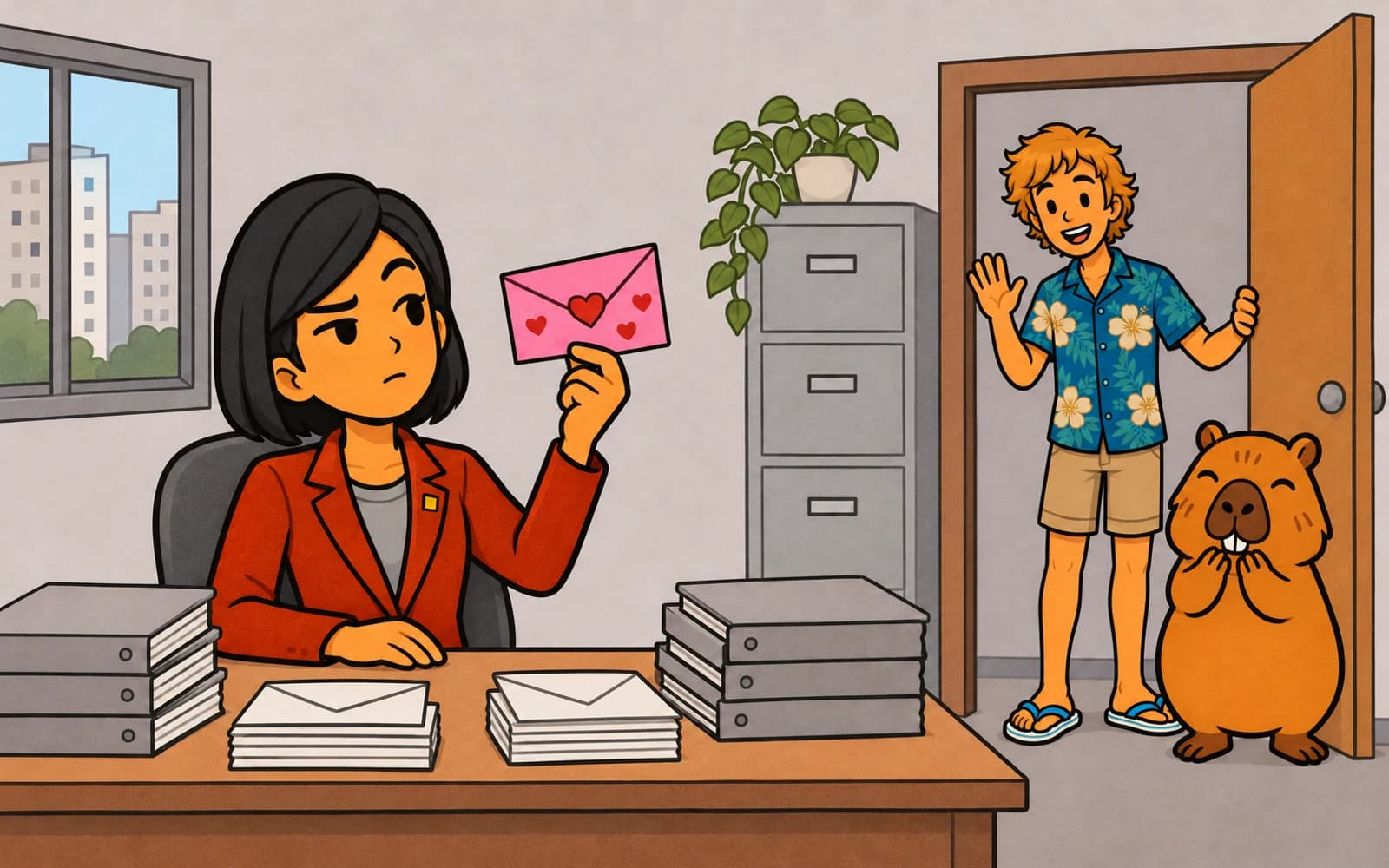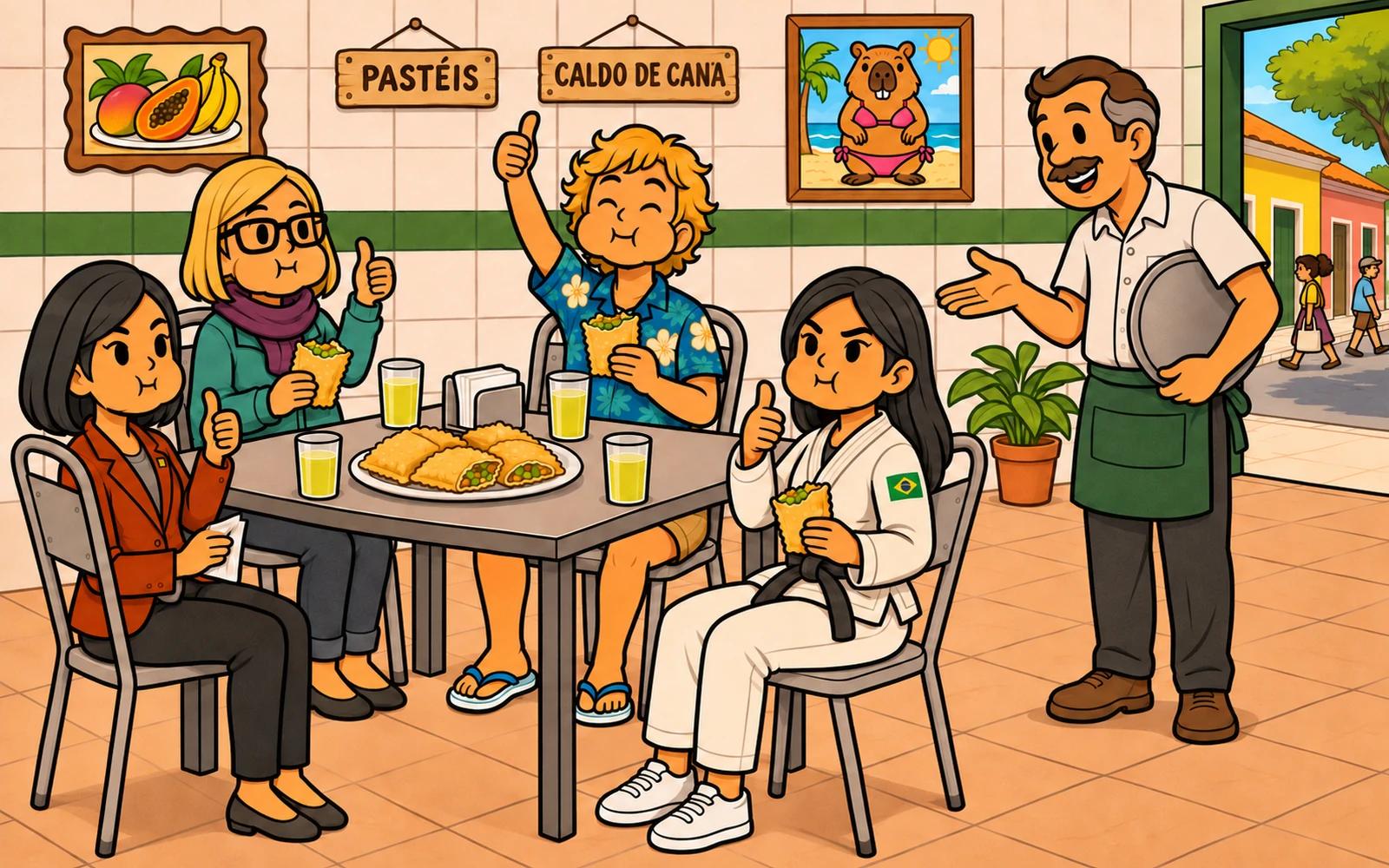
The first time I filled up a rental car in São Paulo, the attendant gave me three thumbs-up in under a minute. One came when I said completa (fill it up), one when my card went through, and one as I pulled away, which I think was just for me. I had used about six words of Portuguese. He had used two. We understood each other perfectly.
Brazilians talk with their hands, and a good part of any conversation happens below the chin. Some Brazilian hand gestures have no English equivalent at all, and a couple are rude. One of the rude ones is the gesture English speakers reach for without thinking when they want to say "perfect."
This guide covers the gestures you'll see every day, the two you should keep in your pocket, how greetings work, and the Portuguese words for whatever your hands are doing.
The joinha: Brazil's all-purpose thumbs-up
If you learn one gesture, make it the thumbs-up. Brazilians call it a joinha (zho-EEN-yah), the diminutive of joia, "jewel," the same word as in the slangy greeting tudo joia? Fazer um joinha (to give a thumbs-up) is something you'll do dozens of times a day:
- A driver stops to let you cross, and you give a joinha through the windshield.
- A waiter asks if everything is fine while your mouth is full.
- Someone across a noisy bar mouths beleza? and your thumb answers for you.
- The bus driver waits while you run for the door.
- A coworker asks if you got the file, and you reply from across the room.
- A friend shouts something at the beach that the wind carries away, and you nod along with a thumb, just to be friendly.
In English, a thumbs-up can feel a bit eager. In Brazil it covers "thanks," "OK," "no worries" and "got it," and nobody finds it cheesy, not even teenagers. It carries over online intact: a lone 👍 is a perfectly normal reply on WhatsApp, next to the abbreviations in our guide to Brazilian texting and WhatsApp slang.
Is the OK sign offensive in Brazil?
This is the one to learn before you land. The ring made with your thumb and index finger has an old, vulgar meaning in Brazil, close to the middle finger in English. The Cultural Atlas guide to Brazilian communication lists it as offensive, and older Brazilians in particular read it that way.
It isn't quite that simple anymore. Decades of Hollywood films and the 👌 emoji have taught plenty of younger Brazilians the English meaning, and some Brazilian news sites now describe the gesture as a plain "agreed." You probably won't start a fight with it. You might get a strange look from someone's grandmother, though, and there's no reason to risk it when the joinha says the same thing with no room for doubt.
Did you just make the ring at your screen to picture it? Most people do. You may also have read that Richard Nixon once flashed it at a crowd in Brazil and got booed. The dates and places shift with every retelling, so treat it as a legend. The advice it illustrates holds up anyway: thumb up, fingers apart.
Brazilian hand gestures you'll see every day
Here are the common ones, with the words people tend to say while making them.
| Gesture | How it looks | What it means | What people say |
|---|---|---|---|
| Joinha | Thumb up | OK, thanks, all good | Beleza! |
| Figa | Fist with the thumb poking out between the index and middle fingers | Good luck, protection | Tô fazendo figa. |
| Lotado | Fingertips bunched against the thumb, opening and closing | Packed, crowded | Tava lotado! |
| Faz tempo | A loose hand shaken so the fingers click together | A long time ago, it took ages | Faz tempo! |
| Earlobe pinch | Thumb and index finger pinching your own earlobe | Delicious, excellent | Que delícia! |
| Money | Thumb rubbing against the fingertips | Money, expensive | Tá caro! |
| The bill | Pretending to sign something in the air | The check, please | A conta, por favor. |
| Finger wag | Index finger moving side to side | No | Não, não. |
Figa: the lucky fist
Fazer figa (fah-ZEHR FEE-gah) means making a fist with the thumb tucked between the index and middle fingers. In Brazil it does the job of crossed fingers: Tô fazendo figa pra você is "I'm keeping my fingers crossed for you." The shape also comes as a charm. Small figas carved from wood or stone hang from souvenir stalls all over Bahia, sold as protection against mau-olhado, the evil eye.
The same fist travels badly. In Turkey and parts of Italy it's obscene, and in Russia or Poland it's the classic way to tell someone they're getting nothing at all. Inside Brazil you can make a figa for anyone, from a nephew before his exam to a friend waiting on a visa.
Lotado: when a place is packed
Ask a Brazilian how the Carnaval bloco was and you may get no words at all, only a hand held up with the fingertips bunched together, opening and closing a few times. That means lotado (loh-TAH-doo), packed. It works for the metro at rush hour, a beach on a holiday weekend, or a concert where you never got near the stage. The phrases that usually come with it:
- O show tava lotado. (The show was packed.)
- Tinha gente pra caramba. (There were loads of people.)
Faz tempo: the clicking hand
To say something happened ages ago, Brazilians let the wrist go loose and shake the hand so the fingers click against each other, three or four times in a row. It goes with Faz tempo! (It's been ages!) or Isso foi há muito tempo (That was a long time ago). The same hand can also mean something took forever. A friend describing the line at the Detran, the vehicle licensing office, will click away while saying demorou demais (it took way too long).
The earlobe pinch: that was delicious
Pinching your own earlobe between thumb and index finger means something was excellent, usually food. You'll see it after a good feijoada or a slice of someone's grandmother's cake, sometimes with the expression da pontinha da orelha, "from the tip of the ear," meaning top quality. It has a slightly old-fashioned feel, so your Brazilian friends' parents use it more than your friends do. That makes it a very good way to win over the parents, né?
Saying no without words
Brazilians often say no before they say anything. The index finger wags side to side, the tongue clicks against the teeth (tsc, tsc), and the head shakes. A wagging finger at a beach vendor is a polite enough "no thanks," and you don't owe anyone an explanation. Linguists have looked at this closely: a 2024 study of negation gestures in Brazilian Portuguese traced six recurring ones through TV shows, TED talks and legislative sessions. For the spoken side, see our guide to saying no in Brazilian Portuguese.
Brazilian gestures to avoid (unless you mean them)
Dar uma banana
Bend one arm upward and slap the other hand into the crook of the elbow, and you've told someone exactly what you think of them. In Brazil this is dar uma banana (DAHR OO-mah bah-NAH-nah), and it's strong. People use the phrase without the gesture too, as in this example from our entry for dar uma banana: O motorista deu uma banana para o guarda de trânsito e saiu acelerando (The driver gave the traffic cop the banana and sped off). In Portugal the same arm is a manguito. Be careful how you stretch after a long bus ride.
Chifre: the horns
Raise your index and little fingers with the others folded down, and at Rock in Rio you're just enjoying the show. Held behind a friend's head in a photo, or pointed at a man, it means chifre (SHEE-free), horns, and calls him a corno, a man whose partner cheats on him. Among friends the photo version is an old joke. Aimed at a stranger, it's an insult about his honor, and that's a conversation you don't want to have in your third month of Portuguese.
How Brazilians greet each other
The first ten seconds of meeting someone in Brazil involve more contact than most English speakers expect. Here's how it usually goes:
- Cheek kisses. Women greeting women, and men greeting women, usually exchange a beijinho (bay-ZHEEN-yoo): cheek against cheek with a small kissing sound in the air. Lips rarely touch skin.
- How many. One kiss is common in São Paulo, two in Rio, and often three in Minas Gerais, where the third sometimes comes with the joke o terceiro é pra casar (the third one means we're getting married). People vary more than any map does, so let the other person lead.
- Men with men. A handshake, often turning into a half-hug with a couple of pats on the back. That's the abraço, and between old friends it can be loud.
- Everyone in the room. When you arrive at a party or a churrasco, you greet each person one by one, and you do it again when you leave. A single wave to the whole room can come across as cold.
- Signing off. Beijo or beijos ends calls and messages to friends and family with no romance implied. Between men, abraço does the same job.
For the spoken half of a greeting, from oi, tudo bem? onward, read our guide to saying hi in Brazil.
Try this in Falando: Practice a whole arrival and goodbye in Bate-papo. Choose Real-life situation and pick Guest at a churrasco. The host welcomes you, keeps offering food as it comes off the grill, and expects a warm goodbye when you leave.
The Portuguese words for what your hands are doing
Knowing the gestures gets you through the day. You also need words for them, especially when a friend asks o que você quis dizer com isso? (what did you mean by that?).
| Portuguese | English |
|---|---|
| acenar | to wave |
| dar tchau | to wave goodbye |
| apontar | to point |
| apertar a mão | to shake hands |
| mandar um beijo | to blow a kiss |
| fazer sinal | to flag down (a bus or a taxi) |
| estalar os dedos | to snap your fingers |
| fazer joinha, fazer figa | to give a thumbs-up, to cross your fingers |
The body parts behind all this are mão (hand), dedo (finger), polegar (thumb), cotovelo (elbow) and orelha (ear), and you'll find more in our body parts vocabulary pack. Hands turn up in idioms as well. Dar uma mão means to lend a hand. Someone who is mão de vaca, literally "cow's hand," is stingy. A person who fala pelos cotovelos, "talks through the elbows," never stops talking, usually while gesturing with both arms.
Try this in Falando: Now take the gestures away. In Bate-papo, choose Real-life situation and pick Booking a table by phone. Nobody can see your joinha on a phone call, so every "OK," "perfect" and "no problem" has to come out in Portuguese.
People also ask about Brazilian gestures
Is the OK hand sign offensive in Brazil?
It can be. Traditionally it's a vulgar insult, roughly like the middle finger, and older Brazilians still read it that way. Many younger Brazilians know the American meaning, but the thumbs-up is the safer choice.
What does a thumbs-up mean in Brazil?
Approval of almost any kind: OK, thanks, all good, got it. Brazilians call it a joinha, and it's one of the most common gestures in the country.
How many cheek kisses do Brazilians give?
Usually one in São Paulo, two in Rio de Janeiro and often three in Minas Gerais, though it varies from person to person. Let the other person lead and follow their face.
What does the figa gesture mean in Brazil?
Good luck and protection, like crossed fingers in English. The same fist is offensive in Turkey and means "you get nothing" in Russia and Poland.
Start with your thumb
You don't need every gesture on day one. Start with the joinha, because it covers more ground than any word you'll learn this week. Retire the OK sign until you know your audience. When someone leans in to kiss your cheek, let them do the counting. Watch for the bunched fingers of lotado and the clicking hand of faz tempo, because you'll see both long before anyone explains them to you.
Then put words next to the gestures. A joinha with beleza! lands better than a joinha alone, and a Brazilian who hears you say tava lotado while your fingers do the same thing will assume you've lived there for years. Which one will you try first?
As for that gas station attendant, I still owe him a proper valeu. Next time I'll say it out loud, and add the thumb.
Beleza? Vamos lá.