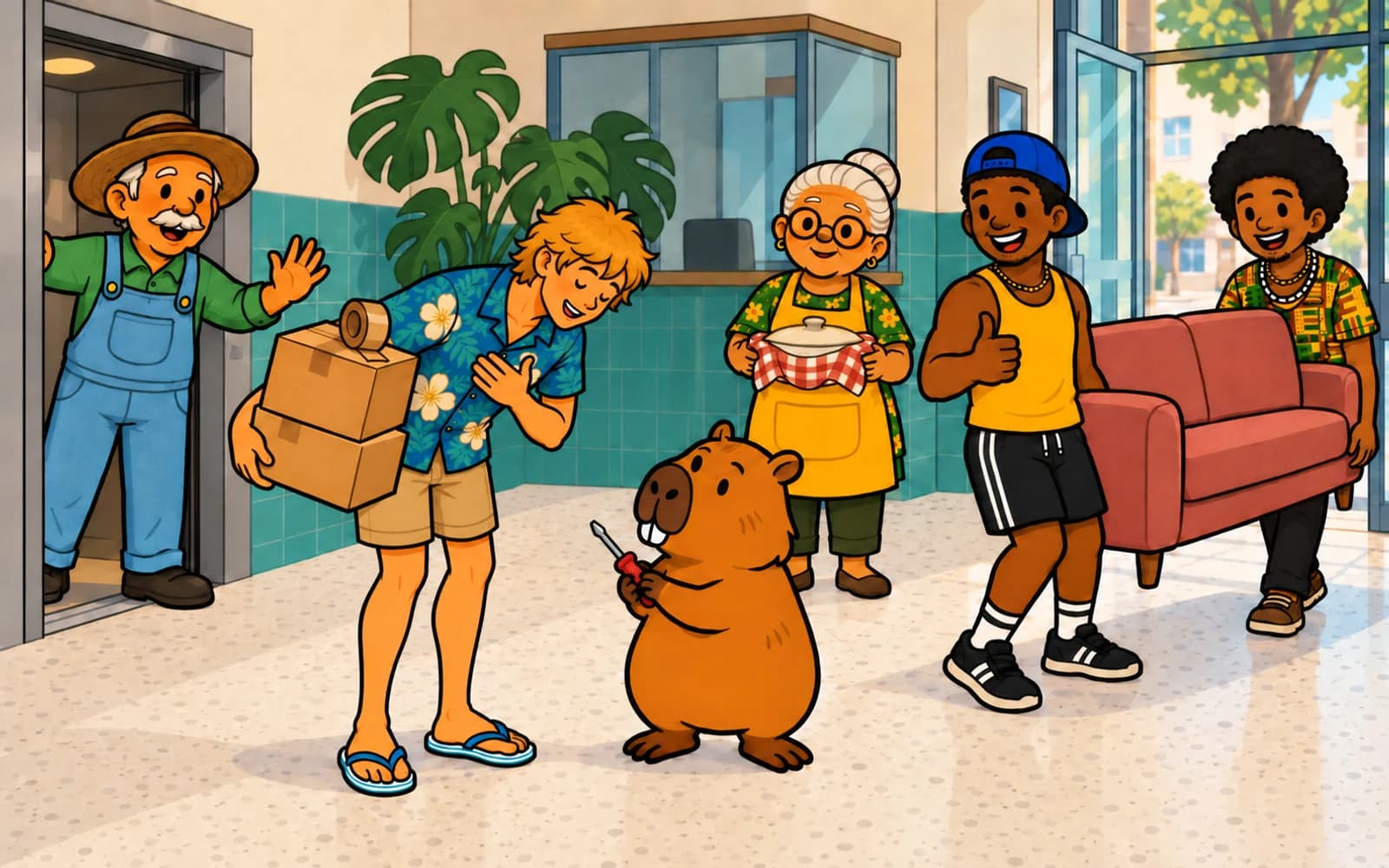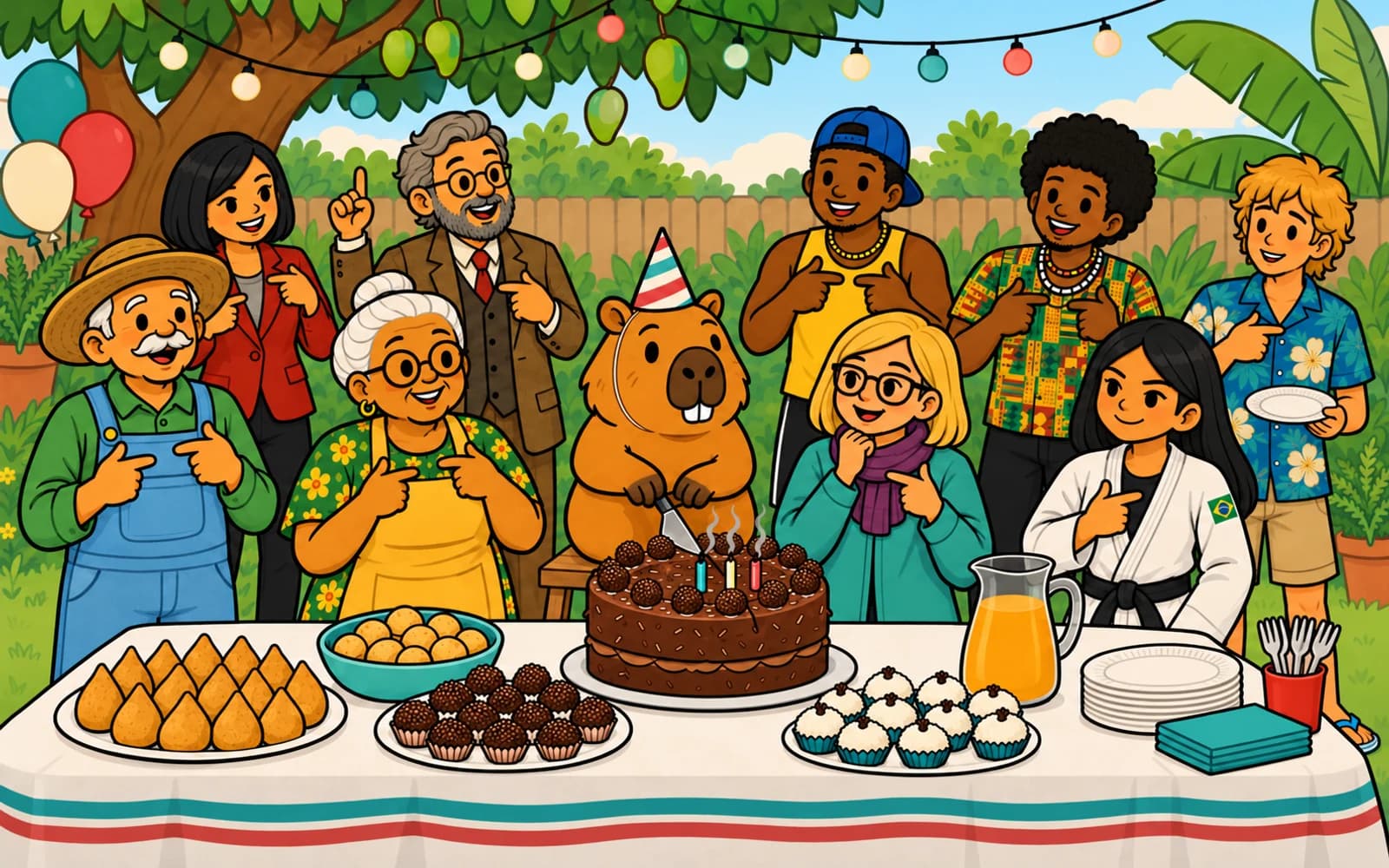
At a friend's birthday party in São Paulo, a seven-year-old in a dinosaur T-shirt asked me my name. "Mike," I said. He gave this some serious thought, then asked whether that was Miguel in English. Close enough, I told him. He grabbed my hand, turned to the table of grown-ups and announced: Ele é meu xará! "He's my namesake!"
Being his xará came with duties for the rest of the afternoon: guarding the pipoca, fetching suco de caju and admiring a plastic jacaré from several angles. That night I looked the word up. Xará, pipoca, caju and jacaré all came into Portuguese from Tupi, the language spoken along a large stretch of Brazil's Atlantic coast and later adopted by Portuguese settlers and missionaries.
You may already speak a little Tupi in English. The American Heritage Dictionary traces cashew, jaguar, piranha, toucan and tapioca to Tupi. Even buccaneer goes back, through French boucan, a barbecue frame, to a Tupian word for a wooden rack. Here's who the Tupi were, how their language lived alongside Portuguese for centuries, and which Tupi words in Brazilian Portuguese you'll hear every week.
Who Were the Tupi?
"Tupi" was a broad label. Colonial writers used it for the Indigenous peoples of the coast who spoke variants of the same language: the Potiguara, the Tupinambá, the Caeté, the Tupiniquim, the Tupi of São Vicente and others. Each was its own people. What they shared, and what interested the Portuguese most, was the language.
Linguists now call that language Old Tupi (tupi antigo), and you'll also see it called Tupinambá. It belongs to the Tupi-Guarani family, inside a larger group of languages known as the Tupi trunk. Guarani is a close relative in the same family, much as Spanish is a relative of Portuguese.
Nobody grows up speaking Old Tupi today. Think of Latin, which no family speaks at home but which lives on in its descendants. Old Tupi's best-known descendant is Nheengatu, still spoken in the Amazon, and we'll get to it in a moment.
Tupi was also one language among very many. Brazil's 2022 census recorded 295 Indigenous languages in the country. This post is about one of them: the coastal language and its colonial descendants.
When Brazil Spoke Tupi: the Língua Geral
Missionaries learned the coastal language and wrote it down. José de Anchieta's grammar of it circulated in manuscript from about 1555 and was printed in Coimbra in 1595. The title says a lot: Arte de gramática da língua mais usada na costa do Brasil, "grammar of the language most used on the coast of Brazil."
The language didn't stay in the missions. In São Paulo, Portuguese and Indigenous families became so intertwined that in 1694 the Jesuit Antônio Vieira wrote that the language spoken in those households was the Indigenous one, and that boys went to school to learn Portuguese. In the town that would become Brazil's biggest city, Portuguese was a school subject.
That colonial Tupi, used by settlers and missionaries as well as Indigenous people, became known as the língua geral, the "general language." The Instituto Socioambiental dates the name to around the second half of the 17th century. It had two main branches:
- The língua geral paulista grew up around São Paulo. The bandeirantes, whose expeditions set out from São Paulo into the interior, carried it into what are now Mato Grosso, Goiás, Minas Gerais and Paraná. It disappeared completely in the early 20th century.
- The língua geral amazônica was spoken across the Amazon, where it turned into Nheengatu in the 19th century.
Paulista Tupi left its mark on the map. São Paulo's state assembly gives a few examples: Araraquara, "den of the macaws"; Tatuapé, "armadillo path"; and Anhangabaú, "river of the evil spirit." I changed trains at Tatuapé for months before I learned there was an armadillo in the name.
How Portuguese took over
Three blows pushed the língua geral aside:
- The ban. The Marquis of Pombal's Diretório dos Índios, dated 3 May 1757, banned the línguas gerais and set Portuguese as the only permitted language.
- The Cabanagem. During this uprising in Pará, thirty thousand caboclos and detribalized Indigenous people died, about a fifth of the province's population. The Tupi scholar Eduardo Navarro calls it the língua geral's second great blow, after Pombal.
- Migration. The great drought of 1877 drove large numbers of people from Brazil's Northeast into the Amazon during the rubber boom. Navarro writes that only with those migrations in the 1870s did Portuguese become the dominant language there.
Nheengatu today
The língua geral never died out completely. Navarro calls the Rio Negro basin its "last refuge" and counted more than 6,000 speakers in Brazil, Venezuela and Colombia. The Endangered Languages Project's estimate, quoted by AFP, is about 19,000, and Unesco lists the language as endangered.
In 2002, the municipality of São Gabriel da Cachoeira made Nheengatu co-official with Portuguese, together with two other Indigenous languages, Tukano and Baniwa. On 19 July 2023, in the same town, Brazil's Supreme Court presented the first translation of the Federal Constitution into an Indigenous language. The language was Nheengatu, and fifteen bilingual Indigenous translators did the work.
Tupi Words in Brazilian Portuguese You'll Hear Every Week
Tupi gave Portuguese its words for things Europeans had never seen: animals, fruit, plants and ways of preparing them. The Tupi forms below come from the Aulete dictionary; the apostrophe marks the stressed syllable.
Animals
| Portuguese | Sounds like | English | Tupi form (Aulete) |
|---|---|---|---|
| capivara | kah-pee-VAH-rah | capybara | kapii'guara, "grass eater" |
| jacaré | zhah-kah-REH | caiman | yaka're |
| tatu | tah-TOO | armadillo | ta'tu |
| tucano | too-KAH-noo | toucan | tu'ka |
| arara | ah-RAH-rah | macaw | a'rara |
| urubu | oo-roo-BOO | black vulture | uru'wu |
| sabiá | sah-bee-AH | thrush | sawi'a |
| tamanduá | tah-mahn-doo-AH | anteater | tamandu'a |
| piranha | pee-RAH-nyah | piranha | pi'ra, "fish," + ãia, "tooth" |
One warning about piranha: as slang, it's also an insult for a woman, so let context do its job.
Food and plants
| Portuguese | Sounds like | English | Tupi form (Aulete) |
|---|---|---|---|
| mandioca | man-jee-AW-kah | cassava | mandi'oka |
| aipim | eye-PEEN | cassava | ai'pi |
| macaxeira | mah-kah-SHAY-rah | cassava | maka'sera |
| tapioca | tah-pee-AW-kah | tapioca | tïpï'og |
| caju | kah-ZHOO | cashew fruit | aka'iu |
| abacaxi | ah-bah-kah-SHEE | pineapple | iwaka'ti |
| maracujá | mah-rah-koo-ZHAH | passion fruit | moruku'ya |
| açaí | ah-sah-EE | açaí berry | ïuasa'i |
| pitanga | pee-TAHN-gah | Surinam cherry | pï'tanga, "reddish" |
| pipoca | pee-POH-kah | popcorn | pi'poka |
| mingau | meen-GOW | porridge | mina'u |
Try this in Falando: Brazil has three everyday words for cassava, and all three come from Tupi. Open the mandioca, aipim and macaxeira page on Falando's Brazilian Portuguese map to see where each one is more common. Then practise ordering it fried in two places: macaxeira frita in Recife, aipim frito in Rio.
Everyday words
| Portuguese | Sounds like | English | Tupi form (Aulete) |
|---|---|---|---|
| xará | shah-RAH | namesake | sa'ra |
| pindaíba | peen-dah-EE-bah | being broke | pina'iwa |
| catapora | kah-tah-PAW-rah | chickenpox | tata'pora |
| peteca | peh-TEH-kah | a shuttlecock you hit by hand | pe'teka |
| cumbuca | koon-BOO-kah | bowl | kui'mbuka |
| arapuca | ah-rah-POO-kah | bird trap; a setup | ara'puka |
| pororoca | poh-roh-RAW-kah | tidal bore | poro'roka |
| sapeca | sah-PEH-kah | cheeky, mischievous | probably sa'peka, "singed" |
Two Tupi adjectives made it into Portuguese, too. Mirim means "small," and Brazilians use it for junior versions of things: futebol mirim, campeonato mirim. Açu means "very big." Both turn up in place names all over the country.
Look back at the tables and you'll notice how many of these words are stressed on the last syllable: jacaré, tatu, urubu, sabiá, caju, abacaxi, maracujá, xará. A study of 10,494 such words in the Houaiss dictionary named Tupi among their main sources, together with Latin, French, Arabic and Yoruba. A stressed final syllable is a decent hint, then, though it can't settle the question by itself.
Not every word that sounds very Brazilian came from Tupi, either. These are often mixed up:
- Caçula (the youngest child) comes from Kimbundu, a Bantu language of Angola.
- Moleque (a kid, a little rascal) is Kimbundu, too.
- Cafuné (stroking someone's hair) is marked as uncertain, possibly from Kimbundu.
- Capoeira has two stories. Its old meaning, scrub that grows back where forest was cleared, comes from Tupi, while the origin of the martial art's name is disputed.
- Caipira (a country person, or rural in style) has a disputed origin, with Tupi as one possibility.
Which of the words in the tables had you already heard without knowing where it came from?
Tupi in Brazilian Idioms
Some of these words do their best work inside expressions:
- Descascar o abacaxi, "to peel the pineapple": to deal with a messy, difficult problem. Anyone who has peeled one with a blunt knife understands. See descascar o abacaxi.
- Chorar as pitangas, "to cry the pitangas": to complain and whine at length. See chorar as pitangas.
- Estar na pindaíba: to be completely broke. Não posso viajar este mês, estou na pindaíba.
- Cair na arapuca: to walk into a trap or fall for a scam.
- Ficar de tocaia: to lie in wait, as in an ambush.
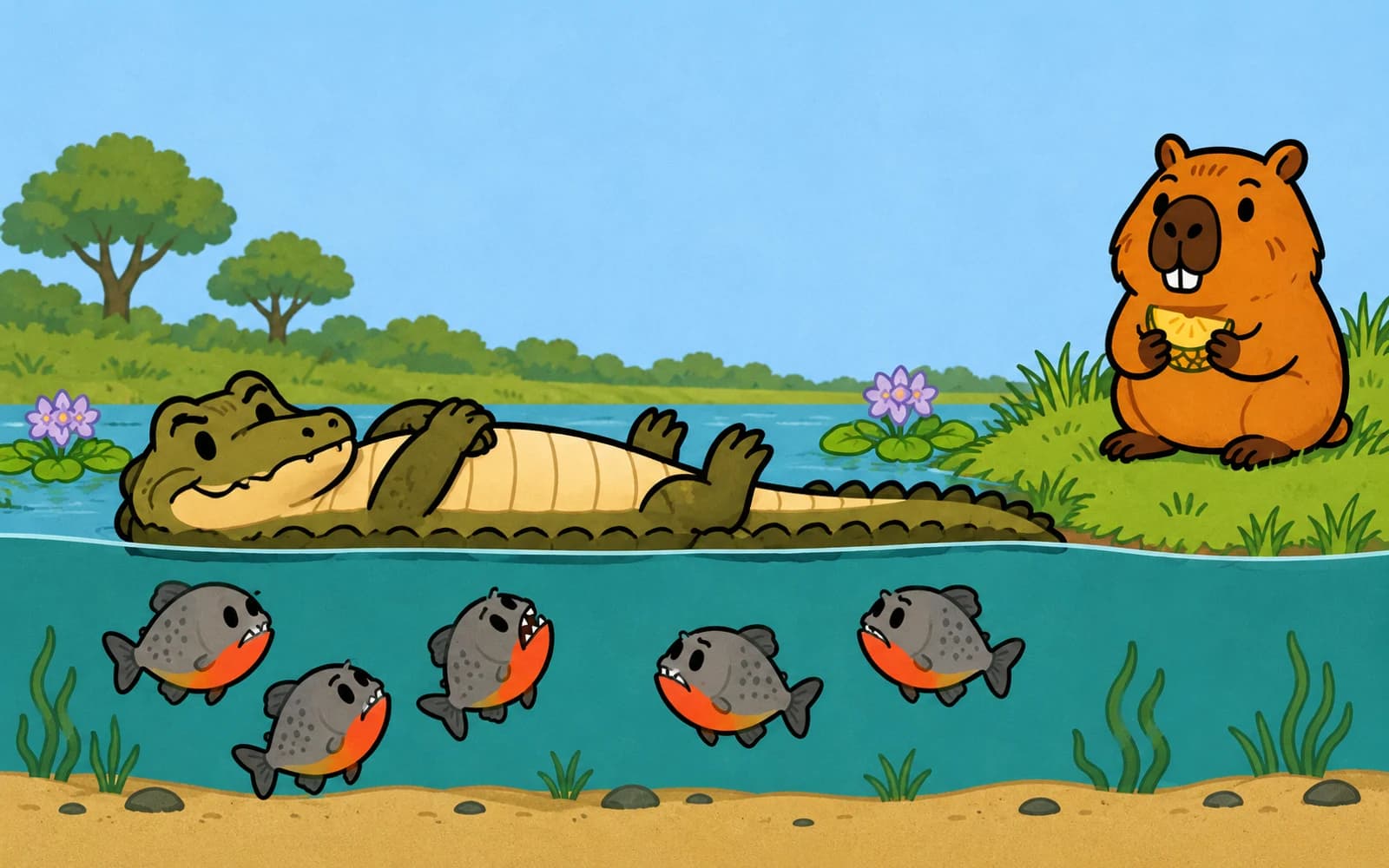
- Em rio que tem piranha, jacaré nada de costas, "in a river with piranhas, the caiman swims on its back": in a dangerous situation, even the strong take extra precautions.
- Isso é para lá de Xiririca, "that's beyond Xiririca": out in the middle of nowhere. Xiririca was a real town in São Paulo's Vale do Ribeira, and the name became so tied to the back of beyond that it was changed in 1948. The expression itself was common in the early 20th century, so expect it more from grandparents than from teenagers.
Try this in Falando: The Idioms Trainer includes descascar o abacaxi and chorar as pitangas, with meaning explanations and sentence-building exercises. Write one sentence about a problem you had to descascar at work and one about someone who chora as pitangas over nothing.
If the caiman and the piranhas caught your attention, our guide to Brazilian Portuguese animal idioms has many more creatures.
From Banned Language to National Symbol
The language the Diretório had banned later became a national emblem. In the 19th century, Romanticism sent writers looking to the past for models of the new nations. In Brazil, Navarro writes, those models were the Indigenous people of earlier centuries and the language spoken in the first years of colonization. The Tupi of the coast became a myth.
In 1928 the modernist Oswald de Andrade compressed the obsession into one pun in his Manifesto Antropófago: "Tupi, or not tupi that is the question." He wrote that line in English, in the middle of a Portuguese manifesto.
The state joined in. In 1935, during the Vargas era, the University of São Paulo created a chair of Tupi, and in 1954 Law 2.311 set up a chair of Brazilian Ethnography and Tupi in every faculty of philosophy and letters in the country. A 1943 decree-law that cleared duplicate town names off the map recommended Indigenous names for the replacements, and many towns got Tupi names they had never had.
Some of the new names were well made. Aiquara, in Bahia, means "sloth's den" in Old Tupi: until 1915 the town was simply called Preguiça, "Sloth," and residents chose the new name in a 1924 plebiscite. Abaiara, in Ceará, renders its earlier name, Pedro Segundo, as "lord of men." A Bahian town called Urubu, "Vulture," became Rio Branco in 1912 and then, in 1943, Paratinga, Tupi for "white river."
Others were not. Navarro points out that Unaí, in Minas Gerais, puts the adjective before the noun, which Old Tupi never does: a correct version of its old name, Rio Preto, would have been Iúna. And Jussara, in Bahia, only looks Tupi. It joins the start of Juscelino, the first name of a former president, to Sara, his wife's name.
People Also Ask
Is Tupi still spoken today?
Old Tupi isn't, but its descendant Nheengatu is. It's spoken mainly in the Rio Negro region of the Amazon, and it's a co-official language in the municipality of São Gabriel da Cachoeira.
Are Tupi and Guarani the same language?
No. They're close relatives in the Tupi-Guarani family. Brazilian dictionaries sometimes label a word tupi-guarani instead of choosing between them, as Aulete does for piá, a southern word for a boy.
Which English words come from Tupi?
The American Heritage Dictionary traces jaguar, piranha, cashew, toucan and tapioca to Tupi, several of them by way of Portuguese. Buccaneer also has a Tupian root, through French.
Is carioca a Tupi word?
Yes. Aulete traces carioca to the Tupi kari'oka. Today it means a person or thing from the city of Rio de Janeiro.
Speak a Little Tupi Every Day
Tupi lost its long contest with Portuguese and then turned up everywhere: on menus, on subway maps, in the names of Brazil's best-known animals and in jokes about peeling pineapples. You don't need to study Old Tupi to use any of it. Learn these words as Portuguese, because that's what they are now, and keep the history for the moment someone asks why so many of them end with a stressed vowel.
Try this in Falando: In Bate-papo, start a conversation about planning a trip to the Amazon or the Pantanal. Use at least five words from the tables: say which animals you hope to see and what you want to eat, then answer the follow-up questions in Portuguese.
Capivara and pipoca are part of Falando's A1 vocabulary, and abacaxi, caju and jacaré arrive at A2. Add them to your Reviews, and the next time a child tells you you're their xará, you'll know exactly how old that word is. Até a próxima!